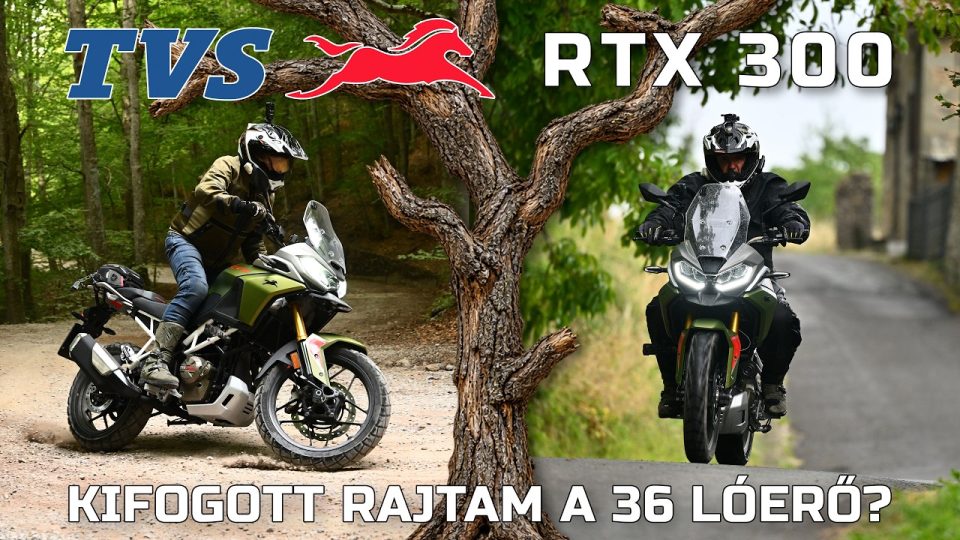
Twisting Tuscan roads, rocky dirt tracks and a serious storm: the TVS RTX 300 launch had a bit of everything. This Indian adventure bike comes with a smooth single-cylinder engine, a well-functioning quickshifter and a friendly, approachable character. Its suspension, however, reminds you that beneath the adventurous styling lies a motorcycle designed primarily for comfortable road riding.
In early September 2026, I travelled to Tuscany for the TVS press launch to try the new RTX 300. The organisers had planned a roughly 200–220-kilometre route through the mountains around Lucca, with countless corners, very little traffic and a section of gravel and rocky dirt road. It would have been difficult to find a better location for a motorcycle like this.
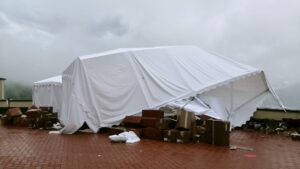
We weren’t quite so lucky with the weather. The rain arrived just as we were about to set off, and later a storm developed that even brought down the event tent housing the motorcycles and equipment. As a result, the test provided a wide range of experiences, from dry tarmac to slippery mountain roads and getting soaked to the skin. I also managed to test one characteristic of the motorcycle that probably wasn’t part of the official press programme: how it behaves when lying on its side.
The TVS name may still be unfamiliar to many European riders, but there’s a substantial manufacturer behind it. The company’s cooperation with BMW on the 310 series and its ownership of Norton help put the brand into perspective. The RTX 300, however, is interesting in its own right: a small adventure bike with power and handling that even beginners can feel comfortable with.
During the presentation, TVS also highlighted its experience in racing and rally competition, but the RTX’s primary purpose is touring. The aim was to create a motorcycle suitable for everyday commuting as well as multi-day trips, one that doesn’t force you to turn around the moment the tarmac ends.
It can be ridden with an A2 licence, and its appearance makes it seem considerably larger and more substantial than the number 300 might suggest. I think the headlight, front fairing and overall stance are particularly successful. Just looking at it makes you start planning your next mountain trip before you’ve even started the engine.
299cc of Smooth, Controllable Power
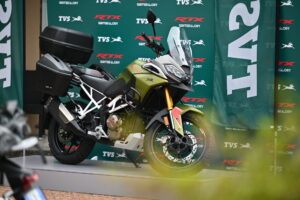
The new RT-XD4 engine is a 299.1cc, liquid-cooled, single-cylinder unit with dual overhead camshafts. It produces 36 hp at 9,000 rpm and a maximum torque of 28.5 Nm at 7,000 rpm. Coming from motorcycles with more than 100 horsepower, it initially feels rather modest. But once you adjust to its rhythm, you discover that there’s more than enough performance to enjoy yourself on these narrow mountain roads.
Its greatest strength is its smooth, consistent operation. Throttle response is predictable, power is easy to control, and the engine never becomes nervous, even at higher revs. During the test, I found it remarkably smooth, without any disturbing vibrations.
The factory presentation revealed just how much work had gone into the engine’s internals and management system to achieve this character. Alongside a crankshaft assembly with greater rotational inertia, the engineers use torque maps tailored to individual gears, while the electronics also smooth out sudden changes in torque. In the saddle, this means that a small throttle movement doesn’t result in unnecessary pitching or jerking.
The D4 in the RT-XD4 name refers to four “dual” solutions: two oil pumps, a double cooling jacket, a crankcase ventilation system with two separators, and two camshafts. Of course, you can’t see any of these while riding. What you can feel, however, is an engine that runs smoothly and doesn’t constantly force you to compensate for some unpleasant habit.
Even the cylinder bore has received a plasma-sprayed coating. TVS associates this technology with improved durability and quieter operation. Naturally, I can’t offer any first-hand conclusions about long-term reliability after a single press test. What is clear, though, is that the company has taken the development of this new engine seriously.
This calm, predictable character could be particularly valuable for someone who has just earned an A2 licence or is moving up from a smaller scooter. There’s enough performance for touring and enjoying winding roads, while the engine’s responses are easy to get used to. Of course, easy handling is no substitute for experience, as the off-road section reminded me.
We Tried Some Light Off-Road Riding, and I Fell Off
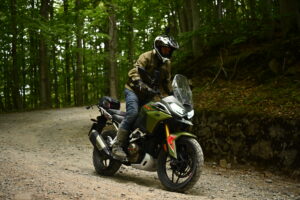
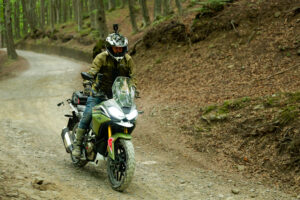
On the gravelly, rocky climb, I was mainly paying attention to the suspension and how the bike felt when ridden standing up. The riding position worked reasonably well, but the soft suspension sometimes made it difficult to find my balance. When I allowed the front wheel to do its job, the motorcycle was quite good at finding its own way through the terrain.
Then I made a mistake approaching a corner. Instead of committing to my chosen line, I tried to correct it for the photographers, and ended up falling. Fortunately, I escaped without injury, but the clutch lever broke and the side of the motorcycle also carried a few reminders of the incident.
It wouldn’t be fair to blame the motorcycle for that. My own decision played a part. The lesson for me was that choosing a good line and riding calmly are more important than getting a good photograph. My ego suffered more than my body, but there’s something to learn from that as well.
In any case, don’t let the adventure-bike styling fool you. Even a friendly little 300 has its limits, and gravel is still gravel, whatever motorcycle you’re riding.
Excellent Gearbox, but the Suspension Needs Some Adjustment
I really liked the six-speed gearbox. Shifts were precise and effortless, neutral was easy to find, and the bidirectional quickshifter on my test bike worked consistently well. That’s something you’ll appreciate every time you downshift before a corner. The assist and slipper clutch is another useful part of the package: it makes operation easier and reduces sudden loads transmitted through the drivetrain to the rear wheel during downshifts. On a motorcycle intended for learning and touring, these less spectacular features are valuable too.
My impressions of the suspension were more mixed. During the test, I found the front end too soft and occasionally uncertain. That’s why the additional adjustment options offered by the Adventurer version could be genuinely useful. At the front there’s a 41 mm cartridge fork, while the rear uses a monotube monoshock with a floating piston. The hardware therefore offers scope for fine-tuning, which I think would have helped considerably. The suspension settings were adjusted on one of my colleagues’ bikes during the event, and he reported a significant improvement. That was his experience, though; I wasn’t able to make the same comparison on my own test motorcycle.
The 180 mm of suspension travel at both ends and 200 mm of ground clearance provide enough room for lighter dirt roads, but not much more. That’s how I see the RTX being used: taking the occasional gravel detour during a road tour is perfectly reasonable, but for more serious off-road riding, I’d look for a different motorcycle.
The chassis consists of a steel trellis frame and a cast aluminium swingarm. Given the approximately 180 kg kerb weight and the engine’s performance, I found the 320 mm front brake disc with its radial caliper entirely adequate. On this particular day, fine-tuning the suspension was a much bigger concern for me than braking power.
Comfortable Seated Position, Practical for Standing Up
I felt comfortable sitting on the motorcycle. The knee angle was natural, the handlebars fell comfortably to hand, and I could place both feet flat on the ground. Based on the first 40–50 kilometres, the seat seemed comfortable, although its sharper edges might change that impression on a longer journey.
During the presentation, TVS specifically emphasised how the shape of the seat and side panels was designed to make reaching the ground easier. This is an important detail: two motorcycles with exactly the same seat height can feel completely different depending on how far you have to spread your legs.
The motorcycle also works reasonably well when standing, helped by the wide footpegs with removable rubber inserts. For my body proportions, I’d prefer handlebars roughly 3–4 centimetres higher in certain standing positions. That’s a personal ergonomic preference, so it’s definitely worth sitting on the bike yourself before making a decision.
The passenger gets a separate seat, but at my own body weight of approximately 95 kg, I wouldn’t choose this bike for touring with two larger adults and their luggage. Available space and available power are two different questions. Travelling solo with a modest amount of luggage suits its character much better.
Tuscan Corners and Rain
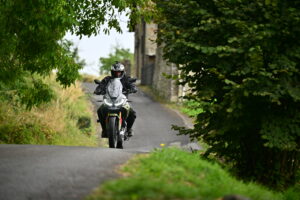
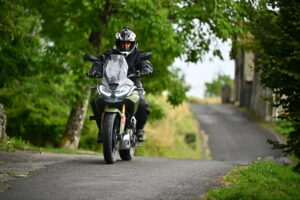
On the narrow mountain roads, I didn’t constantly find myself wishing for more power. Here, the rhythm, the lines through the corners and the scenery were what made riding enjoyable. In this environment, the RTX is a likeable companion: it’s simply a pleasure to ride along and see where the road takes you.
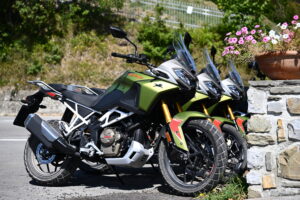
The test motorcycle was fitted with 19-inch front and 17-inch rear alloy wheels and Eurogrip Explo-R tyres. On the road, this combination worked well. On rocky surfaces, however, it was clear that the tyre tread pattern favoured tarmac rather than off-road use.
During the presentation, TVS also highlighted the tread’s three-compound construction: durability in the centre, grip at the shoulders, and a progressive transition between the two. That makes sense for a touring tyre, but it doesn’t eliminate the limitations of the tread pattern when riding off-road.
When the rain arrived, we switched to Rain mode and significantly reduced our speed. The wet tarmac was slippery in places, so the second half of the day became more about predictable handling than anything else. Instead of leaning hard into corners, we rode cautiously, which at least left us plenty of time to enjoy the scenery.
I didn’t measure the claimed top speed of 140 km/h. Based on how the bike felt, I could imagine cruising at approximately 120 km/h, but without a separate motorway test, I’d treat that strictly as an estimate. In any case, the RTX really showed what it was made for among the tight corners that day.
Four Riding Modes with Clear Differences
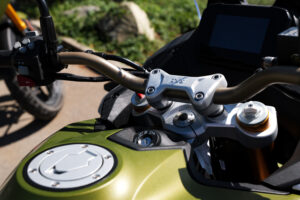
The RTX’s electronics have been tailored to touring use. There are four riding modes: Urban, Tour, Rain and Rally. According to the manufacturer’s specifications, these modes coordinate throttle response, ABS and traction control according to the intended riding conditions.
Tour and Rally use the more responsive engine settings, while Urban and Rain provide gentler reactions. In Rain mode, the ABS is also adapted to wet conditions, while Rally changes the operation of the systems to suit off-road riding.
In Rally mode, rear-wheel ABS is disabled, while the front ABS and traction control switch to off-road settings. This gives the rear wheel more freedom, which can be useful on loose surfaces. There’s no IMU or lean-sensitive cornering ABS, so these features shouldn’t be confused with the more sophisticated systems found on larger adventure motorcycles.
What I liked was that I didn’t have to get lost in endless settings. Throughout the day, it was easy to understand which mode made sense in each situation. And the weather made quite sure that we did more than just admire the Rain mode label while parked.
Small Motorcycle, Generous Equipment
Quite a lot of functionality has been built around the five-inch TFT display. Each riding mode has its own display layout, while smartphone connectivity is handled by the TVS SmartXonnect system.
One particularly interesting navigation feature is Google Maps mirroring. According to the presentation, it works with both Android phones and iPhones, allowing you to see map-based directions on the instrument display. There are also phone and music functions, parking location memory and ride statistics.
The higher equipment level also includes GoPro control and tyre pressure monitoring. I didn’t test all these features individually, so I’m reporting them as capabilities described during the presentation. I did, however, use the handlebar controls, and they made a good impression. The interface hasn’t been unnecessarily cluttered with buttons.
It’s worth keeping the differences between the two versions in mind. According to the presentation, even the Essential comes with four riding modes, a TFT display, smartphone connectivity, cruise control, traction control, switchable ABS and full LED lighting. That’s a particularly generous package for an entry-level version. The Adventurer adds, among other things, greater suspension adjustability, a bidirectional quickshifter and tyre pressure monitoring.
Who Would I Recommend the TVS RTX 300 To?
Primarily to someone looking for a new A2-compatible motorcycle for commuting, weekend rides on winding roads and relaxed touring. The smooth engine, precise gearbox and comfortable riding position combine to make a practical, easy-to-live-with package. However, anyone expecting strong acceleration, regular two-up touring with luggage or serious off-road capability should probably look elsewhere.
The fuel tank holds 12.5 litres, and the manufacturer’s claimed fuel consumption presented at the launch was 3.4 litres per 100 kilometres. I wasn’t able to verify this during the test, so I can’t add any measured consumption figures of my own. On paper, it promises to be an economical travelling companion, but only a longer journey would really show how frequently you’d need to stop for fuel.
At the time of the launch, the Hungarian price of the better-equipped version was quoted at approximately two million forints (around €5,000), while the factory presentation indicated a five-year warranty. It’s worth checking the current Hungarian price, exact equipment specification and warranty conditions with the Hungarian distributor, Sandlander.
For me, the RTX 300 demonstrated above all that you can have a great time riding with just 36 horsepower. On the right road, with the right expectations, its easy-going character adds a great deal to the experience. And modern technology becomes genuinely valuable when, somewhere among the corners, you simply find yourself enjoying the ride.
Even with its soft suspension, it’s well worth trying if you’re looking for a friendly little adventure tourer. As for choosing your line through a corner to please the photographers, I’d suggest giving that a miss. I’ve already tested that part for you.
This review was produced during a press event organised by TVS.
Watch the Video Review Here: