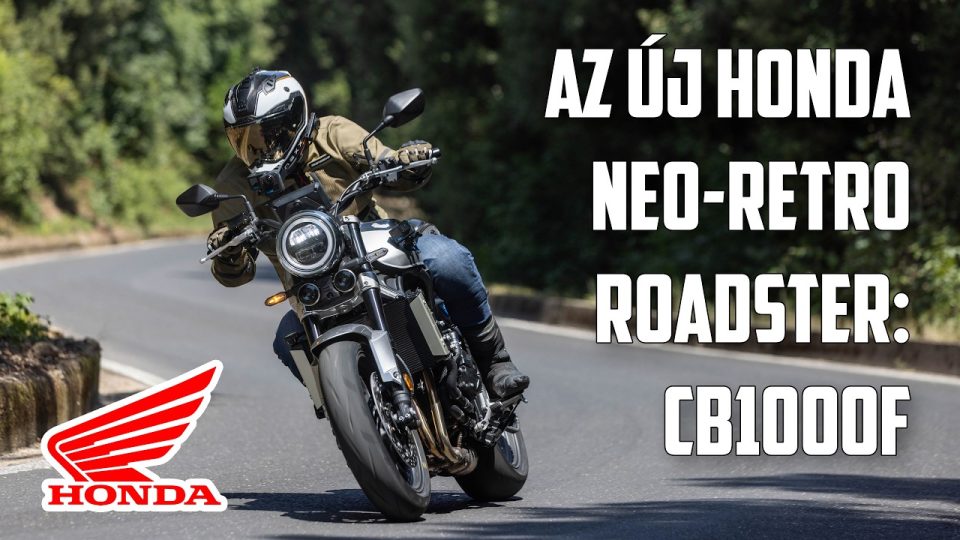
My Inner Honda Fan Has Woken Up
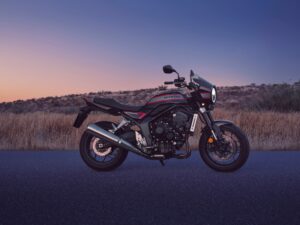
It’s rare for me to arrive at a motorcycle press test already wanting so badly to fall in love with the bike. But that’s exactly what happened with the Honda CB1000F. Based on its looks, specifications and overall concept, I felt as though it had been designed specifically for me. A sporty naked bike with a proper seat, room for luggage, modern technology and the appearance of a classic motorcycle.
Of course, enthusiasm before a test ride isn’t enough. For a motorcycle to really win me over, it needs something you can’t find in a specification sheet. A sound, a response, a perfect corner, or that feeling when, after just a few kilometres, you start wondering how you could make room for it in your garage.
So I arrived in Rome with rather high expectations. The 38°C July heat and the location itself were less exciting, but there was one more little detail in the programme: Freddie Spencer would be riding with us all day. Yes, that Freddie Spencer, the three-time motorcycle Grand Prix world champion.
Classic Honda, Modern Engineering
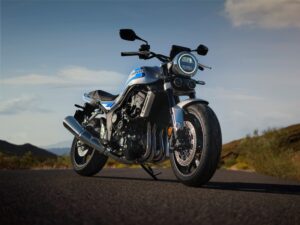
The CB1000F evokes the world of the CB750F and CB900F from the 1980s. The long fuel tank, the shape of the seat, the exposed inline-four engine and the four exhaust headers create a striking overall impression. Seeing it in person, everything immediately clicked for me. I love it when you can look at a motorcycle and understand exactly what its designers were trying to achieve without needing an explanation. With this one, it’s obvious. It captures the spirit of classic Japanese roadsters, while the riding position, suspension, brakes and electronics all belong firmly in the modern world.
Before seeing the bike, I had reservations about two details: the TFT dashboard and the LED headlight. In photographs, I wasn’t sure they suited the classic design. In person, neither bothered me at all. The paintwork, finish and overall appearance made an excellent impression. My affection for Honda had actually begun to reawaken during my earlier test of the CB1000 Hornet. I really loved that motorcycle, but for my own touring needs, I found its comfort and luggage-carrying options rather limited. The CB1000F, however, looked as though it might have answers to those problems.
A Day with Fast Freddie
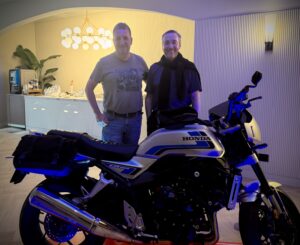
It was during the evening presentation that I truly realised Freddie Spencer wasn’t just going to be a name in the press release. He was sitting right there in the room, and the following day he would be riding with us. We also arranged an interview, which he was more than happy to give.
Spencer won the 500cc World Championship in 1983, then went on to win both the 250cc and 500cc titles in the same year, 1985. For me, talking about motorcycles with someone like that means far more than the usual press event. What I found particularly interesting during the interview was how strongly he emphasised the feedback a motorcycle gives its rider and the connection that develops between them. He talked about effortless handling, stability and how the engine’s character changes with the revs. The qualities that allow you not just to operate a machine, but to really feel it. He also considered the CB suitable for amateur track days. Based on his answer, the main modification he’d consider would be fitting tyres with more grip. It was good to hear that from someone whose experience of where a motorcycle’s limits begin is very different from mine.
He stayed with us for the rest of the day, too. We could watch him ride and discuss our impressions with him. Sometimes he confirmed what I was feeling, while at other times he saw things differently. That alone made this launch an unforgettable experience.
Rome Was Lovely, but I Came for the Corners
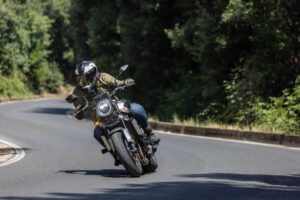
I did come away feeling that the organisation of the event had left something to be desired. A great deal of attention had gone into Italian hospitality, gastronomy and showcasing the atmosphere of the location. There was nothing wrong with any of that. The problem was that I’d come to test a motorcycle, and I wanted to spend as much time riding as possible. Some of the riding footage was filmed on busy, rather straight roads. When we finally reached some proper corners, we got about seven of them before it was time to head off for lunch. After the starter, I asked for the motorcycle and rode back to that short stretch of road. A French colleague had the same idea, so we took turns riding back and forth. Those few corners meant more to me that day than the next course of lunch. Somewhere around that point, I began to feel that I really wanted one of these Hondas.
124 Horsepower, Two Different Personalities
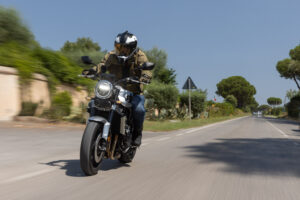
The CB1000F’s 998cc inline-four engine is based on the previous-generation Fireblade unit, which is also used in the CB1000 Hornet. In the CB, it produces 124 hp and 103 Nm of torque, but the way it’s tuned is just as important as the figures. Honda has therefore revised the camshafts, intake system and exhaust. Longer intake funnels improve performance in the low and midrange, while the design of the intake system also shapes the engine’s sound. Together with the 4-2-1 exhaust system, which brings the four headers together, Honda has carefully engineered not only the performance but also what you’ll hear and feel from the saddle.
Peak power arrives at just 9,000 rpm, 2,000 rpm earlier than on the Hornet. Maximum torque also comes at lower revs. This clearly shows the direction Honda wanted to take: creating an enjoyable engine in the rev range most frequently used on public roads. At around 5,000–6,000 rpm, you can ride along quite peacefully. The engine responds smoothly, its power is easy to control, and it produces a deep, rich sound. Then you start winding it up, and a completely different motorcycle emerges. At higher revs, that familiar inline-four scream arrives, the one I’ve always loved. The sound, the way the power builds and the whole experience of accelerating bring out the hooligan in me remarkably quickly. On the overrun and during downshifts, there’s popping and crackling too. Something is always happening to put a grin on your face inside the helmet.
On paper, 124 horsepower might not seem particularly remarkable by today’s standards. On the road, however, I never once felt it was insufficient. It moves the motorcycle with real authority, and there’s plenty of usable performance in the midrange. You can ride it sensibly, commute to work or cruise along at a relaxed pace. That doesn’t make it a beginner’s motorcycle, though. Just because it can behave gently doesn’t mean the power isn’t there. You still need to know how to handle it.
Fifth Gear Is My Favourite
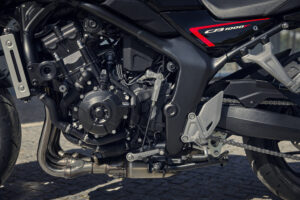
The gearbox worked precisely and smoothly, and neutral was easy to find. That might sound like a minor detail, but on my own motorcycle, I regularly get annoyed when I have to hunt for neutral after stopping. Here, I had no such problem. The quickshifter on the test bike also worked well, although unfortunately it’s not standard equipment.
What I liked most, however, was the gearing, particularly fifth gear. You can shift into it surprisingly early and then stay there for a very long time. It works for cruising along country roads and for accelerating, and you can handle a remarkable variety of situations without constantly changing gears. Freddie Spencer highlighted this characteristic as well. It was satisfying to discover that he’d noticed exactly the same thing. There’s a deliberate engineering decision behind this, too. Compared with the Hornet, first and second gears are shorter, while third to sixth are taller. This preserves lively acceleration when setting off while allowing the engine to run at more relaxed revs when travelling.
Sixth is more of a cruising gear. At 100 km/h, the engine turns at approximately 4,000 rpm, and shifting into sixth noticeably settles everything down. Through its gearbox alone, the CB demonstrates that Honda had longer journeys in mind alongside sporty riding.
Sporty Suspension with Comfort
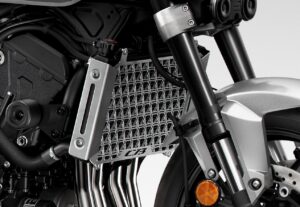
The suspension deserves some attention, because the shared foundations with the Hornet could easily be misleading. There’s a 41 mm Showa SFF-BP fork at the front here too, but suspension travel has been increased from 118 to 130 mm, and the settings have been developed specifically for the CB1000F. At the rear, a revised shock absorber and Pro-Link linkage system provide 140 mm of wheel travel. The idea is for the suspension to respond more gently to smaller road imperfections while providing progressively firmer support as it moves further through its travel. The roads around Rome gave it plenty of opportunities to demonstrate why that matters.
It absorbed smaller bumps very nicely. Naturally, my hands and lower back were still informed about the bigger impacts, but the motorcycle never became unsettled. That was what impressed me most. Even when riding through corners on poor-quality tarmac, I didn’t feel any unnecessary bouncing or pumping. The suspension quickly regained its composure, the CB held its line, and I could simply continue through the corner. I was happy with the standard settings. During this relatively short test, I didn’t need to explore all the available adjustments to enjoy riding it.
The 214 kg kerb weight didn’t make the bike feel heavy on the road. It was easy to turn around at low speeds, it negotiated corners naturally, and it remained stable at a faster pace. After just a few minutes, I stopped thinking about how to ride it and simply enjoyed motorcycling.
The brakes were equally convincing. Up front, there are two 310 mm discs with radially mounted four-piston Nissin calipers. They provide strong stopping power while remaining easy to modulate. During harder braking tests, the motorcycle remained composed, and the amount of front-end dive wasn’t distracting.
The Surprise of the Day: How Does It Handle the Wind?
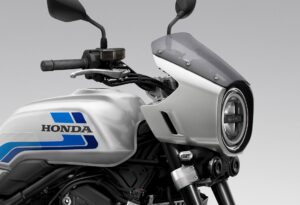
It might seem strange to devote an entire section of a naked bike review to wind protection. But on the CB1000F, this was one of the biggest surprises of the day.
Of course, there’s wind. The difference was that the airflow reaching my helmet was remarkably clean and consistent. It didn’t shake my head, there was no disturbing turbulence, and the pressure on my chest was lower than I’d expected. My helmet felt particularly quiet on this motorcycle, even though I was wearing my off-road helmet, which isn’t exactly famous for its silence. The design around the headlight and instrument display worked exceptionally well with my height, riding position and equipment. What’s more, the motorcycle I rode didn’t have the optional Headlight Cowl.
Of course, this is a personal experience, and the results could be different for someone of another height or wearing a different helmet. But I found it so pleasant that I kept coming back to it while riding. It felt completely different from those naked bikes where, after a while, simply hanging on starts to demand too much of your attention. On the CB, I still had an unobstructed view ahead, without having to look at the world through a large windscreen. That’s exactly what I love about this type of motorcycle.
Comfortable, and You Can Even Stand Up
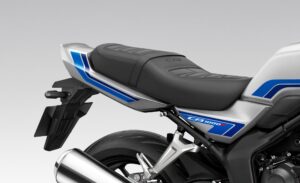
The seat height is 795 mm, and the handlebars are positioned 31 mm higher than on the Hornet. Those few centimetres make a noticeable difference in the saddle. Your upper body is more relaxed, and you don’t have to keep putting weight on your arms. Meanwhile, the footpegs are positioned high enough to avoid scraping through corners.
After approximately 150 kilometres, neither my knees nor my lower back had any complaints. The seat is wide, sufficiently soft, and I didn’t notice any edges pressing uncomfortably against my thighs. A full-day ride of five or six hundred kilometres would reveal more about long-distance comfort, but my initial impression was very positive.
The other surprise came when I saw Freddie Spencer riding while standing up. Naturally, I had to try it myself. And it worked. You need to lean forward a little, but I could stand up briefly and stretch my body. That’s important to me when touring, and it’s something I often miss on naked bikes. The higher handlebars help here too.
The main frame comes from the Hornet, but the rear subframe has been extended and reinforced to provide better accommodation for a passenger and luggage. I didn’t test the bike with a passenger or a full touring load, but based on what I experienced, I’d happily set off on a multi-day journey with it.
Modern Electronics, with One Painful Omission
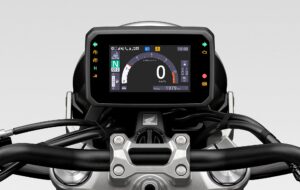
Behind the classic appearance lies a thoroughly modern electronics package. There’s a six-axis IMU, cornering ABS, traction control, wheelie control and a system that monitors rear-wheel lift. The IMU is particularly interesting because it allows the electronics to take the motorcycle’s movement and lean angle into account. Traction control can therefore adapt its operation to what’s happening in a corner. Classic styling or not, in this respect you’re very much riding a modern motorcycle.
The three factory riding modes are Standard, Sport and Rain, alongside two customisable settings. Power delivery, engine braking and traction control can all be adjusted through several levels.
I found the five-inch TFT display easy to operate. There’s a dedicated riding mode button and a four-way controller on the handlebars, without unnecessary switches cluttering the controls. It’s easy to get used to, and the whole interface quickly becomes familiar. Honda RoadSync provides smartphone connectivity and step-by-step navigation, which could also be useful on a multi-day trip, although I’d definitely mount a Chigee or an Aoocci on it.
One thing, however, is sorely missing: cruise control. The bike has ride-by-wire throttle control, yet Honda hasn’t fitted cruise control. On a motorcycle I’d be so happy to use for touring, I’d really appreciate having it. For me, this would be the hardest compromise to accept if I were considering buying one.
Would I Take It on a Long Tour?
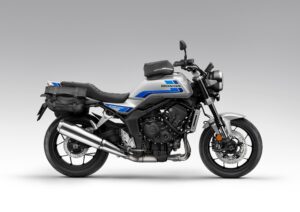
Absolutely! With a 16-litre fuel tank and the manufacturer’s claimed consumption of 5.6 litres per 100 kilometres, the theoretical range works out to approximately 285 kilometres. I didn’t verify this with my own fuel consumption measurements, and on a more spirited tour, riding style would obviously have a significant influence. In practice, of course, we don’t plan our fuel stops around using every last drop, so a longer test would also tell us more about how frequently we’d need to refuel.
Available accessories include a comfort seat, heated grips, soft side bags, a tank bag and a Headlight Cowl. I’d still need to investigate how I could secure my own luggage, but I’d be very happy to equip the bike and head off for at least a few days of winding roads.
The engine’s character, the comfortable riding position and the airflow that worked so well for me all suggested considerably more touring potential than its appearance might initially lead you to expect. Of course, a longer test would be needed to confirm that. After my day in Rome, I was left wanting more, particularly because we had fewer proper winding roads than I’d hoped for.
My Inner Honda Fan Is Back
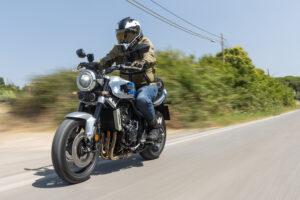
At the end of the day, sitting in the swimming pool, it would have been difficult to hide just how much I liked this motorcycle. And I wasn’t really trying. I love its appearance, its sound, its two distinct engine personalities and how naturally it handles. The gearbox is excellent, the brakes are strong, and the suspension is sporty without sacrificing comfort. On top of that, it manages the airflow in a way I’ve rarely experienced on a naked bike.
During the presentation, Honda used the phrase “Best Balanced Roadster.” It’s easy to overlook marketing statements like that at a press event, but by the end of the day, I understood what they meant. The CB1000F brings together many of the qualities that matter most to me in motorcycling, and here they seemed to be in perfect balance.
You can ride it calmly, enjoy the sound of the four-cylinder engine, and when a proper winding road finally appears, there’s plenty of performance waiting to be unleashed. It’s not the best motorcycle for everyone. But for me, on this particular day, it came remarkably close to what I’ve been looking for. The next step would be a longer tour, and that’s coming soon. Until then, I’ll try not to calculate too often how much I’d need to add if I traded in my BMW…
This review was produced during a press event organised by Honda.
Watch the Video Review Here: