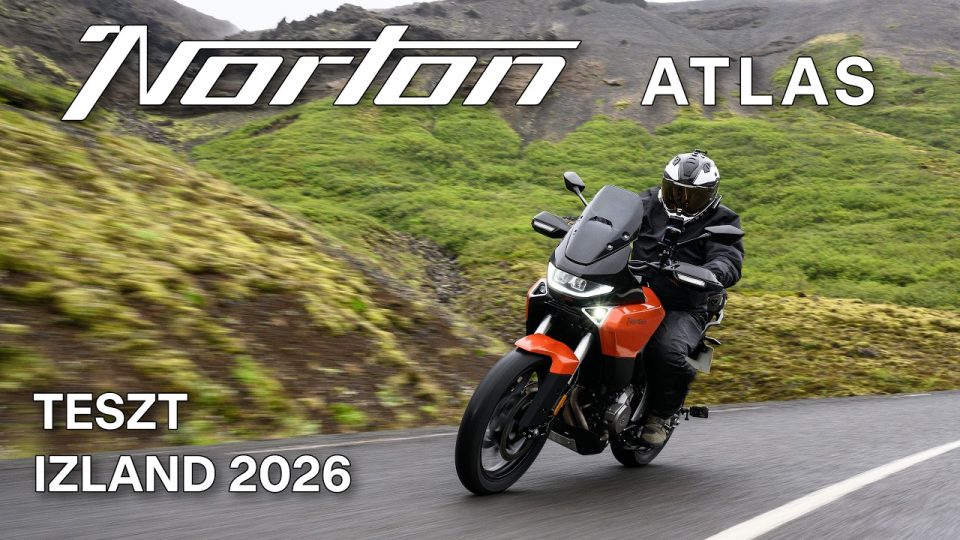
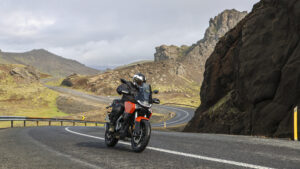
Riding a motorcycle in Iceland had been on my bucket list for a long time. The launch of the Norton Atlas seemed like a pretty good excuse to finally tick it off. A new motorcycle, a historic British brand, and scenery so spectacular that you can’t help staring at it open-mouthed, even while riding. At least nobody can see that inside your helmet.
Of course, the weather made sure this wouldn’t turn into a carefree exercise in producing picture-perfect postcards. Once we left Reykjavík, we were greeted by gale-force winds, rain and temperatures of around 8–10°C. I was wearing approximately sixty-two layers of clothing, but I still had to stop to put on my waterproof trousers. Once again, the whole group was waiting for Peter. Fortunately, there were only four of us, so this time I managed to annoy relatively few people at once.
By the end of the day, though, something else was occupying my thoughts far more than the weather: why had I felt so comfortable on this motorcycle? Especially during that sixteen-kilometre off-road section, after which I really didn’t want to give the bike back.
An Old Name with a New Mission
 Norton’s history began in 1898, and the company built its first motorcycle in 1902. The brand later became synonymous with racing, the Isle of Man TT and legendary models such as the Manx and Commando. The Atlas name isn’t new either. The original model, introduced in 1962, was designed primarily to meet the demands of the American market, offering greater displacement, more torque and performance suitable for longer journeys. The new Atlas is a completely different motorcycle, but the idea of travelling remains at its heart.
Norton’s recent history has been rather more turbulent. Following financial difficulties, TVS arrived in 2020 and rebuilt the brand on new foundations. The Atlas was designed and developed in Britain, with the manufacturing and industrial capabilities of the Indian company now supporting the project. This motorcycle gives us a good indication of the direction Norton is taking. The Atlas is a modern middleweight adventure tourer, with sophisticated electronics, distinctive styling and performance that can genuinely be enjoyed in everyday riding.
Atlas or Atlas GT?
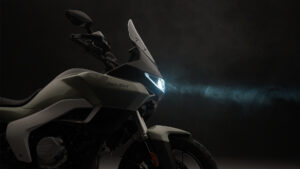 The two members of the model family are designed for different purposes. With a 19-inch front wheel, a 17-inch rear wheel, longer suspension travel and greater ground clearance, the Atlas is prepared for occasional adventures on dirt roads. The Atlas GT, on the other hand, has 17-inch wheels at both ends and shorter suspension travel, making it more focused on paved-road touring. In Iceland, I rode the Atlas with the 19-inch front wheel, in Apex specification. Among other features, Apex adds heated grips, an adjustable windscreen, tyre pressure monitoring, cornering lights, combined braking and hill-hold assistance to the standard equipment.
Divisive Styling, but Everything Falls into Place Once You’re on It
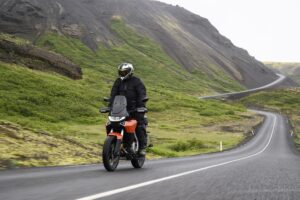
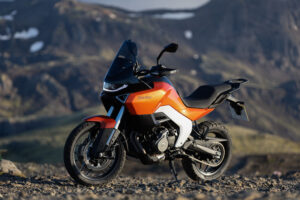
From the side, my first impression was that the Atlas looked a little front-heavy. The front end is large, the proportions are unusual, and the rider seems to sit further back than we’re accustomed to. Then I climbed aboard, and everything fell into place. The handlebars reach back towards you, your upper body sits naturally upright, and your legs aren’t folded up too tightly beneath you. At first, I actually had to look for the footpegs because they weren’t quite where I expected them to be, but I quickly got used to their position. The result is a comfortable, almost armchair-like riding position with a healthy knee angle.
The seat height is 845 mm, and at my height of 183 cm, I could reach the ground comfortably. Ground clearance is 220 mm, so you don’t have to start worrying about the first slightly larger rock when leaving the tarmac.
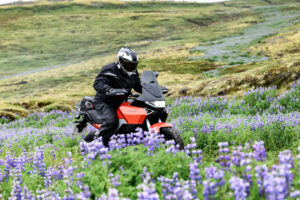
I particularly liked the styling details: the Norton emblem on the side, the lines of the bodywork, the contrasting elements and even the shape of the mirrors. The orange, brick-coloured Sinopia Orange became my favourite. Of course, I might be slightly biased, having spent the entire day riding one.
Seventy Horsepower in All the Right Places
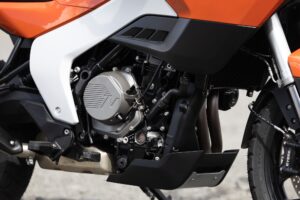 The Atlas is powered by a 585cc, liquid-cooled parallel-twin engine. Its 270-degree crankshaft produces an uneven firing rhythm that brings both the sound and feel closer to that of a V-twin. According to the manufacturer, peak power is 70 hp at 9,300 rpm, with maximum torque of 57.5 Nm. On the road, however, what interested me far more was how broad the engine’s usable powerband felt.
From around 4,500 rpm, it pulled nicely, and there was no need to downshift before every acceleration. In Tour mode, the throttle response felt particularly lively. I moved my wrist, and the motorcycle immediately understood what I wanted. I wasn’t expecting breathtaking acceleration from seventy horsepower, but during overtaking manoeuvres, I was repeatedly surprised by how decisively it picked up speed. The amount of power suited both the motorcycle and its intended purpose very well. At the same time, I experienced no disturbing vibrations. Even at higher revs, the engine didn’t make my hands go numb, and there was no unpleasant vibration coming through the rubber-covered footpegs.
The press material also clarified a technical detail that I had described inaccurately during the event: the special plasma-sprayed coating is applied to the cylinder bores. The manufacturer’s aim is to reduce friction and weight while improving durability. The engine also uses two oil pumps and a carefully designed cooling system. A single day of testing obviously cannot prove long-term reliability, but the engine’s refinement made a very good impression on me.
When It Comes to Weight, Read the Small Print
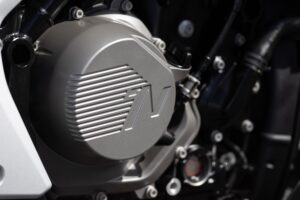 The standard Atlas has a manufacturer-quoted weight of 188 kg, while the Apex weighs 192 kg. There’s a catch, though: these figures include all operating fluids except fuel. Fill the 15.4-litre tank, and the Apex I tested weighs a little over 200 kg. That gives us a much clearer picture when comparing it with other motorcycles. On the road, however, it never felt cumbersome. The motorcycle was easy to balance, and its weight distribution quickly began to feel completely natural.
The engine serves as a stressed member within the steel trellis frame, while a cast aluminium swingarm supports the rear wheel. During the factory presentation, Norton emphasised the frame’s controlled flexibility. What I noticed while riding was that the motorcycle remained stable without becoming an unresponsive, rigid structure over road imperfections.
The Battle Between Suspension and Wind
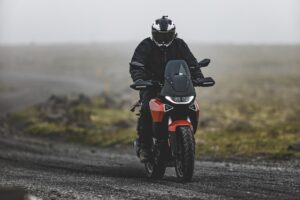
During the first few kilometres, it was difficult to distinguish the motorcycle’s movements from what the crosswind was doing to us. The ride leader’s vest was flapping as though it were about to develop a life of its own, while I was trying to work out whether I was feeling the suspension or had just been blown another half a metre sideways. Later, things became clearer. The Atlas absorbed smaller road imperfections comfortably, yet it didn’t start wobbling or feeling unstable at higher speeds. It was also enjoyable to ride through corners on poorer-quality tarmac.
Up front, there’s a 43 mm inverted KYB fork with adjustable damping, while the rear uses a KYB monoshock with hydraulic spring-preload adjustment. Suspension travel on the Atlas is 180 mm at both ends. That’s not particularly generous compared with serious off-road motorcycles, but the Atlas has a different mission. Touring, poor roads, gravel and lighter off-road riding: in these conditions, it worked remarkably well.
There was some front-end dive under braking, but it didn’t bother me. I could have experimented with the suspension settings, but I didn’t feel the need to start adjusting everything that day. I was perfectly happy with the factory setup.
I Quickly Became Friends with the Brakes
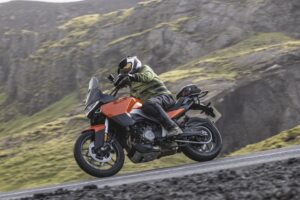
At the front, there are two 310 mm brake discs with radially mounted ByBre calipers, while the rear uses a 270 mm disc. The system also features braided steel brake lines. During harder braking tests, the Atlas remained very stable. It slowed down strongly, didn’t become nervous when the ABS intervened, and never gave me the feeling that I had to fight the motorcycle to keep it under control.
The system, built around a Bosch six-axis IMU, also takes the motorcycle’s movement and orientation into account. In Apex specification, combined braking provides additional assistance: when you apply the front brake, the system can also activate the rear. What I appreciated most was the confident, easily controlled feeling the whole system provided. When you’re riding an unfamiliar motorcycle in the rain on less-than-perfect roads, you quickly learn to value that.
Wind Protection That Was Particularly Welcome in Iceland
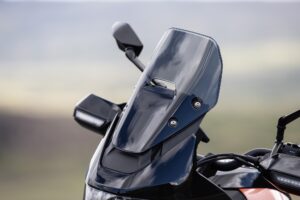 It would have been difficult not to take wind protection seriously during this launch. It was cold, it was raining, and the crosswind wasn’t exactly trying to be considerate. Even in its lowest position, the windscreen worked well for my height. It directed the airflow above the top of my helmet without creating unpleasant turbulence. When I later raised it, the air around me became even quieter. Adjusting the Apex windscreen requires both hands. It’s best to take care of that while stopped, then enjoy the result.
Norton developed the airflow using computer simulations and wind-tunnel testing. In practice, this meant that the wind was less tiring, and the air around my helmet remained calm. The handguards also did a good job of keeping the wind away from my hands. Even in summer gloves, I wasn’t nearly as cold as the weather had led me to expect. And if I had been, the heated grips were there to help. As protective equipment for off-road riding, however, the handguards impressed me less. They’re simply plastic components with integrated indicators, so I wouldn’t recommend using them to knock overhanging branches out of the way.
Special attention was also paid to managing engine heat. Air ducts around the radiator direct hot air downwards, away from the rider. The engine didn’t roast my legs, although Iceland’s cold weather doesn’t necessarily mean it would be equally pleasant when crawling through city traffic in the middle of summer. Still, it’s encouraging that Norton has addressed the issue. Heat directed towards the rider’s legs can be extremely unpleasant, and surprisingly few manufacturers pay sufficient attention to it.
Lots of Electronics, Surprisingly Simple Controls
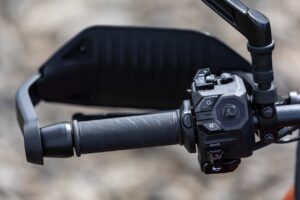 The Atlas has a particularly comprehensive electronics package. There’s lean-sensitive ABS and traction control, engine brake torque control, wheelie control, and systems that monitor rear-wheel lift and sliding. Cruise control is also included. The Apex adds combined braking and hill-hold assistance. With the latter, you don’t need to keep your hand on the brake lever while preparing to set off on an incline.
There are five riding modes to choose from: Urban, Rain, Tour, Sport and Enduro. These coordinate throttle response, engine braking and the various rider assistance systems. In Enduro mode, rear-wheel ABS and traction control are disabled, while the front ABS switches to an intervention strategy better suited to off-road riding.
What really impressed me was how easy everything was to operate. I could use the heated grips and cruise control exactly as I instinctively expected. I didn’t have to stop before every operation, ask for advice or dig out the owner’s manual.
One small detail did bother me, though: when cancelling the indicators, I missed having a distinct click. The system worked, but my thumb didn’t receive the familiar feedback I was used to.
You Could Spend an Entire Test Day Exploring the Display
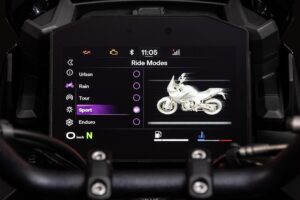 Norton describes the instrument panel as an eight-inch TFT touchscreen. I liked its size and clarity, but the menus contained so many features that it quickly became obvious I wouldn’t have time to explore everything that day. Smartphone connectivity, music and call management, turn-by-turn navigation, GoPro control and various riding statistics are all available. The system also supports wireless updates through the Norton Rider app.
There was one feature on the Atlas, probably inherited from the Manx, that immediately brought out the child in me: a zero-to-100 km/h acceleration timer. After a rather untidy standing start, it displayed 4.7 seconds. That was the motorcycle’s own reading, not a verified measurement, but it was more than enough to make me immediately want to improve it. It’s a dangerous game for someone who originally only wanted to find the average fuel consumption display.
Pre-Production Problems That Can’t Be Ignored
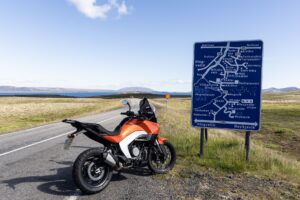 Alongside the positive impressions, there were a few frustrating details. We were riding pre-production motorcycles, and they weren’t entirely finished in every respect.
The six-speed gearbox comes with a bidirectional quickshifter as standard, but the timing of the upshifts wasn’t right. During lunch, one of the engineers told us they were still working on it. The same timing problem appeared elsewhere on the motorcycle. The horn sometimes sounded a few tenths of a second after pressing the button, and on occasion, the expected engine braking was delayed by a similar amount when I closed the electronic throttle. These are fairly serious issues, but they can be corrected through software, and the manufacturer must resolve them before sales begin. I’d definitely recommend checking these functions during a test ride before buying one.
I also found the cable-operated assist and slipper clutch slightly heavy for my taste. I could operate it with two fingers, but during an entire day of off-road riding with frequent clutch use, I suspect my hand would become tired.
There were also questions surrounding the operation of the keyless system. Several riders complained about restarting the motorcycle after longer stops, and there were problems with the fuel cap’s closed-position sensor as well.
The Off-Road Section Was Where I Really Fell in Love with It
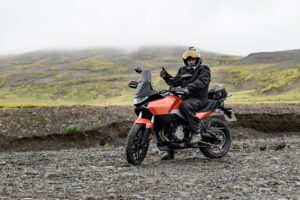
Towards the end of the day, we reached a sixteen-kilometre off-road section. By then, I’d become familiar with the motorcycle. I knew where the controls were, how it responded to the throttle and roughly what sort of inputs it liked. The reward arrived at exactly the right moment.
Off-road, the Atlas felt surprisingly easy to handle. Its power, balance and responses suited me incredibly well. After a while, I realised I was dealing quite naturally with slides that would probably have made me tense up considerably on another motorcycle, or perhaps even sent me face-first into the ground. My own KTM is a wilder, more direct tool. On this terrain, the Atlas gave me more time and composure to make decisions. That doesn’t mean I’d call it a better off-road motorcycle, but for a recreational enduro rider who heads out at weekends, this friendly character could mean a great deal. I suspect the secret behind my confidence was the relatively rearward position of the footpegs, close to the rear wheel. That allowed me to manage rear-wheel slides with far more confidence. I had a level of rear-wheel control on this motorcycle that I’d never previously dared to imagine myself capable of. And I still think that was entirely thanks to the bike.
For standing riding, I’d replace the footpegs with wider ones and raise the handlebars slightly to suit my height. Apart from that, I wouldn’t change anything. The rubber inserts in the footpegs are removable, allowing off-road boots to get a good grip.
The test motorcycle had cast wheels fitted with Eurogrip Explo-R Plus tyres. They worked well for me on both wet tarmac and the off-road section. During the presentation, Norton also mentioned that a tubeless spoked-wheel option would be available, which would be a better choice for off-road riding.
Touring and Everyday Riding: Promising Details
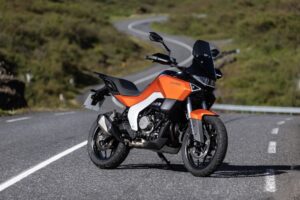 Norton has also considered luggage-carrying options for the Atlas. Apex specification includes a rear luggage rack and passenger grab handles, while the accessories catalogue offers a side-bag system with a combined capacity of 50 litres and a 34-litre top case. Heated grips, a heated rider’s seat, a larger touring windscreen, crash bars and more substantial underbody protection are also available as genuine accessories.
The manufacturer’s claimed fuel economy is 23 kilometres per litre, equivalent to approximately 4.35 litres per 100 kilometres. At one point during the test, the display showed 6.3 litres per 100 kilometres, which I think is realistic given the frequent stops, accelerations and changing test conditions.
The European press material specifies a three-year warranty with unlimited mileage, along with Norton Roadside Assist for the duration of the warranty. Service intervals are 10,000 kilometres or twelve months, and Norton has established an extensive international service network.
Who Is the New Norton Atlas For?
For someone who wants a comfortable touring motorcycle that’s enjoyable on the road but can also venture off the tarmac occasionally. Someone who appreciates manageable power, good balance and a generous electronics package. And finally, it doesn’t hurt if the future owner actually enjoys looking at their motorcycle. The Atlas is divisive in that respect, but those who like its appearance will probably like it a lot.
The press material listed European starting prices of €9,250 for the standard Atlas and €10,525 for the Apex. The Hungarian forint figure I mentioned in the video was my own estimate at the time, not an official Hungarian price. For local pricing, exact specifications and availability, it’s best to contact the Hungarian distributor, Sandlander.
Conclusion
After the off-road section, what stood out most about the Atlas was the confidence it inspired. It was easy to get a feel for, responded well to my inputs, and didn’t require constant effort to keep it under control. It remained enjoyable on paved roads, too, while its suspension and wind protection performed admirably even in Iceland’s extreme conditions.
The problems with the quickshifter and keyless system, however, remain important concerns. These must be resolved on the final production motorcycles if that enthusiastic first encounter is to develop into a happy long-term relationship.
In any case, I was genuinely sad to hand the Atlas back at the end of the day. Iceland would have been a fantastic experience on its own, but the Atlas added something extra: it simply felt good to ride.
And when a motorcycle brings out riding skills on Icelandic gravel that I didn’t even know I had, it’s difficult to imagine that this was the last time I’d ever sit on one…
This review was produced during a press event organised by Norton.
Watch the Video Review Here: