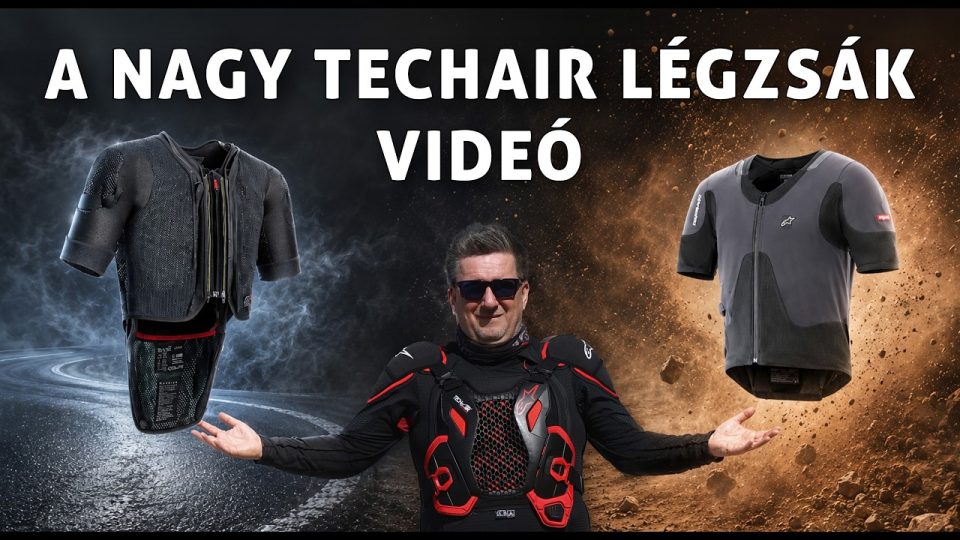
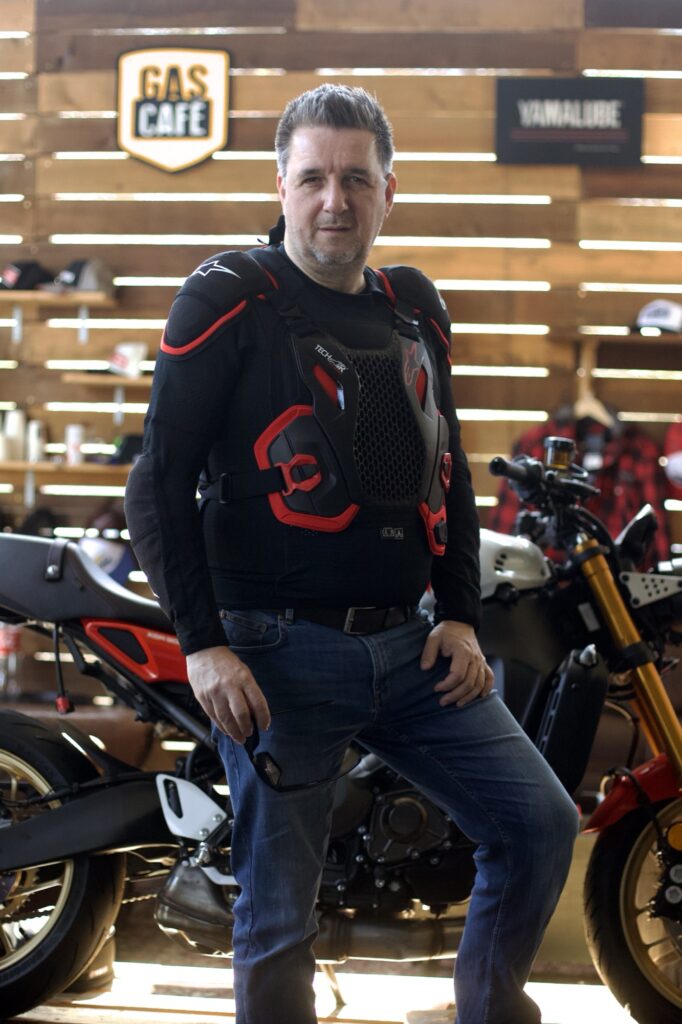
 There’s one piece of motorcycle equipment whose true value we hope never to experience. We buy it, wear it regularly, keep it charged, look after it, and all the while hope we’ll never actually need it. I’m talking about the motorcycle airbag, which has become part of an increasing number of riders’ protective equipment in recent years. I’ve been using motorcycle airbags for several years now, and unfortunately I’ve also had the opportunity to experience one deploying during an accident. So I have some personal experience, but the newer models have also raised plenty of questions for me. That’s why three of us sat down at the Top Motor showroom in Tatabánya to explore the subject in detail.
My guests were Ádám Hauber from MotoStar, an accredited Alpinestars airbag service technician in Hungary, and Bálint Meizer, whom you may know from the Mejzi On The Road YouTube channel. All three of us use Alpinestars airbags, but we ride differently, have chosen different models, and our experiences aren’t entirely the same either. Our conversation, which lasted almost fifty minutes, ultimately provided a fairly comprehensive picture of how modern motorcycle airbags work, the differences between the various models, and what to consider before buying one.
Why Would Someone Buy a Motorcycle Airbag?
We each had a slightly different answer to that question. According to Bálint, anyone who regularly spends a lot of time riding should seriously consider this additional protection. The more time we spend on the road, the greater the chance that one day we’ll encounter a situation where we might need it.
Ádám’s decision was largely influenced by an earlier accident. Approximately eight years ago, a driver swerved into him at urban speeds, causing him to fall. He escaped with a dislocated shoulder, but was unable to work for six weeks and needed an extended course of physiotherapy. At home, he had a six-month-old daughter waiting for him. He didn’t want to give up motorcycling, but he did want to take his own protection more seriously. Later, when he began working on servicing Alpinestars airbags, his professional experience reinforced that decision.
I approach the subject a little differently. Ever since buying my first leather motorcycle suit, proper protective equipment has been important to me. I don’t want to give up the enjoyment of riding, but I also don’t want an avoidable injury to keep me away from work or everyday life for months. For me, an airbag is a natural extension of that philosophy.
Bálint summed up our shared attitude perfectly: let this be the biggest waste of money we ever make. Let’s buy it, wear it for years, and hopefully never have to experience it doing its job.
Doesn’t It Create a False Sense of Security?
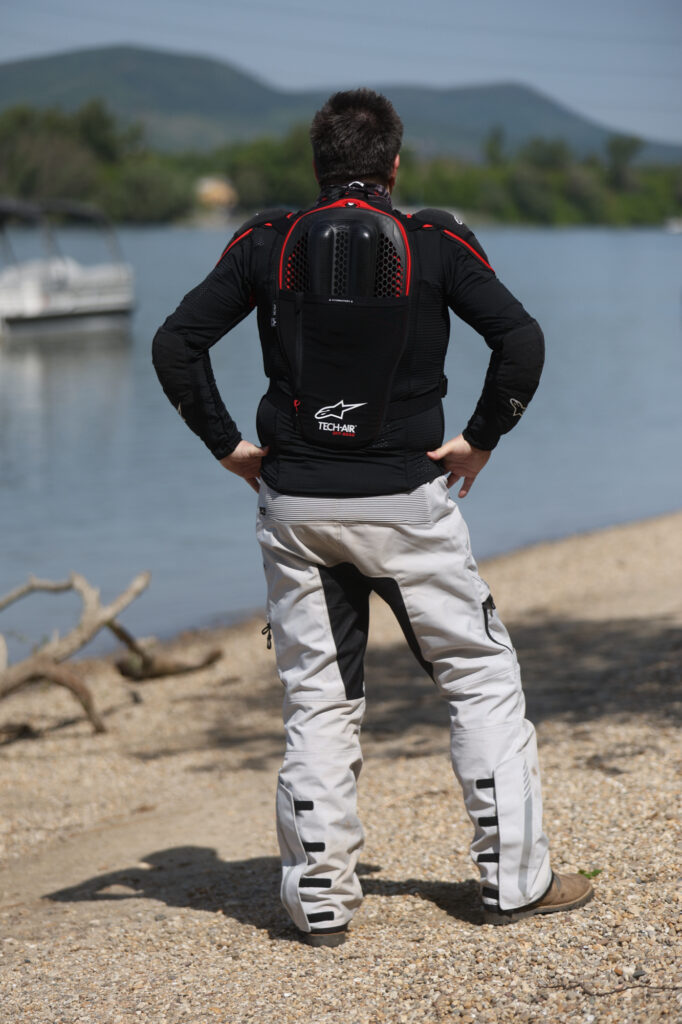 This is one of the most important questions when it comes to using motorcycle airbags. Good protective equipment can make a rider feel more confident, and there’s nothing wrong with that. The problem begins when someone starts riding faster or less responsibly because they feel better protected.
According to Ádám, an airbag can genuinely increase your sense of security because it may reduce the risk and severity of injuries against which conventional protectors offer more limited protection. However, that certainly doesn’t make the wearer invulnerable. An airbag cannot prevent every injury. For example, it doesn’t protect the hands or lower limbs, and some mechanisms of collarbone fractures may not be adequately addressed by an airbag either. The areas protected also vary between models.
Personally, I don’t feel that wearing an airbag makes me ride more boldly. My conventional motorcycle clothing is also an important part of feeling comfortable on the bike. If I’m not wearing proper protective equipment, I simply don’t feel right. The airbag hasn’t made me faster or more adventurous either. I ride exactly as I did before, just with an additional layer of protection. Perhaps that’s the most important attitude: an airbag complements proper motorcycle clothing and responsible riding.
An Accident in Greece That Changed My Mind
My first airbag-equipped motorcycle jacket was a Dainese with an integrated D-Air system. I once had a fall while wearing it in Greece. Based on our subsequent analysis of the footage, I was travelling at approximately 29 km/h, while under those particular conditions the system was designed to activate above a threshold of 30 km/h. The airbag didn’t deploy.
It’s important to emphasise that this didn’t, in itself, indicate a technical malfunction. The system behaved according to its operating conditions at the time. Unfortunately, during the fall, my elbow was forced against my ribs. Nothing was broken, but the injury remained painful for approximately three months. Every time I took a deep breath, I was reminded how much better it might have been if the airbag had deployed. That was when I decided to look for another system. Not because my previous airbag was faulty, but because I wanted something better suited to my riding habits and the accident scenarios I considered possible.
Eventually, I chose the Alpinestars Tech-Air 5. I particularly liked the fact that I didn’t necessarily have to buy a new motorcycle jacket to use it. Under the appropriate conditions, the vest can be worn beneath clothing from various manufacturers, which was a significant advantage for me. Then, one day, I had another fall while wearing it. This time, the airbag deployed before I even hit the ground.
The Dog, the Bang and the Soft Landing
During a ride in Romania, a dog caused a situation that ultimately ended with me falling off the motorcycle. I remember losing my balance and beginning to fall. Your perception of time changes in a very strange way during moments like these. The whole event takes place in a matter of seconds, yet it feels as though everything is happening in slow motion. I must have been about halfway between my normal riding position and the ground when I suddenly heard an enormous bang.
My first thought was that someone was shooting at me as well! Then I realised it was my airbag deploying. The vest inflated in an instant, firmly supporting my upper body, and by the time I hit the ground it was fully inflated. The landing felt surprisingly soft, almost as though I’d fallen onto a thick cushion. Incidentally, the dog was at least as frightened by the bang as I was, and immediately ran away.
The airbag gradually deflated over the following few minutes. The experience strengthened my confidence in the technology, although naturally one successful deployment doesn’t tell us how a system will perform in every possible accident. But the story didn’t end there. On the next working day, I visited an Alpinestars service centre in Romania, where, following the necessary inspection and replacement of the gas cartridge, my vest was ready to use again by one o’clock that afternoon. That was an extremely important experience for me. On a longer tour, a deployed airbag isn’t simply a safety issue; it’s a logistical one too. There’s a considerable difference between being able to use your protective equipment again after a few hours, a few days or several weeks.
According to Ádám, under normal circumstances the Hungarian service centre generally aims for a turnaround time of three to five working days. Naturally, this depends on their workload and the work required.
The Evolution of Tech-Air: From Racetracks to Public Roads
Alpinestars has been developing motorcycle airbags for more than two decades. Initially, the technology was primarily associated with racing, but systems designed for road use gradually began to appear as well. One of the most important developments was making airbags increasingly independent of specific motorcycle clothing models. Some early systems could only be used with specially prepared clothing. The later Tech-Air 5, however, operated as a standalone vest, giving users considerably more freedom.
Since then, the range has expanded significantly. There are now external vests designed for urban commuting, systems developed for racetrack use, protective equipment intended for off-road riding, and newer versions that are particularly thin and well ventilated. At first glance, the selection can be rather confusing, because the different models aren’t simply cheaper or more expensive versions of the same product. They’re designed for different riding styles and conditions.
At the time of our conversation, the Tech-Air 3 family primarily offered a more convenient solution for commuters and urban riders. The Tech-Air 5 and newer Tech-Air 5 Plasma were intended for broader road and touring use. The Tech-Air 7X and Tech-Air 10 provided further options for sporty and racetrack riding, while the Tech-Air Off-Road and Tech-Air MX Plasma addressed different requirements of off-road motorcycling.
Tech-Air 5 or Tech-Air 5 Plasma?
 This is one of the most interesting questions, because the difference between these two vests isn’t simply a generational update. The original Tech-Air 5 is bulkier and less breathable, but its airbag has a Level 2 impact protection rating under the relevant standard.
The newer Tech-Air 5 Plasma has a thinner, lighter and better-ventilated design, but its airbag has a Level 1 impact protection rating. Level 2 represents a higher testing requirement. However, that alone doesn’t describe the complete protective capabilities of the two systems, because the areas covered and other protective characteristics must also be considered. The differences between the two vests reflect different development priorities. With the older Tech-Air 5, sportier riding, including potential racetrack use, was an important consideration. With the Plasma, the emphasis shifted towards lower weight, greater comfort and improved ventilation.
Bálint has already chosen the Plasma, and Ádám has switched to it as well. They’re both very satisfied with its comfort. Thanks to its reduced thickness and revised airbag layout, air can circulate through the vest more easily, which can be particularly beneficial during summer riding. For now, I’ve kept my old Tech-Air 5. Partly because I know it well, and partly because I appreciate its higher protection rating. At the same time, I readily admit that ventilation isn’t one of its strengths.
How Hot Does an Airbag Vest Get?
I think this is one of the most common objections to airbag vests. I have to admit I’ve had some uncomfortable moments wearing the old Tech-Air 5, particularly in the summer heat. Beneath a thicker motorcycle jacket, the vest can further restrict airflow, which can become quite exhausting in very hot weather. However, wearing the right base layer makes an enormous difference.
During an earlier trip to Norway, for example, I rode in some fairly extreme conditions. In Norway, I encountered rain and temperatures of 6°C, while on the journey there, in Poland, I also rode in temperatures of 42°C. I wore a well-ventilated motorcycle jacket over the airbag and an appropriate base layer underneath it. The moisture-wicking clothing and airflow combined to cool my body surprisingly effectively. At one point, I actually needed to protect my neck more carefully from the hot oncoming air, while the temperature around my upper body beneath the jacket remained acceptable. Inside my helmet, however, I was coping with the heat considerably less well.
The Plasma offers new possibilities in this respect. According to Ádám and Bálint, its thinner construction provides noticeably better ventilation, to the point where it can even become a disadvantage on cooler morning rides. However, at the time of our conversation, they didn’t yet have enough personal experience for a longer comparison in extremely hot summer conditions. In any case, I believe ventilation is one of the most important comfort considerations when choosing an airbag. There’s little benefit in a system providing a high level of protection if it’s so uncomfortable that its owner sometimes decides to leave it at home.
What Happens When an Airbag Deploys?
One of the major advantages of modern electronic motorcycle airbags is that they don’t require an activation tether attached to the motorcycle. Alpinestars systems operate independently, using built-in sensors and electronic control units to monitor the rider’s movements. Different models use accelerometers and gyroscopes. The control system continuously evaluates movement data and determines whether airbag activation is necessary based on recognisable accident patterns.
Some systems developed for racetrack use employ additional sensors, because extreme lean angles, intensive braking and rapid changes of direction create particularly complex movement patterns. Road-going systems, meanwhile, must also be prepared for different types of accidents. Consider, for example, a collision at a junction, which can cause serious injuries even at very low speeds. Operating speed ranges and activation conditions therefore differ between models and riding modes.
When the system detects an accident scenario, it uses a gas cartridge to inflate the airbag extremely quickly. The precise activation and inflation times depend on the particular design. The aim is for the airbag to reach an appropriate level of inflation before impact, reducing the forces transmitted to the body. I experienced this very clearly in my own accident. By the time I hit the ground, the vest was already fully inflated.
The airbag then gradually deflates so the rider can move more freely again. The time required also varies between systems. Newer designs use specific solutions to accelerate deflation, allowing the airbag to return to its normal state more quickly. This is particularly important for systems used off-road or on racetracks, where a rider might be able to continue after a minor fall.
Where Does the Airbag Inflate, and What Does It Protect?
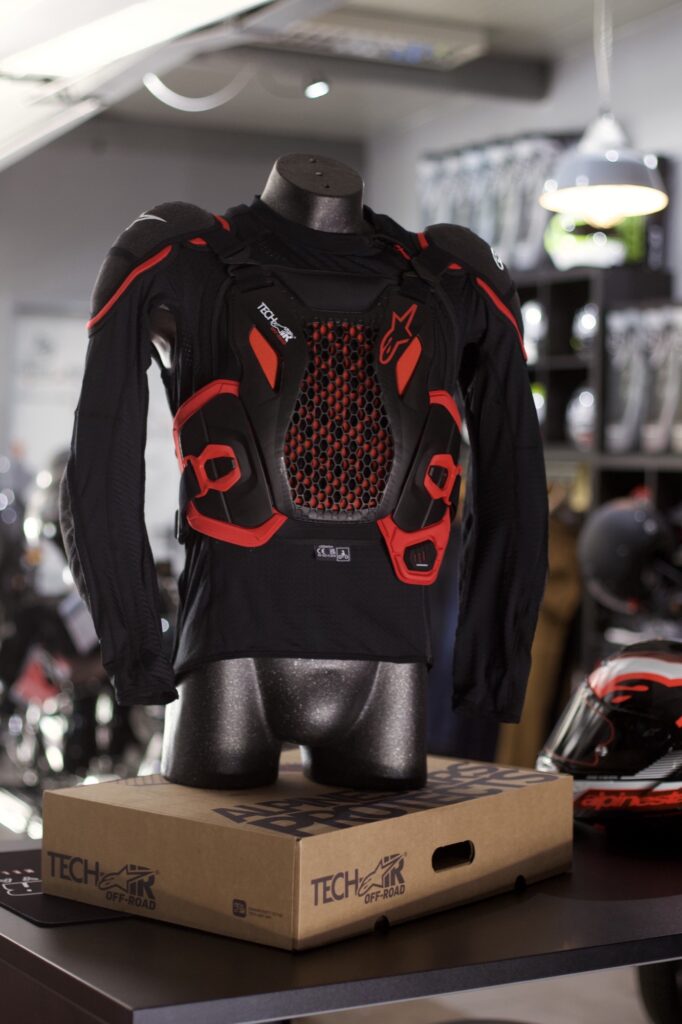
There are significant differences between airbags in this respect too. The Tech-Air 5 family, for example, is designed to protect the chest, shoulders, collarbone area, sides of the ribcage and back. The inflatable system also extends over the upper arms and reaches considerably further down the back than a conventional back protector integrated into a vest. The Tech-Air 3 has a different design, primarily intended to protect the chest and back. The Tech-Air 10 offers more extensive coverage, including protection around the hips.
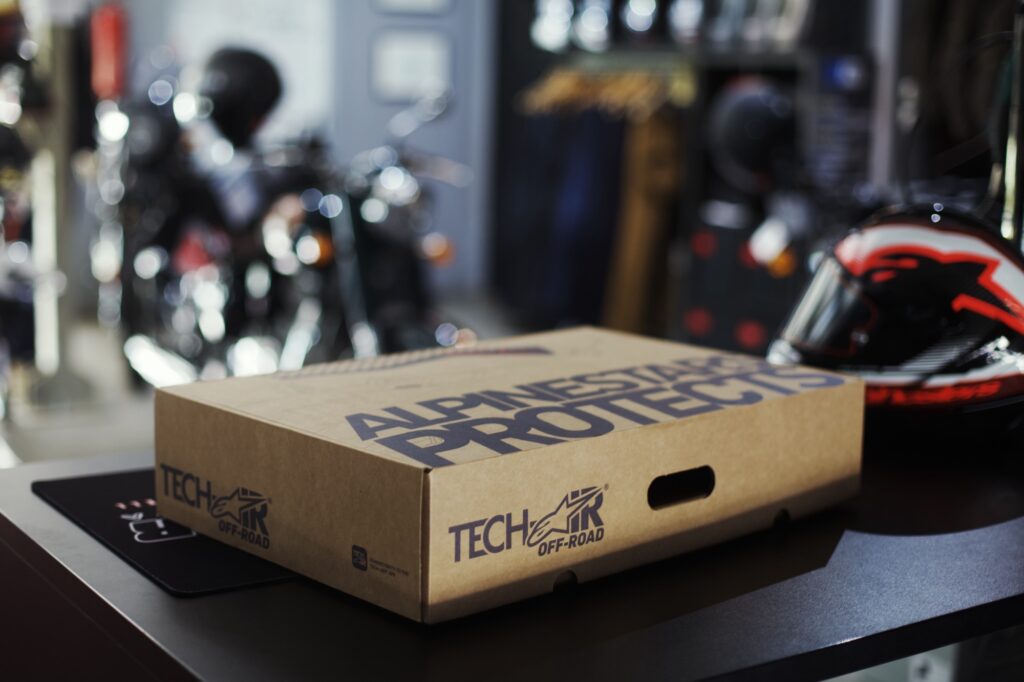
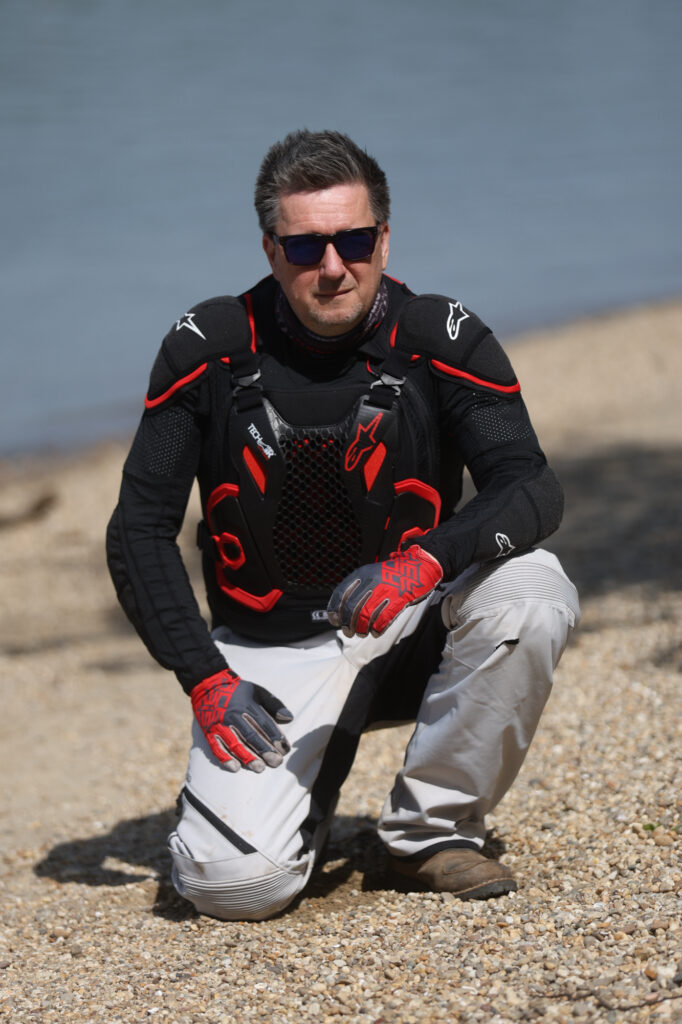
The Tech-Air Off-Road is particularly interesting because it incorporates conventional passive protectors alongside the airbag. For me, this is one of its most important features. I much prefer having physical protectors secured directly to my body rather than relying exclusively on outer clothing to keep them in place. That reduces the likelihood of them moving during a fall. My Tech-Air Off-Road vest includes chest, back, shoulder and elbow protection. I can use the equipment on its own with an appropriate abrasion-resistant outer layer or a motocross jersey, in configurations approved by the manufacturer.
It’s also reassuring that if the airbag has already deployed or is temporarily unavailable, the passive protectors continue to provide some protection. Naturally, that doesn’t mean the vest automatically replaces a complete set of motorcycle protective equipment. Protection for the various parts of the body and the abrasion resistance of the clothing still need to be considered separately.
Replacing Gas Cartridges: One of the Biggest Advantages of the New Generation
 One of the inconveniences of older electronic airbags was that after deployment, they had to be sent or taken to a service centre. The original Tech-Air 5, for example, works this way. Replacing the gas cartridge and inspecting the system requires an accredited service centre. With some newer models, however, the user can replace the gas cartridge themselves. For me, that’s an enormous step forward, particularly when touring.
The Tech-Air 5 Plasma uses a single cartridge, and the manufacturer requires a more comprehensive service inspection after a specified number of deployments. During our conversation, Ádám mentioned six deployments for the Plasma, provided the prescribed inspection and replacement requirements are followed. The Tech-Air Off-Road has two separate charges, meaning that under the appropriate conditions, it can potentially deploy twice in succession. The used cartridges can be replaced, so it’s possible to carry spares on a longer off-road tour. However, the system has maintenance limits. After a certain number of deployments, the internal airbag assembly must be replaced and a more comprehensive service inspection carried out.
I usually carry a spare cartridge on longer tours. Minor falls can easily happen off-road, and I like knowing that I can restore my airbag to working condition if necessary. Of course, the condition of the equipment must be checked after every deployment. If the airbag itself, its outer covering or the protective structure has been damaged, simply replacing the cartridge isn’t enough.
What Jacket Can You Wear It Under?
One of the most important requirements when using an airbag vest is leaving sufficient room for it to inflate. This is something many people tend to underestimate. If an airbag is worn beneath a very tight jacket, the jacket may prevent it from expanding properly when activated. Not only can this reduce the system’s protective capabilities, but it may also place dangerous pressure on the body. That’s why motorcycle jackets approved by the manufacturer and specifically designed to accommodate airbags are the simplest solution.
Some vests can also be worn beneath clothing from other manufacturers, but in these cases it’s particularly important to ensure the required expansion space and suitable garment construction for the specific airbag. During our conversation, Ádám mentioned at least four centimetres of clearance around the chest and abdomen as a general guideline for jackets without specifically designed airbag expansion panels.
My old Dainese jacket has quite an unusual story in this respect. I loved that leather jacket and didn’t want to part with it after switching to another airbag system. Eventually, Marika and the team at Cölöp’s workshop in Cegléd modified it. They incorporated suitable expansion panels and created a way to secure the Tech-Air 5 vest. Later, my airbag deployed while I was wearing this modified jacket, and it had enough room to inflate. However, I’m sharing this as a personal experience, not as general advice.
How Do You Clean an Airbag Vest?
Anyone who has ridden in full protective equipment in 40°C summer heat knows that eventually, cleaning your riding gear becomes unavoidable. Cleaning the older Tech-Air 5 isn’t straightforward because the electronics and airbag assembly can’t be removed as easily as in newer designs. Ádám explained that the Hungarian service centre also offers a cleaning service for certain models. This can be particularly practical outside the riding season, when the owner doesn’t need the equipment for a few days.
With newer systems designed to be disassembled by the user, things can be simpler. The construction of the Tech-Air 5 Plasma, Tech-Air 7X and some other new-generation models allows the outer textile section to be cleaned separately once the appropriate components have been removed. The exact procedure must always follow the manufacturer’s instructions. Naturally, the electronics, gas cartridges and airbag assembly itself must never be put in a washing machine, and there are specific procedures for disassembly and reassembly.
I regularly wear a base layer beneath my old Tech-Air 5. It absorbs a lot of perspiration, helping to keep the vest cleaner. With the Tech-Air Off-Road, meanwhile, I’ve needed surprisingly little cleaning despite some intensive off-road riding. Good ventilation makes a significant contribution to keeping the equipment comfortable to wear.
How Long Does the Battery Last?
Modern electronic airbags are battery-powered, so regular charging is a natural part of using them. In my experience, I can generally complete two full days of riding safely on a single charge with both the Tech-Air 5 and Tech-Air Off-Road. Bálint takes a more cautious approach: he normally charges his Plasma every day.
Ádám explained that the manufacturer’s quoted battery life varies between Tech-Air models, generally amounting to several dozen hours. The precise figure should always be checked in the specifications of the particular vest. Battery charge can be checked using the vest’s indicators or, on compatible models, through the smartphone application. The Alpinestars Tech-Air app also provides more detailed battery information, various system details and access to user manuals. On certain models, riding modes can also be selected through the app.
The application can also record routes, but it uses the phone’s location services to do so. The airbag system doesn’t contain an independent GPS capable of performing this task without a phone. I regularly switch between road and off-road modes on my enduro vest. Fortunately, it’s a straightforward operation, and newer systems can also provide vibration feedback to confirm the change.
Taking an Airbag on a Plane – Not So Simple Either
Because I regularly travel abroad for motorcycle press launches, transporting an airbag by plane is particularly important to me. The gas cartridge means an airbag is classified as special safety equipment, subject to specific transport regulations. Airline approval and the necessary documentation are therefore essential considerations. The permitted number and size of cartridges, how they must be transported and any notification requirements depend on the applicable regulations and the airline’s own rules.
I’ve had some interesting experiences in this area too. On one occasion, when taking a Wizz Air flight from Budapest Airport, I informed the staff that I wanted to transport motorcycle airbag safety equipment. At first, they weren’t entirely sure how to handle the situation. Several phone calls followed, and eventually they somehow reached DHL, where someone confirmed that similar equipment had been transported before. Of course, this doesn’t replace official airline approval, but it demonstrates how unfamiliar motorcycle airbags can still be during airport procedures.
In Barcelona, the staff were a little better prepared for my request, although it still took several minutes to clarify everything. In Swiss’s case, this type of safety equipment was specifically mentioned in its transport conditions, and advance approval was required. However, I hadn’t arranged the booking myself, so I only began corresponding with customer services a few days before departure. The reply eventually arrived when I was already on my way to Almería. I can’t say it was particularly helpful.
That’s why I now try to clarify the conditions in advance and, if necessary, also take conventional passive protective equipment with me. The most important lesson is that arranging to transport an airbag by air shouldn’t be left until the last minute. Even with the correct documentation, advance permission may be required, and carriage can ultimately still be refused on a particular flight.
Which Motorcycle Airbag Is the Best?
 By the end of our conversation, we returned to the most important question: which Tech-Air system should you choose? Interestingly, the three of us had settled on three different solutions. Bálint uses the Tech-Air 5 Plasma, which he finds comfortable, thin and well ventilated. Road riding and touring are his main activities, although the possibility of lighter off-road riding was also a factor in his decision. Ádám has switched to the Plasma as well, because he rides a lot during summer and considers its improved ventilation a decisive advantage.
I, on the other hand, continue to use two different systems. I primarily keep the old Tech-Air 5 for everyday road riding, wearing it beneath a suitable leather jacket. The Tech-Air Off-Road accompanies me on off-road rides and increasingly on longer tours too. I particularly like the latter because, in addition to the airbag, it offers a more comprehensive set of passive protectors. The replaceable cartridges, different riding modes and good ventilation are also major advantages for me. During our conversation, I also learnt that the Plasma has an Enduro mode suitable for lighter off-road riding. That was news to me, and it demonstrates just how versatile the newer systems have become. Nevertheless, the Tech-Air Off-Road is designed for a different purpose, particularly because of the passive protective elements intended for more demanding off-road use.
According to Ádám, it’s always worth discussing your riding habits in detail before making a purchase. What motorcycle do you ride? How much time do you spend on country roads, in the city or off-road? What weather conditions do you ride in? What jacket do you have, and what protective equipment would you like to use with it? These questions are much more important than simply choosing the most expensive vest in the range. The right airbag is one that suits your riding, offers appropriate protection, is comfortable to wear, and has operating and maintenance requirements you can comfortably live with over the long term.
It’s Worth Trying One On in Person
We didn’t choose the location for our conversation by accident. Top Motor in Tatabánya has been dealing with Alpinestars motorcycle protective equipment for a long time and stocks a substantial selection of Tech-Air systems. The different models are available in several sizes, so it’s worth trying them on before buying. That’s particularly important with equipment where correct sizing and positioning directly affect its protective capabilities.
Ádám also contributed a great deal to the technical and maintenance aspects of our discussion, drawing on his experience as a MotoStar service technician. Bálint brought the perspective of a relatively new user, which I found particularly interesting. The three of us ride differently, wear different equipment and don’t always agree on the best solution. But by the end of the conversation, we were in complete agreement on one thing. A motorcycle airbag can be an extremely useful piece of protective equipment, but choosing the right model requires careful consideration. It’s worth understanding how it works, its limitations, servicing requirements and how it fits with the motorcycle clothing you already own.
I’ve personally experienced what it feels like when an airbag deploys at exactly the moment I need it. That experience meant a great deal to me and strengthened my determination to continue using this technology. I hope I never have to experience another deployment. And I wish the same for everyone considering buying a motorcycle airbag: may it be the biggest waste of money you ever make!
Watch the Video Here: