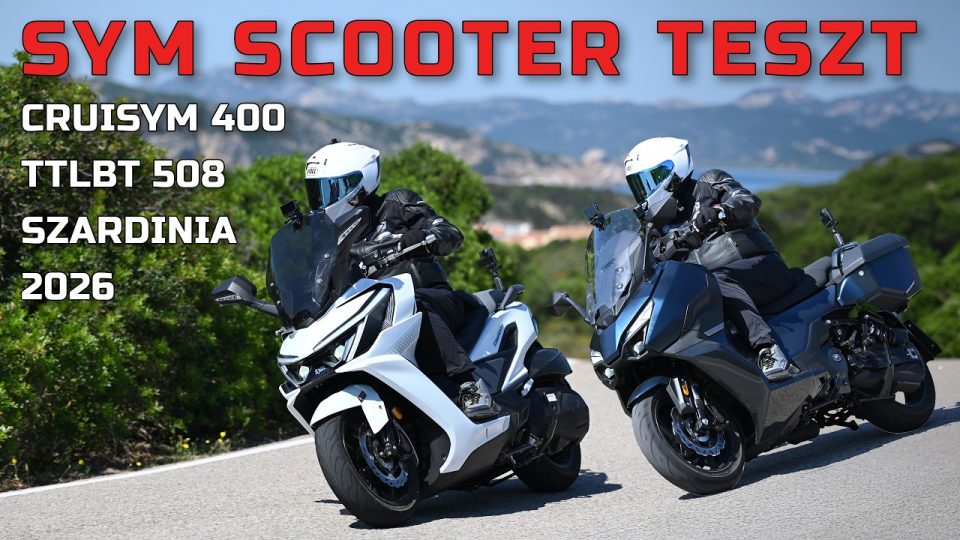
 We usually expect comfort, practicality and ease of use from a maxi-scooter. If it also handles corners well and has enough power to make riding enjoyable, that’s already a pretty good combination. But Taiwanese manufacturer SYM decided there was considerably more potential in this category and created the TTLBT 508.
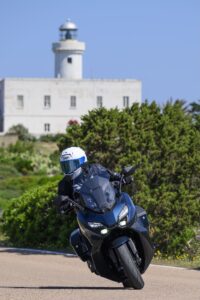
I had the opportunity to test this strangely named machine in Sardinia during the brand’s European press launch. We set off from Olbia and headed into the island’s beautiful winding roads, occasionally riding at a rather lively pace. I spent the morning riding the smaller Cruisym 400 before switching to the TTLBT halfway through the tour. The difference was noticeable almost immediately. The TTLBT is more powerful, more substantial and considerably better equipped. It’s a machine that’s genuinely suited not only to urban commuting but also to longer journeys. And it’s surprisingly entertaining to ride.
Turtle Best Technology – Seriously, Doc?
 Let’s start with the name, because that certainly deserves a few words. TTLBT stands for Turtle Best Technology, which roughly translates as “Turtle – the Best Technology”. I find this naming convention so charmingly quirky that it’s almost endearing in itself. SYM associates the turtle with stability, protection and endurance. Those qualities certainly suit the character of a large touring scooter, although I quickly discovered that, when it comes to speed, the TTLBT doesn’t really live up to its namesake from the animal kingdom. The Best Technology part isn’t merely a catchy slogan either. The engineers have genuinely tried to pack this machine with just about everything you’d expect from a modern, electronically sophisticated touring motorcycle.
There’s cruise control, ride-by-wire throttle control, lean-sensitive ABS and traction control, multiple riding modes, an electrically adjustable windscreen, heated grips, cornering lights, a large TFT display and Apple CarPlay. And that’s far from the complete list. It’s an interesting approach, and I was curious to find out how successfully all these features had been integrated in practice.
Two Cylinders, 46 Horsepower and Plenty More Punch
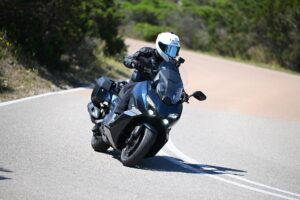 At the heart of the TTLBT is a 508cc, liquid-cooled parallel-twin engine with dual overhead camshafts and eight valves. Maximum power is 33.5 kW, or approximately 45.5 hp, at 6,750 rpm, while peak torque is 49.9 Nm at 5,250 rpm. Power is transmitted through a CVT automatic transmission, so riding it is just as straightforward as operating any conventional scooter. Twist the throttle and off you go, with the transmission continuously adapting to speed and load.
On the road, however, I immediately realised this was a completely different experience from the smaller Cruisym 400. There’s approximately a 12 hp difference between the two engines. That might not sound like much on paper, but in practice it’s very noticeable. The TTLBT accelerates considerably more decisively, has greater performance reserves and makes overtaking on country roads genuinely effortless. On one winding section, Claudio, our ride leader, was setting a pretty good pace on a smaller scooter. I was doing my best to keep up, and I was surprised by how easily I could follow him. At one point, I even considered overtaking. The engine’s character suits this kind of riding particularly well. Throttle response is sufficiently direct, acceleration is continuous, and on ordinary roads I never felt that the engine’s performance was significantly limiting me.
Naturally, you shouldn’t expect the acceleration of a 120 hp naked bike. Nevertheless, the TTLBT has reached a level of performance where there’s enough power in reserve for both everyday transport and enthusiastic touring. On winding roads, it’s still worth maintaining momentum, but you can accelerate out of slower corners much more decisively than on the smaller single-cylinder scooter. For me, the TTLBT can already be considered a fully capable touring motorcycle, just with an automatic transmission and the comfort associated with scooters.
The Scooter That Needs Its Chain Lubricated
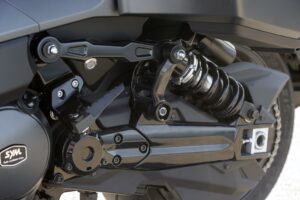 The TTLBT’s mechanical layout differs from that of conventional scooters. On most scooters, the engine and much of the transmission move together with the rear wheel. On the TTLBT, however, the engine is centrally mounted, and power reaches the rear wheel through a final chain drive. Yes, you read that correctly: a scooter whose owner gets to clean and lubricate the chain just like the owner of a conventional motorcycle. Of course, the purpose isn’t simply to give scooter riders something to do in their garages. A centrally mounted engine and separate rear swingarm allow more favourable weight distribution and can also reduce the mass moving with the rear wheel. Both factors benefit suspension performance and handling.
The TTLBT also features more sophisticated suspension. At the front, there’s a 41 mm inverted fork, while the rear uses a monoshock with a linkage system. Both wheels are 15 inches in diameter, fitted with a 120/70 front tyre and a 160/60 rear. The motorcycle’s fully fuelled and ready-to-ride weight is 241 kg. That’s certainly substantial, but based on how it behaved on the road, it never felt particularly cumbersome to me.
The Cruisym 400 responded to steering inputs a little more quickly and directly, whereas the TTLBT changed direction in a calmer, more deliberate manner. That didn’t make it difficult to handle. Instead, it felt more predictable. It held its line beautifully through corners, remained stable on the road and showed no unpleasant wallowing or instability. I can’t give such a definitive opinion about suspension comfort over bumps because we didn’t encounter any genuinely poor road surfaces during the test. However, I was very satisfied with its cornering stability.
The Brakes Needed a Little Attention
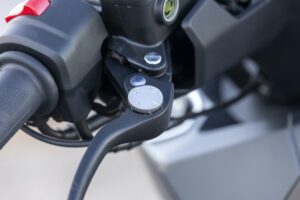 The more sophisticated suspension is accompanied by a suitably capable braking system. Up front, there are two 275 mm discs with radially mounted four-piston calipers, while the rear has a single 275 mm disc. I had no particular complaints about braking power. There were a few situations during the test that required harder braking, but the Turtle handled them well. What I didn’t like initially was the feel of the front brake lever. On the smaller Cruisym 400, the brake lever had been relatively firm, with a clearly defined biting point. On the TTLBT, by contrast, the lever felt soft, with unnecessarily long travel. To achieve really strong braking, I had to pull it quite close to the handlebar grip. That bothered me because I like receiving precise feedback from my brakes.
At one of our stops, we adjusted both brake levers. We moved the front lever slightly further away from the grip and brought the rear lever closer. After the adjustment, operating the brakes felt considerably more pleasant. Not perfect, but much better.
Electronics Worthy of a Serious Touring Motorcycle
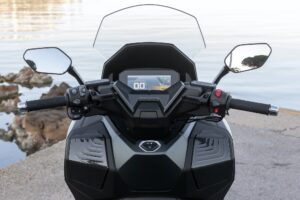 One of the TTLBT’s most interesting features is its electronics package. The motorcycle has a Bosch IMU that monitors the vehicle’s movement and lean angle. It’s the same kind of technology found on modern high-performance motorcycles. There are three riding modes. Normal + TCS provides full power with traction control enabled. Normal delivers full power with traction control switched off. Rain offers more restrained power delivery with traction control active. On the test bike, I could only change riding modes while stationary. That’s a slightly unusual arrangement, since many other motorcycles allow you to switch modes while riding, provided you close the throttle.
On the other hand, there is cruise control, which I particularly appreciate on touring motorcycles. Using it on the TTLBT was one of my most pleasant experiences with its electronics. I’d barely climbed aboard when I instinctively found the cruise control switches without having to study anything beforehand. A couple of button presses, and it was working. In my opinion, that’s exactly how a well-designed user interface should behave. Cruise control can be used above 50 km/h.
Electronics also play an important role in the lighting system. The full LED headlight arrangement is complemented by lean-sensitive cornering lights, which help illuminate the inside of a corner depending on the motorcycle’s lean angle. I particularly liked the appearance of the headlights. The segmented arrangement of several separate lighting elements gives the front end a very distinctive character.
Electric Windscreen and a Little Desire for Freedom
 The TTLBT’s windscreen is electrically adjustable, even while riding. The difference between its lowest and highest positions is approximately twenty centimetres, which provides a substantial range of adjustment. Operation is simple. You select the windscreen function from the dashboard menu, then use the appropriate switches to raise or lower it. Naturally, I tried it while riding. In the highest position, the airflow around the motorcycle changed immediately. Most of the wind pressure disappeared from my upper body, and the noise around my helmet was significantly reduced. Riding became much quieter and more relaxed. However, once the gentle supporting pressure of the oncoming air disappeared, I noticed that my upper body tended to lean slightly forward instead of remaining in my usual riding position. What’s more, the raised windscreen and the camera I’d mounted in front of it began to obstruct my view. The latter, of course, isn’t the motorcycle’s fault. I like riding with as little as possible between my helmet and the world ahead, enjoying an unobstructed view of the road and scenery. That’s what happens when you’ve spent half your motorcycling life on naked bikes.
Then I lowered the windscreen all the way down, and the pleasant airflow I enjoy so much immediately returned. Even in this position, I experienced no significant turbulence. I could feel some airflow and hear a little rushing noise around my helmet, but there was no buffeting or unpleasant booming, if that’s even the right word for it. At my height of 183 cm, with my riding position and helmet, the lower setting proved more comfortable. Naturally, the result could be different for someone of another height or wearing a different helmet.
The temperature was above 30°C on the day of the test, so I certainly appreciated the cooling effect of the airflow. In cooler weather, I’d probably have a very different opinion of the protection offered by the raised windscreen.
Even Comfortable Seats Come in Different Levels
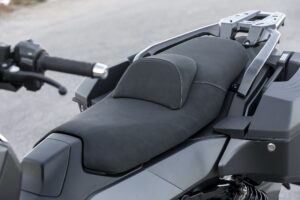 For me, one of the TTLBT’s most important advantages is its spacious riding position. Unlike on the smaller Cruisym 400, there was plenty of room in front of my knees. At my height of 183 cm, I measured approximately five to eight centimetres of clearance, depending on how I positioned myself on the seat.
It also features a three-position adjustable lumbar support located between the rider’s and passenger’s seating areas. On the test bike, this was set to its rearmost position, which worked best for me. I could comfortably keep my feet in a conventional, more upright scooter riding position or stretch my legs forward. The latter creates a particularly pleasant, relaxed posture. There is one thing worth mentioning, though: I actually found the Cruisym 400 slightly more comfortable. The TTLBT’s seat is a little firmer and less armchair-like. That isn’t necessarily a disadvantage. Over longer distances, firmer support might even prove preferable, but I can’t determine that from a single day of riding.
The 780 mm seat height is pleasantly low for such a large machine. Thanks to its centre of gravity, I could hold it securely when stopping. The passenger also gets a generously sized seating area, which could provide a good foundation for two-up touring.
Plenty of Features, Simple Operation
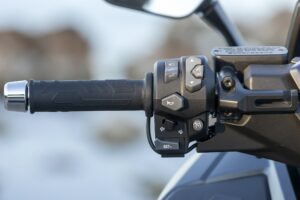 The TTLBT features a seven-inch colour TFT touchscreen with Apple CarPlay connectivity. Several display layouts are available, along with day and night modes. Four-level heated grips are also included as standard equipment. Despite the sheer number of electronic functions, I think SYM has managed to keep the controls reasonably straightforward.
The left-hand switchgear contains more buttons than on the smaller Cruisym, but you become familiar with them relatively quickly. The main functions are accessed using a central selector button, and the same switches can be used to adjust things like the windscreen or heated grips. The buttons are well shaped and positioned, and I could find them while riding without having to look down very much. Overall, I didn’t feel that operating all these features distracted me from riding. Unfortunately, I often encounter motorcycles where manufacturers have included so many menus and settings that riders have to spend ages searching for even the simplest functions. The TTLBT, by contrast, became understandable quite quickly. It has good functional ergonomics, or something along those lines…
Touring Motorcycle or City Scooter?
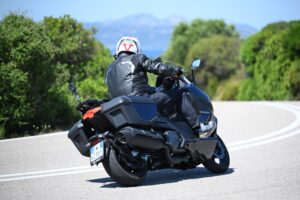
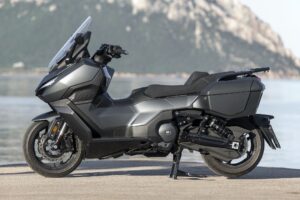
The TTLBT adapts easily to both roles. The price of centrally mounting the engine is that under-seat storage is smaller than on conventional scooters. According to the manufacturer, the compartment has a capacity of 37 litres, enough to accommodate one helmet. To compensate, SYM provides two side cases that blend neatly with the motorcycle’s design. One has a capacity of 14.4 litres, the other 13.6 litres. Together with the under-seat compartment, that gives a total luggage capacity of 65 litres. That’s already a very useful amount of storage. What’s more, the side cases are easy to remove. Their locking mechanism is accessed beneath the seat. With just a few movements, they can be lifted off the motorcycle and refitted just as easily. The scooter doesn’t look ugly or unfinished without them, either. It retains its clean, fully enclosed appearance, effectively giving us two different configurations.
During the week, when commuting to work, you remove the side cases and have a relatively narrow maxi-scooter that’s easy to manoeuvre. At the weekend, you put the cases back on, pack your belongings and head off on a tour. Of course, the motorcycle becomes significantly wider with the cases fitted. They extend a little further out than the handlebars, but that’s a reasonable compromise when touring. A top case can also be mounted on the rear luggage rack.
The TTLBT has a 16-litre fuel tank, providing a good foundation for longer journeys. With its wind protection, cruise control, heated grips, spacious seating and luggage capacity, I could easily imagine taking it on a multi-day or even week-long tour.
One More Thing: The Mirrors
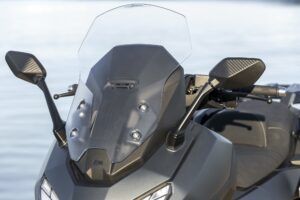 Unlike on the Cruisym 400, I was completely satisfied with the positioning of the mirrors on the TTLBT. The mirror surfaces are large and slightly convex, providing a sufficiently wide field of view. This time, I could clearly see the traffic approaching from behind. The designers have positioned the mirrors a little further out, which I think was a good decision. On a motorcycle with this level of performance, intended for country-road riding as well as urban use, good rearward visibility is particularly important. And the width of the mirrors didn’t make the motorcycle difficult to handle even in narrower spaces.
What Was It Like Riding in Sardinia?
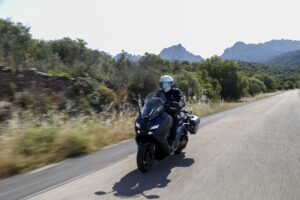
I thoroughly enjoyed linking together the same corners I’d ridden on the Moto Guzzi Mandello a year earlier. I didn’t feel that anything was missing. Sardinia remained one of my favourite islands even on this scooter, despite the fact that I’m not particularly devoted to scooters in general. I enjoy changing gears, I love the character of conventional motorcycles, and I appreciate that feeling of being completely in tune with a good machine on a winding road. But the TTLBT showed me that an automatic transmission and scooter-style construction don’t necessarily mean sacrificing that experience. And in everyday life, it offers a number of advantages that conventional motorcycles can’t always provide.
Conclusion
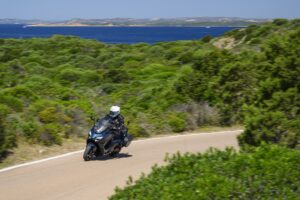 The SYM TTLBT 508 is a very interesting motorcycle. It combines the comfort and practicality of traditional maxi-scooters with the suspension, performance and electronic equipment of a more serious motorcycle. The parallel-twin engine provides convincing performance even on country roads, the suspension is stable, and the handling is predictable. Cruise control and the electric windscreen also make it particularly well suited to longer journeys. I especially liked the luggage system and the ability to use the scooter in two different configurations. Without the cases, it’s an urban maxi-scooter. Fit them, and it becomes a genuinely capable touring machine.
Of course, there are compromises. At 241 kg, it isn’t light. The chain drive requires more maintenance than the enclosed transmission of a conventional scooter, and I found the seat slightly firm. I wasn’t impressed by the initial brake lever feel either, although some adjustment made it acceptable. Long-distance comfort, actual fuel consumption, and riding with a passenger and luggage would naturally need to be tested separately.
Overall, the TTLBT made a very positive impression on me. It’s one of the most interesting maxi-scooters I’ve encountered recently, and I could easily imagine making room for one in my garage. This motorcycle introduced me to the pleasures of Mediterranean scooter touring. A good motorcycle, a few beautiful winding roads, a pleasant coffee, and a little relaxation at the end of the day. That’s a lifestyle I could get used to very easily – on a TTLBT, for instance.
The Hungarian importer lists the 2026 TTLBT at HUF 3,990,000 (around €10,000), excluding registration tax and on-road registration costs. That’s a substantial amount of money, but its equipment should also be considered when comparing prices. Cruise control, cornering ABS, the electrically adjustable windscreen, heated grips and side cases are all included in the TTLBT’s standard equipment.
This review was produced during a press event organised by SYM.
Watch the Video Review Here: