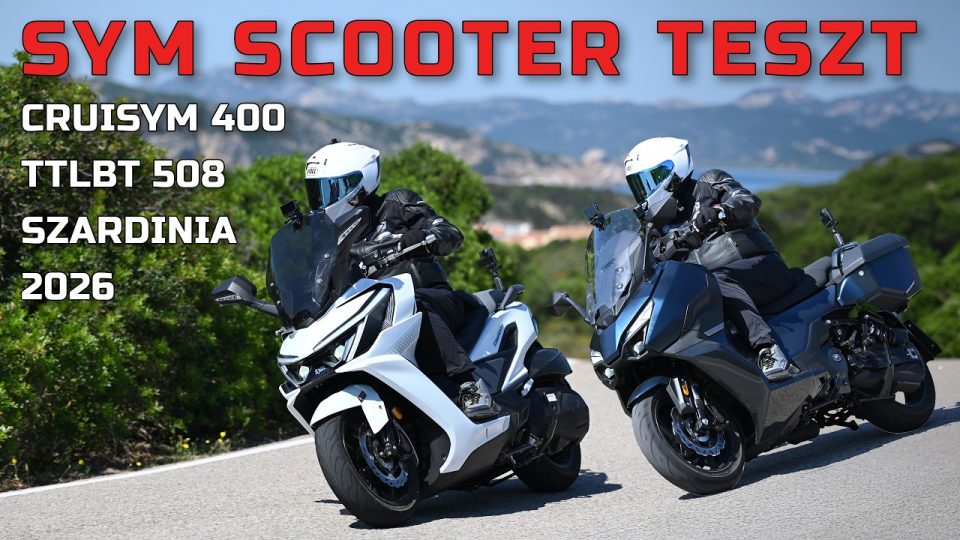
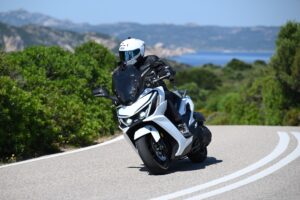
Riding in Sardinia is always a special experience. Wonderful winding roads, beautiful coastlines, excellent coffee and that distinctive Mediterranean atmosphere that makes you forget you’ve actually come here to work. This time, I travelled to Olbia to test two new maxi-scooters from Taiwanese manufacturer SYM. First up was the Cruisym 400, a machine primarily designed to make everyday transport comfortable and convenient. But on Sardinia’s winding roads, it quickly became clear that it had considerably more potential than that.
SYM might not be as familiar a name in Hungary as some Japanese or European manufacturers, but it’s a major scooter producer. Taiwanese company Sanyang Motor has been involved in motorcycle manufacturing since the 1960s and now operates in numerous countries around the world. The brand is particularly strong in Southern European markets, where scooters are an integral part of everyday transport. Sandlander has been SYM’s official Hungarian importer since 2024.
The Cruisym 400 is one of SYM’s larger, more comfortable scooters. At first glance, it’s a modern maxi-scooter with bold styling but an essentially conventional design. It promises to be a practical everyday commuter during the week and an enjoyable companion for weekend trips. Let’s see how well it delivers on those promises!
Is 34 Horsepower Enough for Sardinia’s Winding Roads?
 On the morning of the test, I quickly packed my equipment into the scooter, and we were off. Somehow, I ended up directly behind the ride leader, which suited me perfectly. At least I wouldn’t have to ride at the back of a long group, although I soon discovered that keeping up with Italian scooter riders isn’t always easy.
The Cruisym 400 is powered by a 399cc, liquid-cooled, four-stroke single-cylinder engine. According to the manufacturer, it produces 25 kW, or approximately 34 hp, at 6,750 rpm, with maximum torque of 37 Nm at 5,000 rpm. Power is delivered through a conventional CVT automatic transmission. At first, that level of performance might not sound particularly impressive, especially if you’re accustomed to larger motorcycles. But on the winding roads, it quickly became clear that it was anything but inadequate. You do have to ride it appropriately, though. On a scooter like this, it’s best to carry momentum through corners and maintain your speed whenever possible. After all, there aren’t a hundred horsepower waiting at the exit of a bend to recover any speed you’ve lost with a single twist of the throttle. But that’s exactly what makes riding on Sardinian roads so enjoyable. You don’t need to accelerate furiously along every straight and brake heavily before the next corner. Instead, you link the bends together smoothly, preserve your momentum and let the motorcycle do its job.
I have to admit, during the first few kilometres, I couldn’t decide whether the Cruisym was really this good or whether riding in Sardinia was simply that enjoyable. It was probably a combination of both. In the city, 34 horsepower is already more than enough. You can easily pull away ahead of cars at traffic lights, accelerate and overtake comfortably in traffic, and the automatic transmission is particularly convenient when speeds are constantly changing. On country roads, overtaking requires a little more planning, but for normal touring speeds, the engine has perfectly adequate power.
Surprisingly Easy to Handle
 The Cruisym 400 has a manufacturer-quoted weight of 222 kg, which sounds fairly substantial. Once I started riding, however, I barely noticed it. The scooter has a low centre of gravity, making it feel considerably lighter than the specifications would suggest. Its cornering ability was a particularly pleasant surprise. It responds willingly to even small shifts in body weight, follows countersteering inputs naturally and can be tipped quickly from one side to the other. The handlebars are relatively narrow, yet there’s no need to wrestle with them. The whole machine is easy to control and moves naturally beneath the rider. This is particularly important because I believe a scooter like this should excel primarily in everyday use. Anyone who buys one will probably use it frequently for commuting, shopping or running errands around town. In those situations, being able to manoeuvre easily between lines of cars makes a huge difference. The Cruisym’s narrow construction helps considerably. In Olbia’s traffic, I found several times just how nimbly it threads through. The sufficiently powerful engine, automatic transmission and low centre of gravity combine to make it a genuinely practical urban vehicle.
The suspension didn’t disappoint either. At the front, there’s a 41 mm telescopic fork, while the rear uses two adjustable shock absorbers. The 15-inch front wheel and 14-inch rear are quite respectable sizes in the scooter world. On Sardinia’s relatively good roads, the suspension absorbed smaller imperfections nicely, and I didn’t experience any unpleasant wallowing or instability in corners. I’d still like to test it over Hungary’s potholes before reaching a final conclusion about its ability to absorb bumps, but my initial impression was definitely positive. There is, however, one limitation when it comes to sportier riding. When I really started leaning the scooter over, some of its components quickly began scraping the tarmac. That’s hardly surprising for a machine of this design, but on Sardinia’s beautiful bends, it occasionally forced me to restrain my enthusiasm.
I was satisfied with the brakes. At the front, there’s a 288 mm disc with a radially mounted four-piston caliper, while the rear uses a 275 mm disc. The brake lever felt firm, with a clearly defined biting point. I particularly liked that because I could feel precisely when the brakes began to engage. Safety equipment includes dual-channel Bosch ABS and traction control, which can also be switched off. With this level of power, traction control might not be the most essential extra, but it could prove useful on slippery roads or in the rain.
A Sofa on Two Wheels
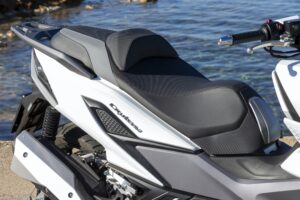 Comfort is one of the most important qualities of a maxi-scooter, and in this respect, the Cruisym 400 performed particularly well. Its seat is soft, wide and nicely padded. Between the rider and passenger sections, there’s a lumbar support adjustable to three different positions. Adjusting it requires repositioning the mounting screws beneath the seat, so it isn’t something you can change while riding. Nevertheless, it allows you to tailor the seating position to your body to some extent. I’m 183 cm tall, with fairly average proportions. With the lumbar support in its rearmost position, I had just enough room to sit comfortably. There was approximately one centimetre of clearance between my knees and the front storage compartment. That was sufficient, but someone considerably taller than me might find the space rather cramped.
I could position my legs in two different ways. In the conventional scooter riding position, they rested relatively naturally beneath me. Alternatively, I could stretch them forward into a more relaxed, cruiser-style posture. Trying the latter, I practically sank into the seat. A proper armchair-on-wheels experience. After approximately fifty kilometres, I still found it comfortable, although naturally that isn’t enough to draw conclusions about comfort over an entire day of touring. Thanks to the 785 mm seat height and low centre of gravity, the scooter is also easy to manage when stopping. I could place both feet firmly on the ground, and the 222 kg weight caused no particular difficulties.
The windscreen height can be adjusted without tools. You simply grip it with both hands and slide it upwards or downwards. Naturally, this can’t be done safely while riding, but when stationary, it only takes a few seconds. I didn’t examine the effect of the different windscreen positions in enough detail on this scooter to say exactly how much turbulence each one created around my helmet. Nevertheless, the ability to adjust the windscreen is a useful feature, particularly for riders who regularly travel on country roads.
Little Ideas That Make Life Easier
 The Cruisym 400 is essentially a conventional scooter, but it has a few technical features that I particularly liked. One is the parking brake linked to the side stand. When you lower the side stand, the mechanism automatically applies the rear brake. This prevents the scooter from simply rolling forward when parked. It’s a very practical idea. After all, scooters don’t have a gear you can leave engaged when parking, making a parking brake especially useful.
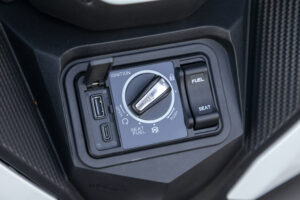
Another favourite of mine was the keyless system with NFC technology. One inconvenience of conventional smart keys is that when their batteries run flat, you need some kind of backup solution. Here, however, the key contains a passive NFC chip that works even without a battery. By holding it against the appropriate sensor, you can still operate the system. These are the little details that might not sound revolutionary on their own but can make a motorcycle particularly enjoyable to live with.
The dashboard features a seven-inch colour TFT display with three different layouts and day/night modes. The scooter also has a tyre pressure monitoring system, and the display supports smartphone connectivity. During the test, however, I missed having a more comprehensive trip computer. Searching through the menus, I couldn’t find an average fuel consumption figure, for example. On a vehicle that’s likely to be used frequently for everyday transport, I’d consider that useful information. I also have another long-standing complaint about modern displays. It would be nice if manufacturers occasionally considered those of us who already use reading glasses. Personally, I’d love a display mode that simply uses larger letters and numbers. All those tiny pieces of information might look impressive, but if I can’t read them easily while riding, they aren’t much use to me.
Otherwise, the controls are pleasantly straightforward. They aren’t unnecessarily complicated, the important switches are easy to find, and you don’t need to take a special training course to understand how everything works. The Cruisym also has two built-in cameras. One faces forward and the other rearward, and both can record riding footage in 1080p resolution. Live images from the cameras can also be displayed on the dashboard. The equipment list is completed by USB-A and USB-C charging ports and LED lighting.
Storage Space Matters on a Scooter
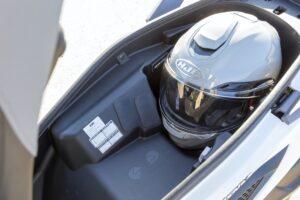 One of the Cruisym 400’s strongest practical arguments is its under-seat storage. The Hungarian importer quotes a capacity of 42 litres, which is genuinely useful. The large compartment may even accommodate two helmets, although the exact sizes that fit naturally depend on their design. Before the test, I had no trouble packing a substantial portion of my equipment into it. There are also additional smaller storage compartments in the front bodywork, which are especially useful for everyday commuting.
The 14.5-litre fuel tank also sounds promising. I didn’t carry out an accurate fuel consumption test, so I don’t want to speculate about the scooter’s range. Nevertheless, a tank of this size should provide a reasonable foundation for trips beyond the city.
I wasn’t satisfied with the mirrors. They’re large, slightly convex and provide good visibility to either side. Unfortunately, my own arms occupied a substantial portion of the reflection, so I couldn’t see directly behind me properly. I’d position them a few centimetres further out. Of course, that would come at a price: the scooter would become wider, making it more difficult to manoeuvre between cars.
Commuting or Touring?
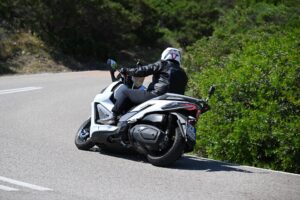
I think the Cruisym 400’s greatest strength is that it could be suitable for both. During the week, you can use it effortlessly around town. The automatic transmission eliminates the need to change gears, the generous storage compartment accommodates everyday belongings, and the low centre of gravity and manageable suspension make manoeuvring easy. Then the weekend arrives, and there’s nothing stopping you from heading out on a pleasant ride. With the right packing arrangements, I could even imagine taking it on a multi-day tour.
There’s a reason I enjoy this side of scooter riding. People in Mediterranean countries understand very well how pleasant it is to travel in a way that makes life’s other pleasures easily accessible along the way. Stopping for a coffee, admiring the scenery, or simply enjoying the journey. Of course, I’d still do all of that wearing proper motorcycle protective equipment, however tempting the relaxed clothing habits of southern countries might seem. For me, the Cruisym 400 represents exactly this kind of effortless motorcycling. It doesn’t pretend to be a sportbike, doesn’t try to make riding unnecessarily complicated, and doesn’t attempt to solve problems that don’t really need solving.
Conclusion
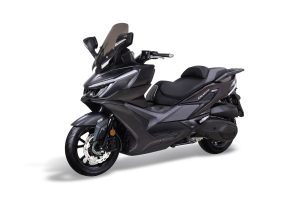 The SYM Cruisym 400 was a pleasant surprise. Above all, I was impressed by how naturally and effortlessly it handles, and how well it balances practicality with riding enjoyment. I liked the usability of the single-cylinder engine, the easy cornering, the low centre of gravity, the comfortable seat and the straightforward controls. The built-in cameras, NFC key and side-stand-operated parking brake are also ideas I’d be happy to see on more motorcycles.
I’d change the position of the mirrors, I’d like more information and larger text on the display, and the available lean angle is somewhat limited for enthusiastic cornering. Even with these shortcomings, the Cruisym 400 proved to be a very capable and versatile scooter. I’d recommend it to riders who primarily want a practical, comfortable means of transport but don’t want to give up the pleasure of heading out for a ride on a beautiful weekend morning.
At the time of the test, sales of the model had already begun in Hungary. The Hungarian importer listed the 2026 model at HUF 2,490,000 (around €6,200), excluding registration tax and on-road registration costs.
This review was produced during a press event organised by SYM.
Watch the Video Review Here: