How I Went from Unusable Luggage Systems to SW-Motech
 Packing for a motorcycle tour isn’t quite as simple as it might seem at first. Especially when you’re heading off for several weeks, planning to camp and taking the equipment of a small film studio along with you. That’s when you quickly discover that a good motorcycle luggage system involves much more than simply having somewhere to throw your belongings.
Over the years, I’ve tried all sorts of solutions. I’ve had some bags that worked extremely well, others that were practically useless, and even a top box mounting bracket that broke four times under the weight of my luggage. These days, I use almost exclusively SW-Motech bags and cases, but it took a long journey to develop this much confidence in a single manufacturer’s products.
The story began with my Honda NC750S and continued with the BMW F900R. Along the way, I rode through Norway, completed quite a few longer tours and gradually developed the luggage setup I now trust for even a multi-week journey involving camping and filming.
A Top Box Mount That Broke Four Times
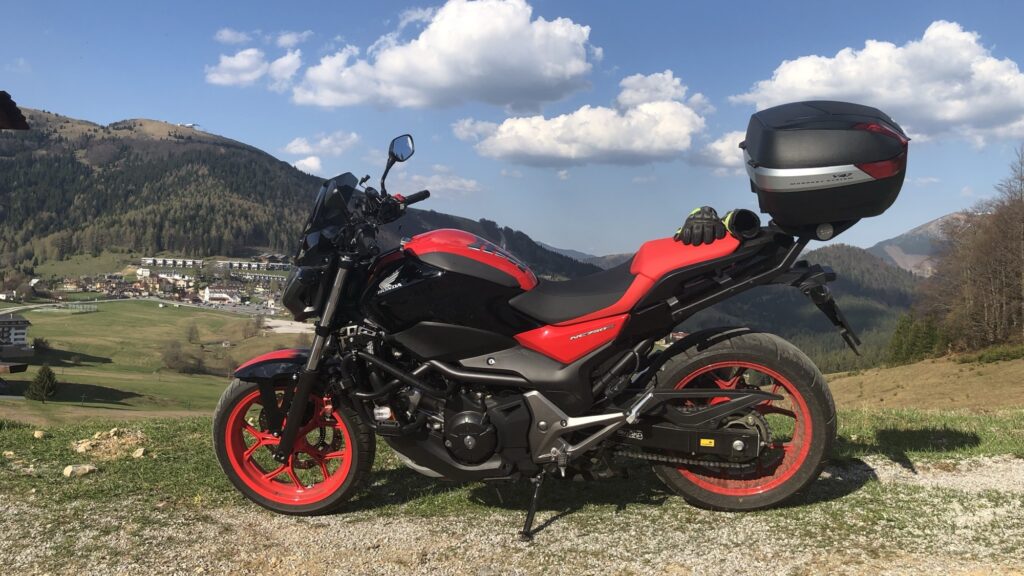 I bought my first serious motorcycle luggage system for my Honda NC750S DCT. I chose a top box from a well-known Italian manufacturer, together with its mounting bracket, which the dealership fitted to the motorcycle. At the time, I had relatively little riding experience, so I naturally assumed that if something was designed for a particular model and installed by a motorcycle dealership, it would work properly. Then I started noticing some strange behaviour. The motorcycle would occasionally begin to weave through corners. The handlebars moved from side to side, and the bike felt unpleasantly unstable. It took months before I connected this behaviour with the top box.
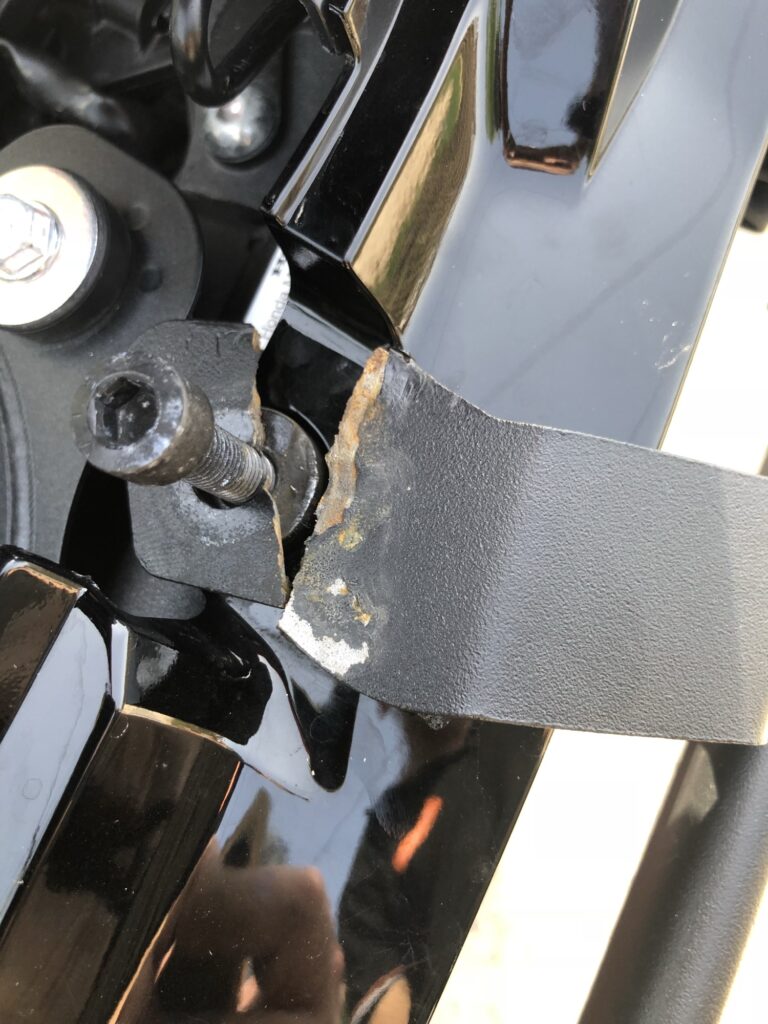 When I finally started examining the mounting system more carefully, I was shocked to discover that one of the bracket’s mounting tabs had broken. I removed it, took it to a friend who welded it back together, and then reinstalled it. Even then, I noticed something wasn’t quite right with its design. The mounting points on the bracket didn’t line up precisely with the holes on the motorcycle. To fit it, I had to force the entire structure into position. No wonder it broke.
The problem returned on the next tour, and the bracket broke again. Then again. In total, it broke four times, each time in a different place. The only part that remained intact was the section we’d previously welded. To make matters worse, the motorcycle’s unpleasant weaving continued even when the bracket wasn’t broken. This led me to suspect that the aerodynamics of the top box or the distribution of its weight might also have been adversely affecting the bike’s handling. Eventually, I’d had enough of the whole thing.
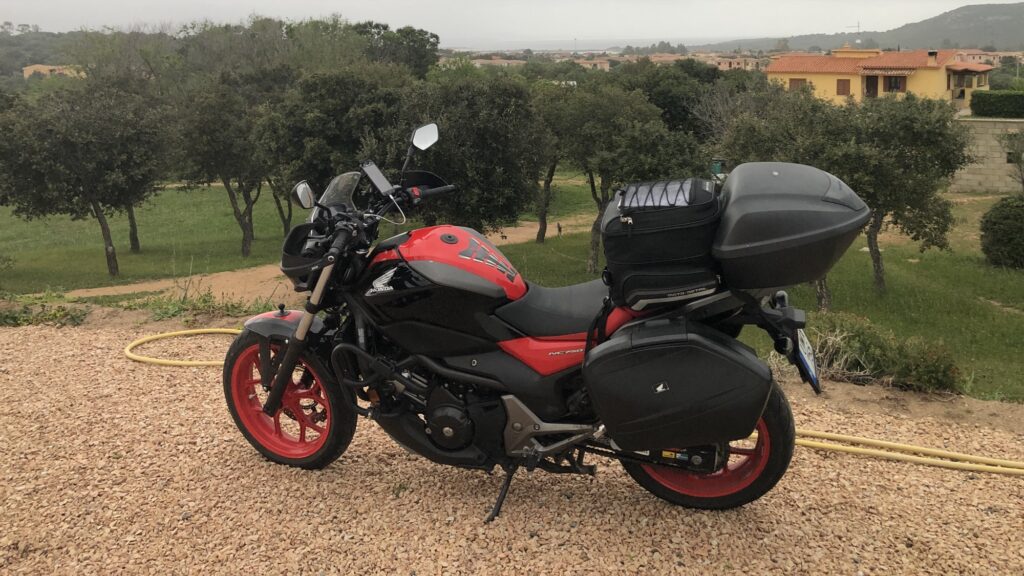 I sold the box, threw away the bracket and decided that from then on, I’d only buy genuine manufacturer accessories. Surely the motorcycle manufacturer would know exactly how to design a suitable luggage system for its own models. At least, that’s what I thought at the time. So I bought a complete set of genuine Honda luggage, with two side cases and a top box. And would you believe it? All the unpleasant handling characteristics disappeared. The motorcycle became stable and predictable, and I no longer had to wonder whether something would break again in the next corner. That solved the luggage problem on the Honda NC.
BMW’s Genuine Luggage Didn’t Live Up to All My Expectations Either
When I replaced the Honda with a BMW F900R, I already had a clear idea of how I wanted to carry my luggage. I didn’t want to experiment with aftermarket systems of uncertain quality again, so I ordered BMW’s genuine side cases and top box, complete with their mounting brackets. The top box arrived first, and it proved to be exceptionally well made. I even completed the Héthatár Tour with it. Once, I managed to fit it incorrectly, causing it to fall off and get lost, but fortunately I found it a day later. Despite the enormous impact and the excessive load, it suffered nothing worse than a few scratches. To this day, it opens and closes just as smoothly as when it was new. That, to me, is exactly the quality I’d expect from BMW.
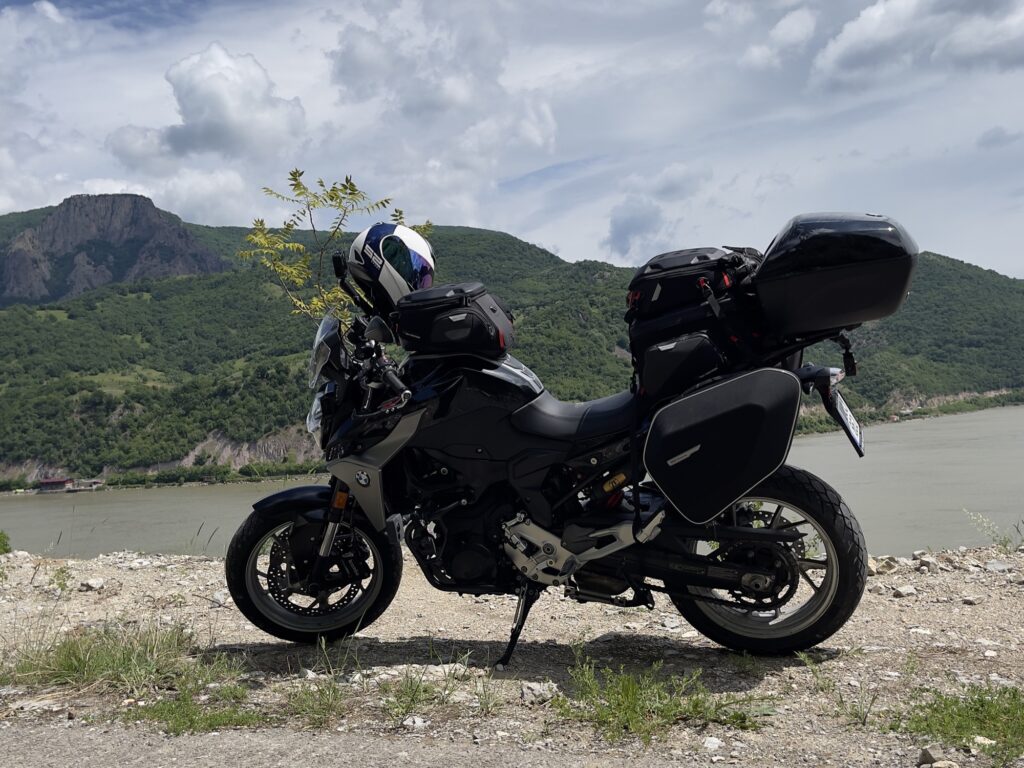 Then the side cases arrived. As soon as I picked them up, I could tell they somehow didn’t offer the same level of quality as the top box. But since I’d ordered them, I didn’t want to put the dealership in an awkward position, so I took the set home. There, I tried turning the lock on one of the cases. Nothing happened. No matter what I tried, the locking mechanism wouldn’t move. Eventually, I removed its cover and discovered that during assembly, a component intended for the left-hand lock had been installed in the right-hand one. The two side cases are mirror images of each other, and certain components of their locking mechanisms differ accordingly. Somehow, mine had been assembled with a part from the wrong side. There was simply no way that lock could ever have worked.
What shocked me most was that apparently nobody had tested the case after assembly. All they needed to do was turn the key once, and the problem would have been immediately obvious. I waited a month for the replacement part. Eventually, I could finally start using the side cases, but I still wasn’t satisfied. They weren’t waterproof, and although they could be locked to the motorcycle with a key, the bags themselves could be opened with ordinary zips. I still don’t really understand that design. You couldn’t simply lift the bags off the motorcycle, but anyone could access their contents. What’s more, the overall construction, material quality and usability were, in my opinion, completely out of proportion to their price.
I used them for almost two years, but I never really grew to like the set. Eventually, I sold them at a substantial discount. Once again, I found myself with a beautiful motorcycle, an excellent top box and no way to carry luggage on the sides. For a while, I tried using my Mosko Moto off-road touring bags on the BMW. They looked particularly good on the bike, but for everyday use, they felt a little too basic and expedition-oriented for my needs. I wanted something more convenient, better thought out and more durable.
It All Started with a Tank Bag
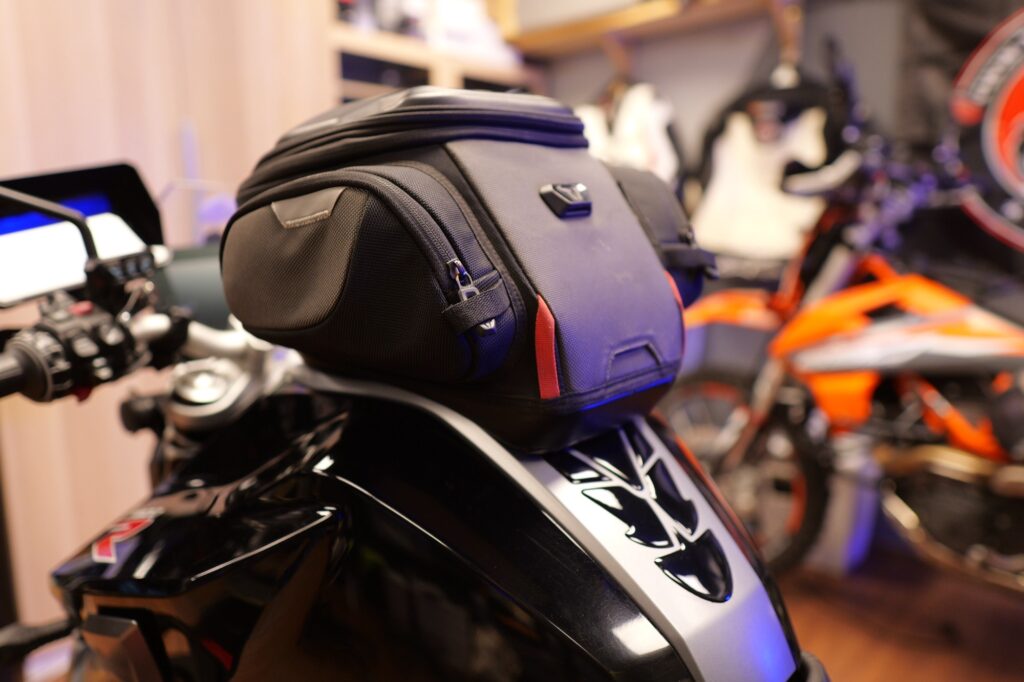 I first became properly acquainted with SW-Motech products at the HP Motor shop. The first thing I bought was a simple tank bag that attached mechanically to a ring mounted around the fuel filler cap. However, I quickly realised that the size I’d chosen was too small for my needs, so I went back and bought a larger one. This was the SW-Motech PRO City, featuring the manufacturer’s magnetically guided PRO tank ring system. It’s extremely simple to use. I position the bag over the tank ring, the magnets guide it into the correct position, and a mechanical latch locks it in place. To remove it, I simply pull a small red cord, and the bag lifts straight off.
What I really came to love was the number of small, carefully considered details. There are two practical pockets on the sides and a separate zipped compartment in the lid, where I keep the rain cover. The zip pulls can be secured with small retainers to stop them flapping in the wind, while the release cord can be tucked away and secured so it can’t accidentally become trapped between the bag and the tank ring. The interior layout is equally practical. For example, I can fit my spare clear helmet visor against the side wall, where it takes up hardly any space that could otherwise be used for other equipment.
The PRO City isn’t inherently waterproof, but it has survived lighter showers without any problems. In heavier rain or prolonged wet weather, I pull its supplied rain cover over it. I bought this tank bag approximately five years before making the video, and I’ve been using it regularly ever since. Not a single seam has torn, none of the zips has broken, and the mounting mechanism still works perfectly. I’ve noticed only one minor change: one of the elastic loops that secures a zip pull has stretched slightly over the years. That’s pretty much everything that has happened to it in five years.
Since then, I’ve also bought a smaller tank bag that’s waterproof by design, but because of its size and practicality, I still frequently choose the PRO City. This tank bag was the first SW-Motech product I owned that proved completely reliable over an extended period. Afterwards, I gradually bought more and more accessories from the brand, developing the confidence that now plays a major role in my purchasing decisions.
Roadpack and Rearbag – When Bags Work Together
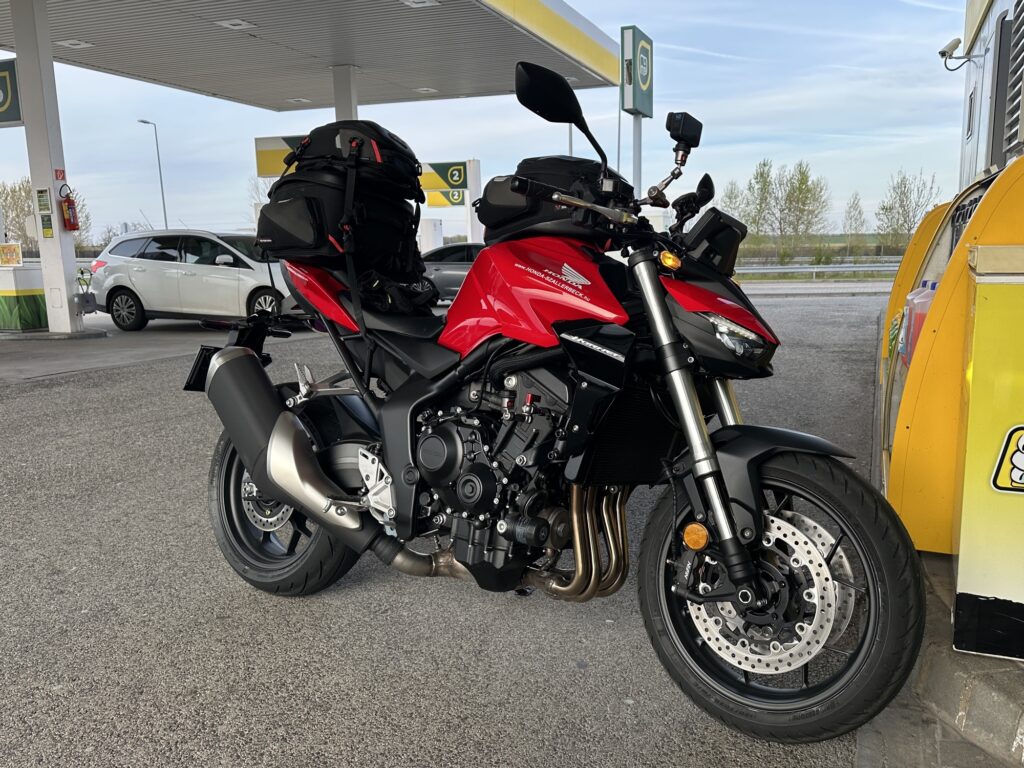 My next two SW-Motech products were the Roadpack and Rearbag rear bags. Both are soft luggage solutions that can be secured to the motorcycle’s pillion seat or luggage rack. What I find particularly interesting is that they can be used individually or combined with each other. The smaller Roadpack is perfect for a shorter ride. It can hold a few cameras, spare batteries, a sandwich or a drink. If I’m only heading out for a few hours, it generally provides enough space together with the tank bag. I like simple arrangements like this. There’s no point mounting three enormous cases on a motorcycle when you only want to carry a few small items.
The larger Rearbag can provide enough space for a one- or two-day tour, particularly if you’re not taking camping equipment. What’s more, the two bags can be stacked together. The smaller Roadpack can be strapped onto the top of the Rearbag, creating a two-tier luggage system. Both bags also have expandable capacity. By opening the appropriate zips, the available space can be increased considerably. I’ve already completed a three-day trip using this combination. The tank bag, Rearbag and Roadpack together provided more than enough room for my equipment.
Their mounting system is extremely practical too. They can be fitted quickly using strong hook-and-loop straps routed beneath the pillion seat, although separate straps with hooks can also be attached to the loops on the sides of the bags. For example, I took the smaller Roadpack with me to the Kawasaki KLE500 press launch in Spain. I simply removed the test bike’s pillion seat, joined the bag’s hook-and-loop straps underneath it, and refitted the seat. The Japanese Kawasaki staff looked on in surprise at how easily I’d solved the luggage problem.
While the other journalists were struggling with backpacks, I comfortably secured my cameras and spare batteries on the motorcycle’s pillion seat. It’s little things like this that make me appreciate well-designed motorcycle equipment.
Why Do I Use Waterproof Inner Bags?
The Roadpack and Rearbag aren’t completely waterproof, but that’s never particularly bothered me. Years ago, I developed a packing method that works extremely well for me. I organise my belongings into waterproof inner bags of different sizes and colours, then simply place them inside the motorcycle luggage. This solves two problems at once. Firstly, my equipment stays dry, and secondly, it’s much easier to find whatever I’m looking for. If I need a clean pair of socks, for example, I don’t have to unpack everything. I know exactly which coloured bag contains the socks, which holds the T-shirts and which contains the various electronic accessories.
Over the years, I’ve accumulated quite a collection of these bags. Different sizes, different colours, different purposes. In fact, I’ve reached the point where I even keep my waterproof organising bags inside a larger waterproof bag. Perhaps that’s taking things a little too far, but at least everything is organised.
Norway Was the Real Test
One of the luggage system’s most demanding tests was my 23-day tour of Norway. I set off with a substantial amount of equipment, including clothing, filming gear, cameras, batteries, a tent, sleeping equipment, a stove, a gas canister and various other camping essentials. At the time, I was using the BMW’s genuine top box and side cases, with the Rearbag and Roadpack stacked together on the pillion seat. Naturally, the PRO City tank bag was mounted at the front. I secured some of the camping equipment to the tops of the side cases using elastic bungee cords. It was quite an impressive load, but everything I needed fitted on the motorcycle.
And it rained an enormous amount in Norway. I spent much of the trip riding in wet conditions, often for several consecutive days. However, the waterproof inner bags performed brilliantly. None of the equipment stored inside them ever got wet. That journey confirmed my belief that outer luggage doesn’t necessarily have to be completely waterproof in every situation if the contents are packed appropriately. Of course, an inherently waterproof bag can be more convenient, especially when you need frequent access to its contents. But I still like my waterproof inner-bag system, and I now use it even when the outer case is perfectly waterproof, because organisation is at least as important as protection from the rain.
Soft Luggage on a Naked Bike
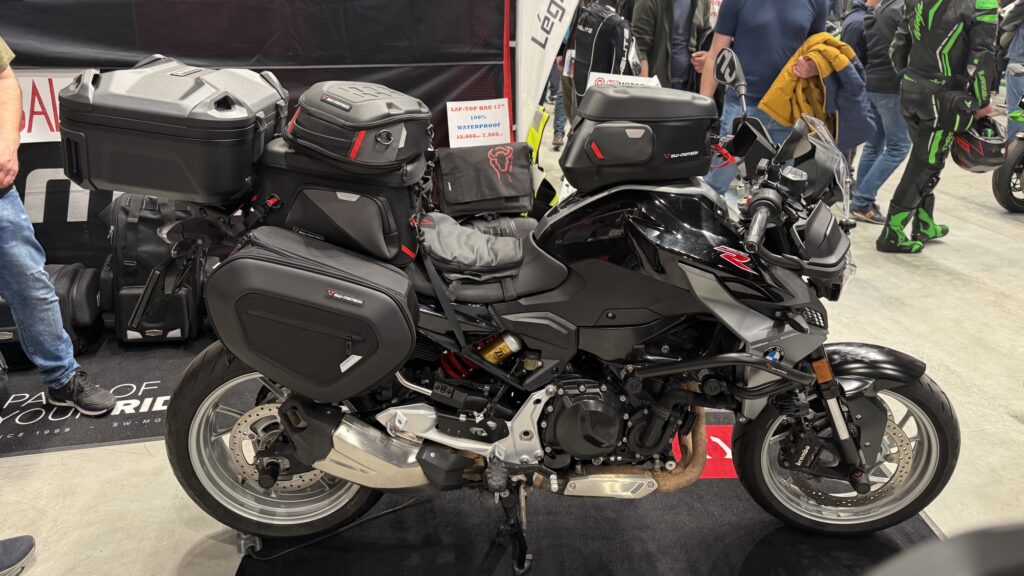 The BMW F900R is fundamentally a naked motorcycle, for which most manufacturers tend to recommend smaller, lighter luggage systems. SW-Motech offers solutions like these too. The Blaze side bags, for example, suit the motorcycle’s character particularly well. They’re soft bags that attach to a cleverly designed, removable side support system. Only a couple of relatively small mounting points remain on the motorcycle, and the support arms can be fitted to them in just a few movements whenever needed. The bags slide onto these supports and are held in place by a hook-and-loop connection across the top and additional securing straps. When I don’t need the bags, I can remove the support arms at the press of a button, and the motorcycle almost completely regains its original appearance. I think that’s an excellent design.
The same modularity can be seen in the rear luggage rack. A relatively discreet base bracket remains on the motorcycle, and different adapters can be fitted to it. One adapter allows a hard top box to be mounted, while another accommodates a soft bag. The appropriate mounting plate can be swapped in just a few moments, allowing the same motorcycle to be adapted for different trips.
The SW-Motech Rackpack rear bag, for example, can be a very practical addition to the Blaze side bags. Its capacity is expandable, it features various external attachment points, and MOLLE-compatible accessories can also be mounted on top. This combination allows a substantial amount of equipment to be carried while keeping the motorcycle’s appearance relatively light and uncluttered. I understand riders who don’t want to spoil the appearance of a beautiful naked bike with huge, bulky luggage cases.
I see things differently, though. For me, the BMW F900R is primarily a versatile, enjoyable motorcycle that I like riding in the city, on country roads and on longer tours. I want my luggage options to reflect that versatility. And personally, I think it looks particularly good with large cases too.
The DUSC Cases Finally Gave Me What I’d Been Looking For
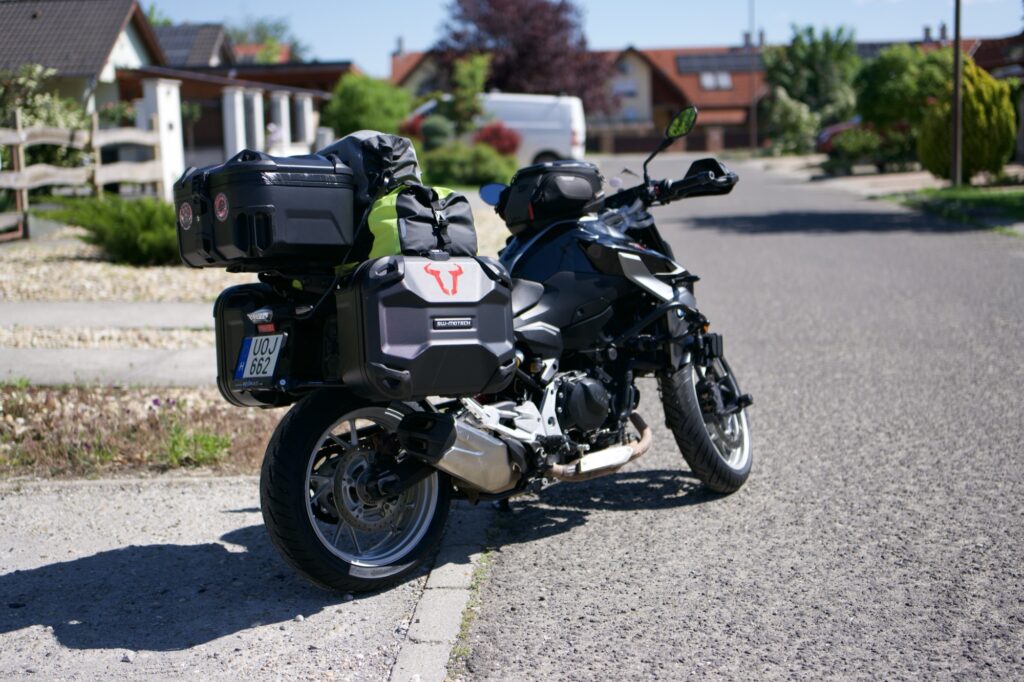 What I find particularly interesting about SW-Motech’s DUSC system is the way it attempts to combine the practical advantages of hard cases and soft luggage. The DUSC cases are made from rigid, durable plastic, feature lockable, waterproof construction and can be mounted in different positions using various carrier systems. The smaller case, for example, can be used either as a side case or a top box, provided you have the appropriate adapters.
I particularly like that flexibility. If I’m simply commuting to work and only need to carry a laptop, some spare clothing and a few small items, I don’t need an enormous luggage system. I just click a smaller DUSC case onto the rear carrier, and I’m ready to go. The motorcycle remains relatively narrow, and the case doesn’t particularly spoil its appearance. But when I’m setting off on a longer tour, I can move the same case to one of the side carriers, mount another one on the opposite side and fit a larger DUSC at the rear.
The DUSC L has a capacity of 41 litres, while the smaller DUSC M holds 33 litres. A combination of two smaller side cases and one larger top box therefore provides a total luggage capacity of 107 litres. That’s an enormous amount of space, especially on a naked motorcycle. Of course, capacity isn’t everything. You also have to consider the permitted load, how the weight is distributed inside the cases and its effect on the motorcycle’s stability. With a setup like this, it’s particularly important to position heavier items as low as possible and close to the motorcycle’s centreline.
For me, the biggest advantages of the DUSC cases are their modularity and mounting system. Once the appropriate brackets are fitted, the cases can be attached or removed in just a few movements. Some elements of the carrier system can also be removed quickly, so when I don’t need side cases, I don’t have to leave the entire mounting structure on the motorcycle all year round. This is exactly the kind of thoughtful design I’d been looking for.
One Key for the Entire Luggage System
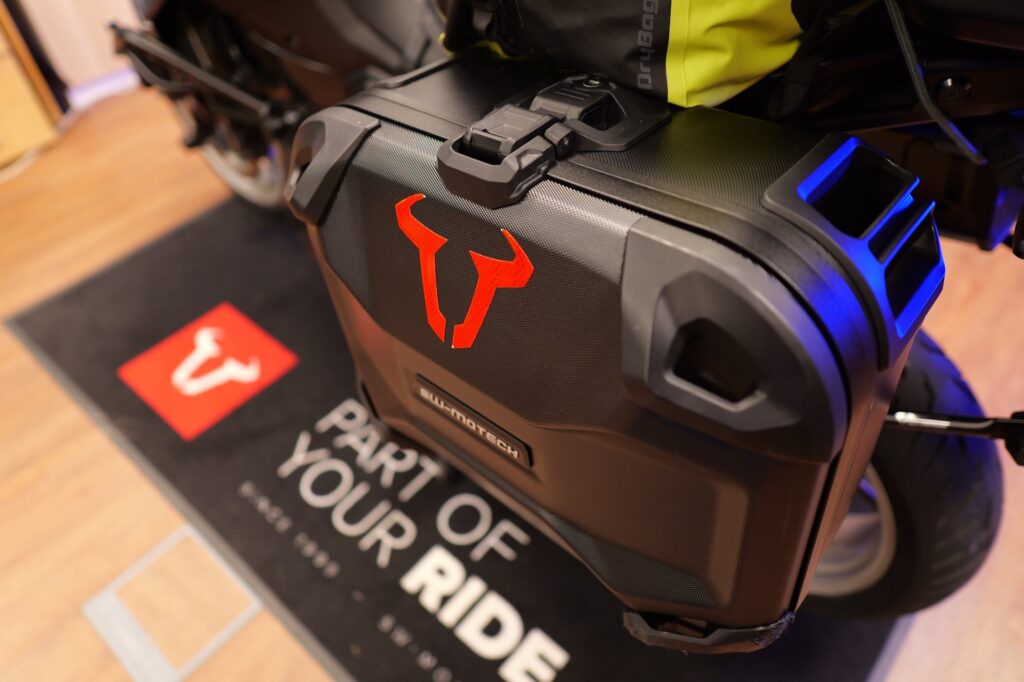 Another major advantage of the DUSC system is its unified locking arrangement. SW-Motech offers a lock set that allows the various cases, toolboxes and mounting components to be operated with a single key. I chose this system too, so the same key opens and locks my top box, both side cases, the toolboxes and the locks on the removable carrier brackets. It might sound like a small detail, but on a tour, not having to struggle with five or six different keys makes an enormous difference. What’s more, the cases aren’t just locked to the motorcycle; their contents are also protected against casual access. Naturally, no luggage system is completely immune to theft if someone has the right tools and enough time. But the locks provide useful protection against opportunistic theft.
The interior design is also very refined. The cases have a soft inner lining, there’s a luggage-retaining net inside the lid, and the straps that limit the lid’s opening angle can be repositioned depending on whether the case is mounted at the side or rear. When using a case as a pannier, for example, I don’t want the lid to fall completely open when I release it. Repositioning the straps prevents exactly that. The locks, connectors, rubber supports and the entire mounting system show me that the designers have genuinely considered everyday usability.
Separate Toolboxes Behind the Side Cases
Naturally, on longer tours, I don’t just carry clothes and cameras. I also take tools, spare parts and other repair equipment. I don’t like packing these among my clothes. For one thing, they can be dirty, and for another, they’re often needed at precisely the moment when I least want to unpack all my luggage. That’s why I’ve fitted a separate toolbox to each side of the BMW.
The boxes sit in otherwise unused space behind the side-case mounting brackets. They’re lockable and exactly the right size for the small items I always want to have with me. One contains spare bungee cords, securing straps and various tools. The other holds additional repair equipment and items that I rarely need, but which are extremely useful to have within reach when I do. These little storage compartments aren’t particularly impressive to look at, but they’re a very useful part of my overall luggage system.
Preparing for My Aegean Sea Tour
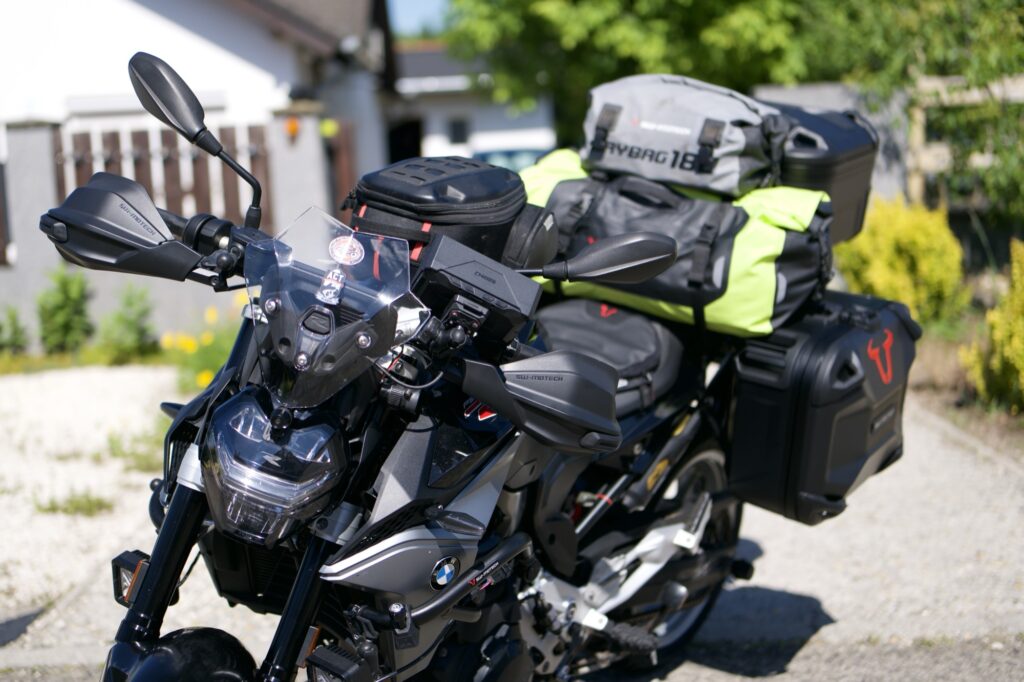
At the time of making the video, I was preparing the BMW for my next big journey. Once again, I needed clothes, cameras, batteries and tools, along with camping equipment because I was planning to spend some nights in a tent. The DUSC cases formed the foundation of the luggage system, with two smaller cases at the sides and a larger one at the rear.
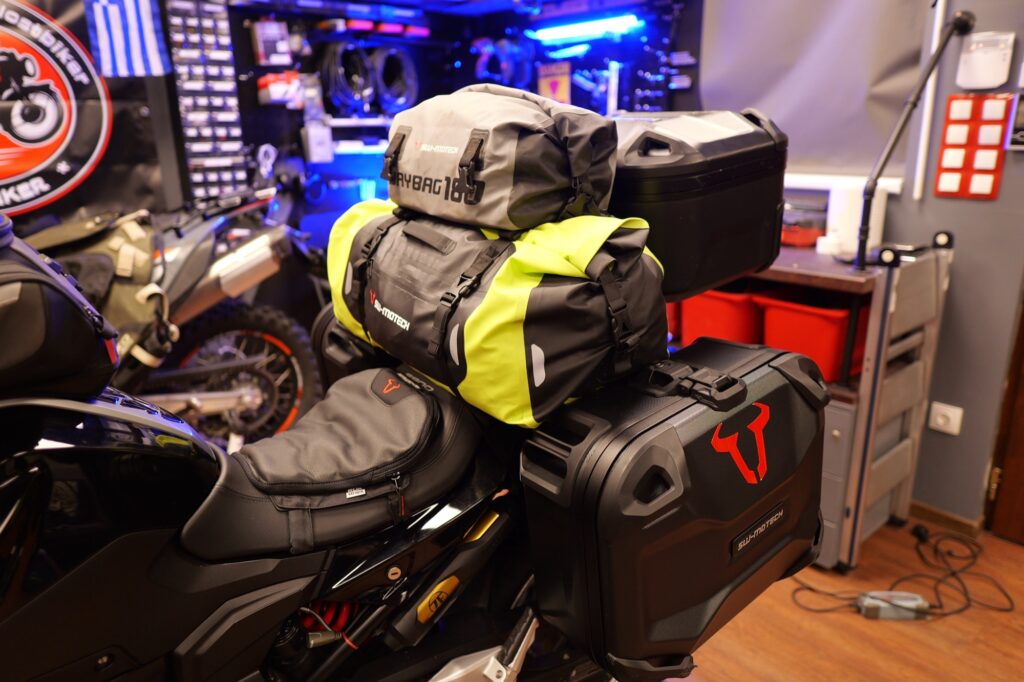 For the pillion seat, I prepared a 35-litre SW-Motech Drybag 350 waterproof bag. I packed some of my camping equipment inside it, including cooking utensils, the gas canister, lighting and various camping accessories. I could also secure a smaller, 18-litre Drybag 180 on top, which contained additional small items. However, I ran into a minor compatibility problem when attaching the two waterproof bags. One of the Drybags was approximately six years old, and its older mounting system didn’t match that of the newer bag. Fortunately, I had a solution for that too. Out came my trusty old bungee cords, which ultimately allowed me to secure the entire arrangement properly.
Together, the DUSC cases and Drybags already provided a very substantial amount of luggage capacity. There were still external attachment points available too, where I could secure something like a removed motorcycle jacket with a luggage net if necessary. With equipment like this, heading off on a longer tour is no problem at all.
Almost Everything on My BMW Is Now SW-Motech
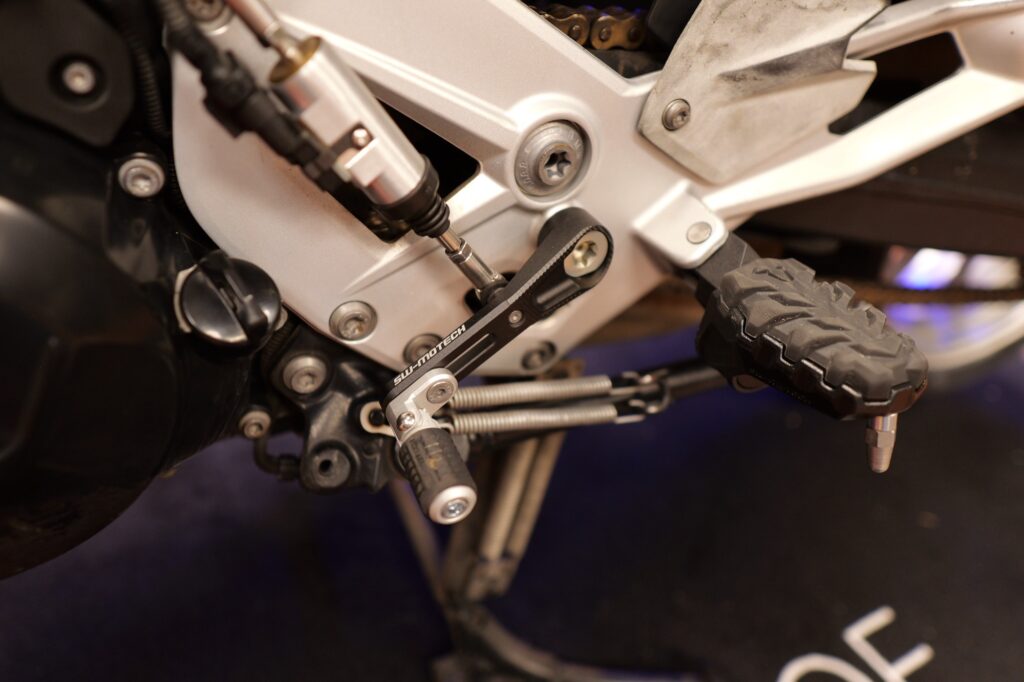 Over the years, I’ve fitted numerous other SW-Motech accessories to my BMW alongside the luggage system. One example is the enlarged side-stand foot, which provides more stable support on softer ground. The gear lever is also an SW-Motech product. It’s adjustable, has a folding tip, and I think it looks particularly good on the motorcycle. The fitted footpegs have removable rubber inserts, allowing me to stand directly on the serrated metal surfaces when riding on rougher terrain. The brake pedal’s length and contact surface can also be adjusted, helping me tailor it to my body size and riding style. I’ve also added substantial metal-reinforced handguards, nicely shaped crash bars and several other smaller accessories. I didn’t buy all these products at once. They were added gradually over the years whenever a specific need or problem made me feel that a change was worthwhile.
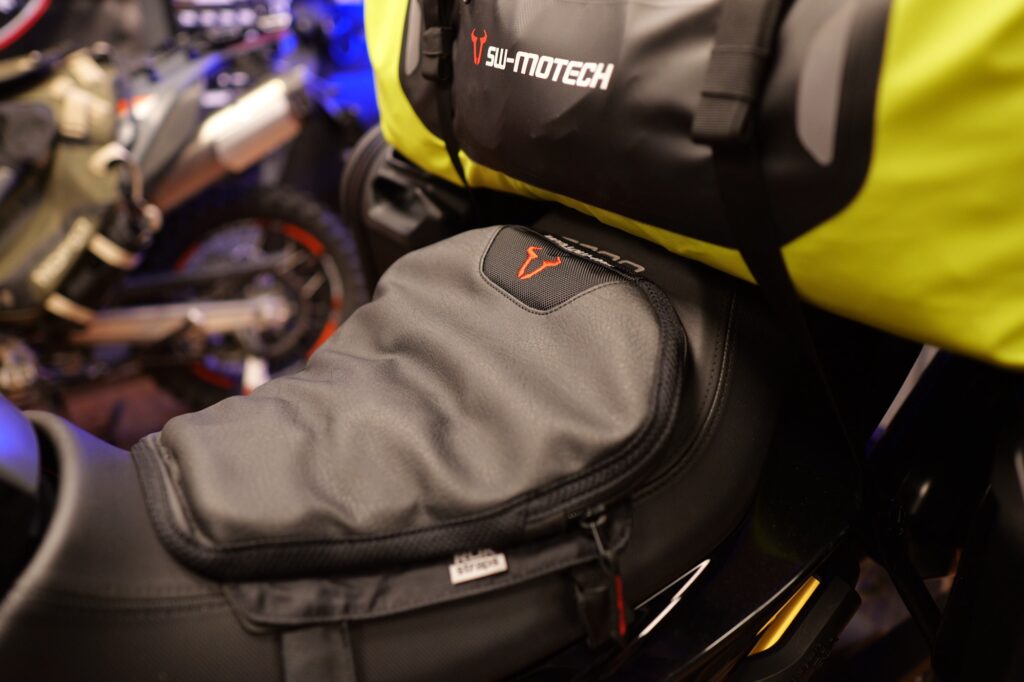 There is, however, one SW-Motech accessory that I still haven’t decided whether I actually like. It’s the inflatable seat cushion. The principle is simple: the air-filled cushion distributes body weight over a larger area, theoretically reducing pressure on certain parts of the seat. In practice, however, I haven’t been entirely satisfied. When I inflated it more firmly, it became uncomfortable after a while because it put pressure on certain parts of my backside. Later, I started experimenting with lower air pressure, which seemed more comfortable, but still wasn’t perfect. I’ll share my final opinion after the tour.
Why Am I So Loyal to SW-Motech?
Anyone looking over my BMW might easily assume that I’m suffering from some strange obsession with SW-Motech. They wouldn’t be entirely wrong, but my confidence in the brand didn’t develop overnight. Previously, I’d owned several luggage systems that could only be used with significant compromises. Broken mounting brackets, poorly functioning locks, inferior material quality, unpleasant aerodynamic effects and awkward operation were all part of the experience.
By contrast, my experience with SW-Motech products over many years has been overwhelmingly positive. My tank bag has worked flawlessly for five years, and I’ve used the various rear bags on countless tours. If something wears out, replacement parts are available. Most problems could be solved with the appropriate replacement component.
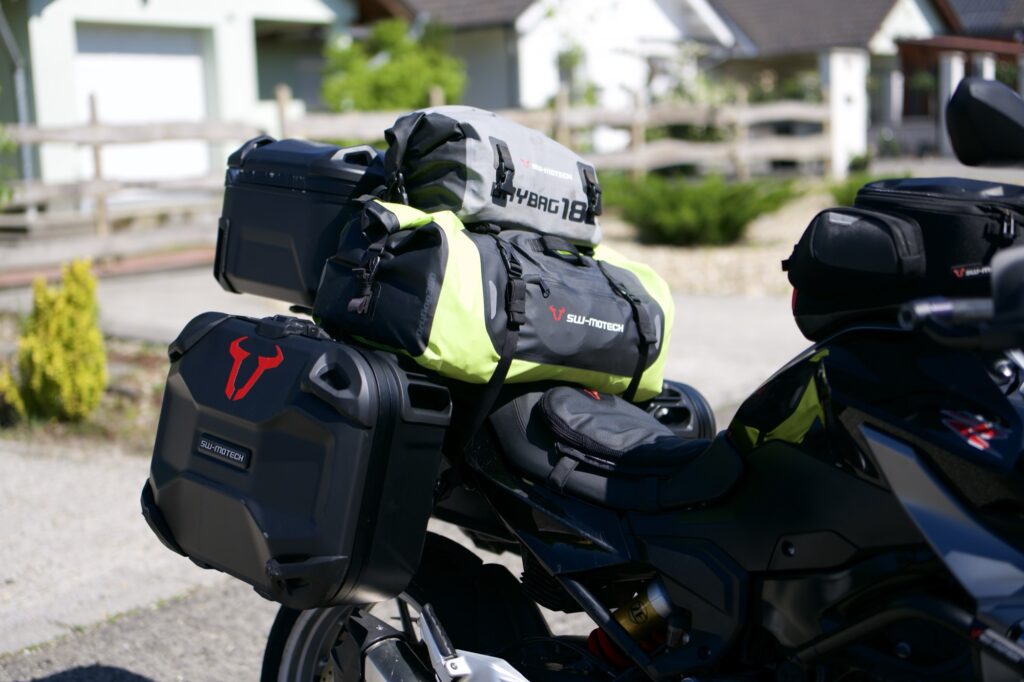 Even more important, however, is how thoughtfully the entire system has been designed. In just a few movements, I can transform the same motorcycle from a lightweight naked bike suitable for city riding into a serious touring machine. I can remove the cases, swap the mounting plate, use soft or hard luggage, and combine many of the different components. I can operate the locks with a single key, the interiors are practical, and I don’t have to work out how the mounting systems function all over again every time.
Naturally, SW-Motech isn’t a cheap brand. Its products often come with a substantial price tag, and I’m sure other manufacturers offer perfectly usable alternatives at more affordable prices. But over the years, I’ve simply reached the conclusion that I trust SW-Motech systems, understand how they work and find that they suit my riding habits extremely well. My relationship with HP Motor also began as an ordinary customer. I visited the shop several times, became familiar with the product range, and only later did a partnership develop through which I received discounts on certain products. I think it’s important to mention this because my opinion of the brand is based primarily on my own experience of using its products over several years, rather than on what I’ve received from the company.
The Lesson: Don’t Start by Choosing the Biggest Cases!
Looking back at all the luggage systems I’ve used over the years, perhaps the most important lesson is that the biggest or most expensive solution isn’t necessarily the best. It’s worth starting by considering what you actually want to use your motorcycle for. For an afternoon ride, a small tank bag and a bag secured to the pillion seat might be enough. For a weekend tour, a larger Rearbag or a pair of side bags could be useful. On a multi-day trip staying in hotels, two side cases and a smaller rear bag may already provide more than enough space.
But if you’re setting off for several weeks, camping, cooking, filming and preparing for unpredictable weather, your requirements become quite different. These days, I prefer being able to adapt my motorcycle’s luggage system to each individual journey. Modularity, ease of installation, secure mounting, water resistance and proper weight distribution are far more important to me than carrying the maximum possible luggage capacity on every trip. And of course, it’s no small bonus that when I remove the cases, the beautiful naked motorcycle I love is standing there in front of me again.
It’s been a long journey from the top box bracket that broke four times on my Honda NC to my current SW-Motech DUSC system. Along the way, I’ve spent plenty of money, experienced my share of frustration and learnt quite a few lessons the hard way. But today, I know exactly how I want to pack, and I know I no longer need to worry about my cases and bags.
Watch the Video Here: