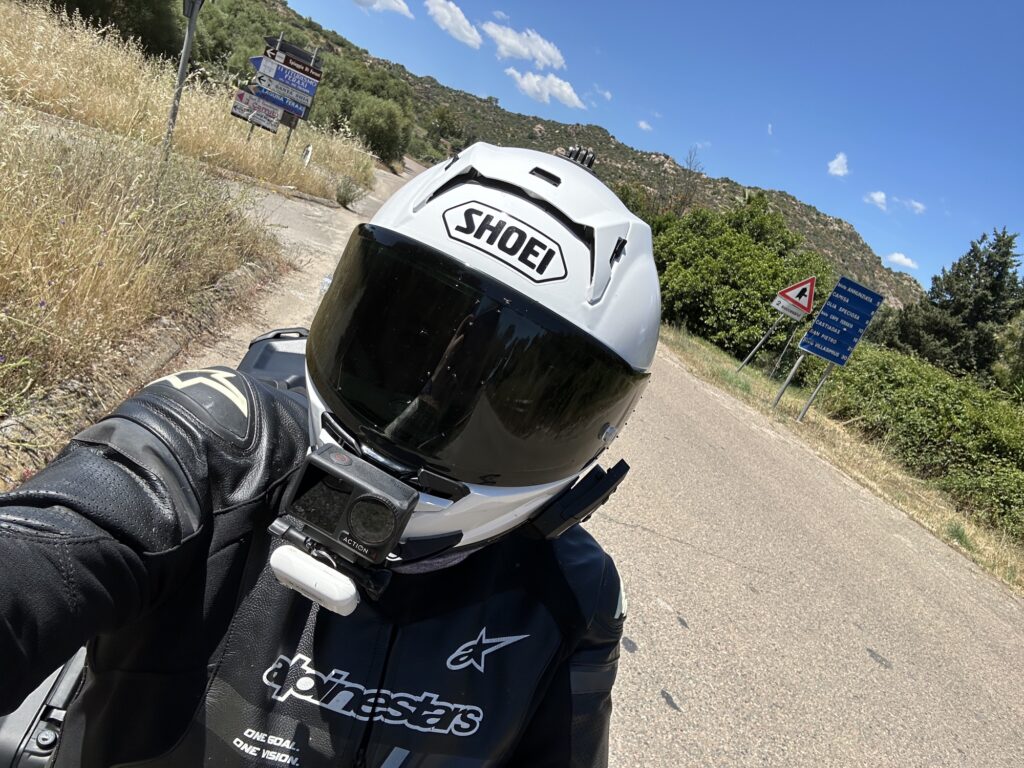
There are moments in life that we know in advance will be memorable. We look forward to them, prepare for them and imagine how we’ll feel when they finally arrive. Then, when the moment actually comes, things usually happen quite differently from how we’d imagined. In my case, for example, I reached my 100,000th kilometre of motorcycling on a tiny bridge in Sardinia, riding a Moto Guzzi V100 Mandello S. There was nobody there to celebrate with me, no fanfare, and we certainly didn’t open a bottle of champagne. Just me, the motorcycle, the Sardinian mountains and a road disappearing somewhere in the distance around the next bend. Yet it felt incredibly special. Those hundred thousand kilometres weren’t simply a number. They represented all the journeys of the past years, the places I’d discovered, the countless motorcycles, the friendships, the adventures and, of course, the more difficult moments too. And perhaps the best part was that I was already looking forward to the next hundred thousand kilometres.
Planning the Great Escape
I planned my big motorcycle tour of 2025 a little differently from my previous journeys. I didn’t want to schedule every day in advance, follow a strict timetable or know exactly where I’d be sleeping each night. Instead, I wanted to set off and let the roads, the places and my mood shape the journey. That’s how the idea for “The Great Escape” was born: a motorcycle adventure of approximately 6,000 kilometres, beginning in Sardinia and ending who knows where. I planned to spend the first few days with Peti Bistei, also known as “Fotelmotoros”, and his friends, exploring some of Sardinia’s most beautiful winding roads. After that, however, I wanted to continue alone. I only planned the rest of the tour in broad terms. Corsica, for example, seemed a particularly attractive destination, but I certainly didn’t rule out the possibility that a sudden change of mood might take me somewhere completely different.
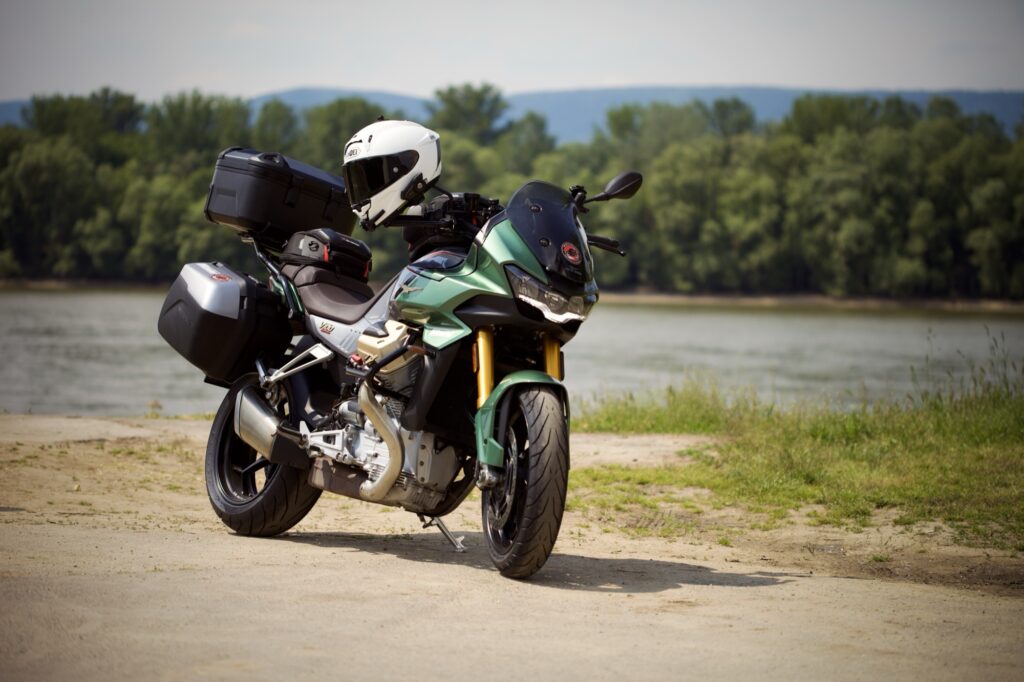
For this journey, I’d been given a rather special motorcycle: a Moto Guzzi V100 Mandello S, provided by IMC Motor in Dunakeszi. So instead of my own BMW F900R, I’d be setting off across Europe on an Italian sports tourer. The choice was exciting in itself, because the Mandello’s character, transverse V-twin engine and unusual technical features promised a very different experience from the touring motorcycles I’d become accustomed to. Besides, a journey this long reveals far more about a motorcycle than a few hours in the saddle or a short test ride ever could. I’d have plenty of opportunities to discover how it behaved on motorways, winding mountain roads, poor-quality surfaces and perhaps even in places where a sensible person wouldn’t necessarily venture on a sports tourer.
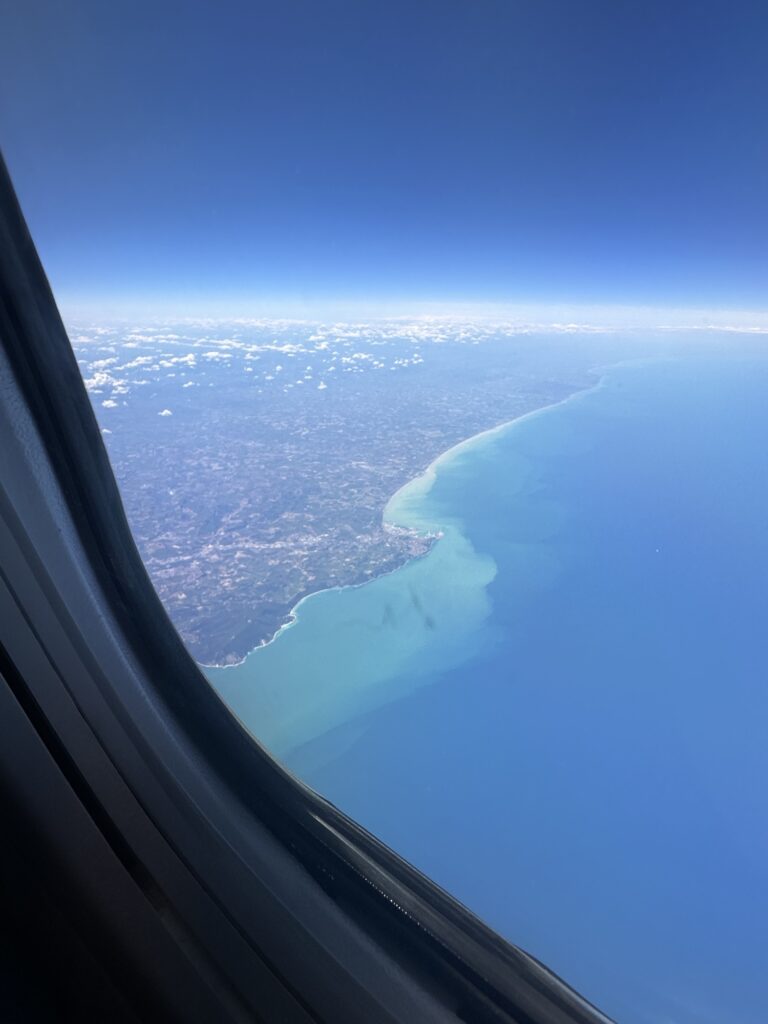
This time, I arranged the logistics with the help of Moto-Trans. The Guzzi and all my equipment had already left for Sardinia on Wednesday in a motorcycle transport trailer, and I followed by plane a few days later. At Cagliari Airport, I met the owners of the other motorcycles travelling with the transporter, who for some reason were convinced I belonged to their group. They thought I might be a friend of one of their absent mates who had simply decided to join them. After a fairly lengthy conversation, we eventually established that I was travelling with a different group and that we just happened to share the same motorcycle transporter and destination. The confusion was made even greater by the fact that we were all heading to Cala Gonone, the same little seaside town where our own group had booked accommodation. We had a good laugh about it.
The Unexpected Gift of a Misremembered Date
From the airport, we only had to walk a few minutes to the meeting point, where the motorcycles were already waiting for us. I quickly changed into my riding gear, loaded the Guzzi and set off. Where to? I hadn’t the faintest idea. I thought I’d start by having a proper Italian coffee and then calmly plan the evening. I stopped at a petrol station, ordered an espresso and took out my phone to check the exact address of the following night’s accommodation. That’s when I discovered I’d made a rather significant mistake. I’d been absolutely convinced that our group ride in Sardinia was starting on Sunday, but the booking revealed that it wouldn’t begin until Monday. In other words, I had not one evening but two nights to fill on the island before meeting the others.
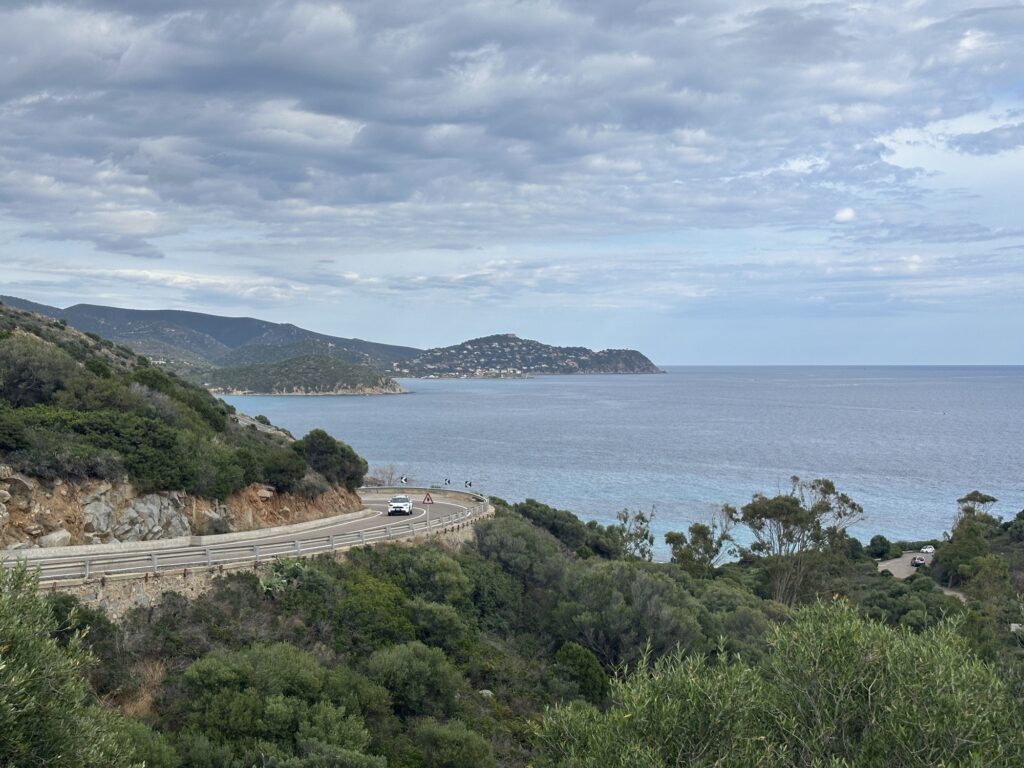
Someone else might have been annoyed by such carelessness, but I quickly recognised the opportunity it presented. I’d effectively been given an entire extra day in Sardinia, with absolutely nobody and nothing to adapt to. Why should that be a problem? I quickly studied the map and decided to spend the first night in the south-eastern corner of the island, then devote the following day to exploring the surrounding mountains and winding roads. I wouldn’t head north to Cala Gonone until Monday. With that in mind, I booked accommodation in Villasimius, a lovely seaside town, and set off towards the island’s southern coastline. The first day turned out to be rather hectic, because almost all my filming equipment was new, as well as the motorcycle. New helmet, new cameras, new audio recorders, new mounting solutions: everything needed to be coordinated, and naturally not everything worked perfectly at the first attempt. By two in the morning, I’d finally finished preparing everything, leaving just enough time for a quick pizza dinner and a few hours’ sleep. I decided that over the following days, I’d rely on the tried-and-tested method of trial and error: record the footage during the day, check it in the evening and correct whatever hadn’t worked properly the next day.
Villasimius and the South-Eastern Corner of the Island
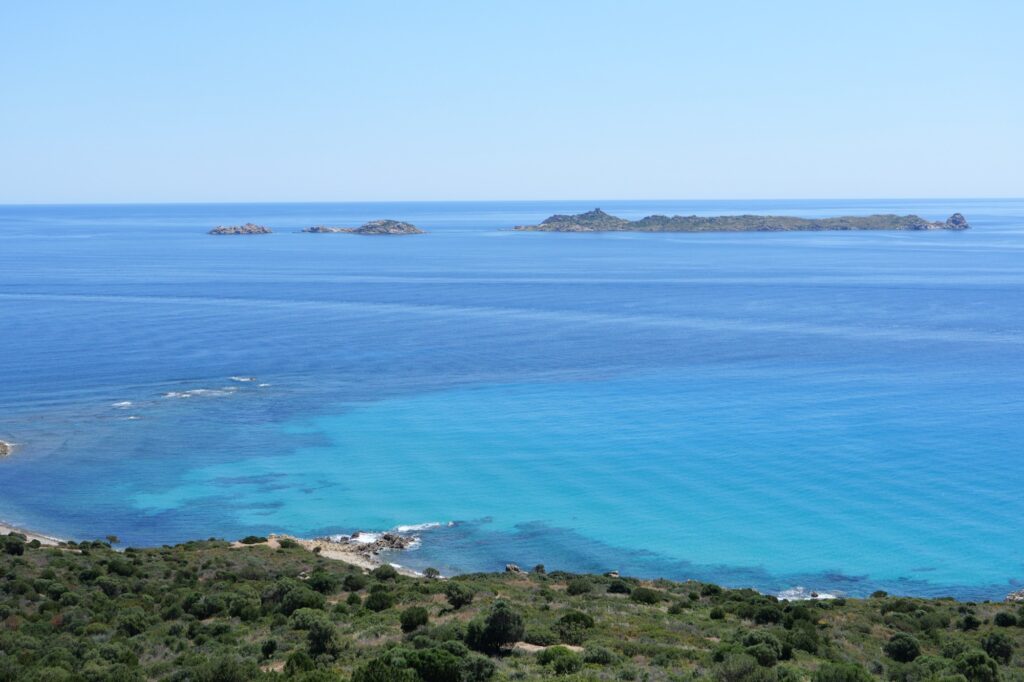
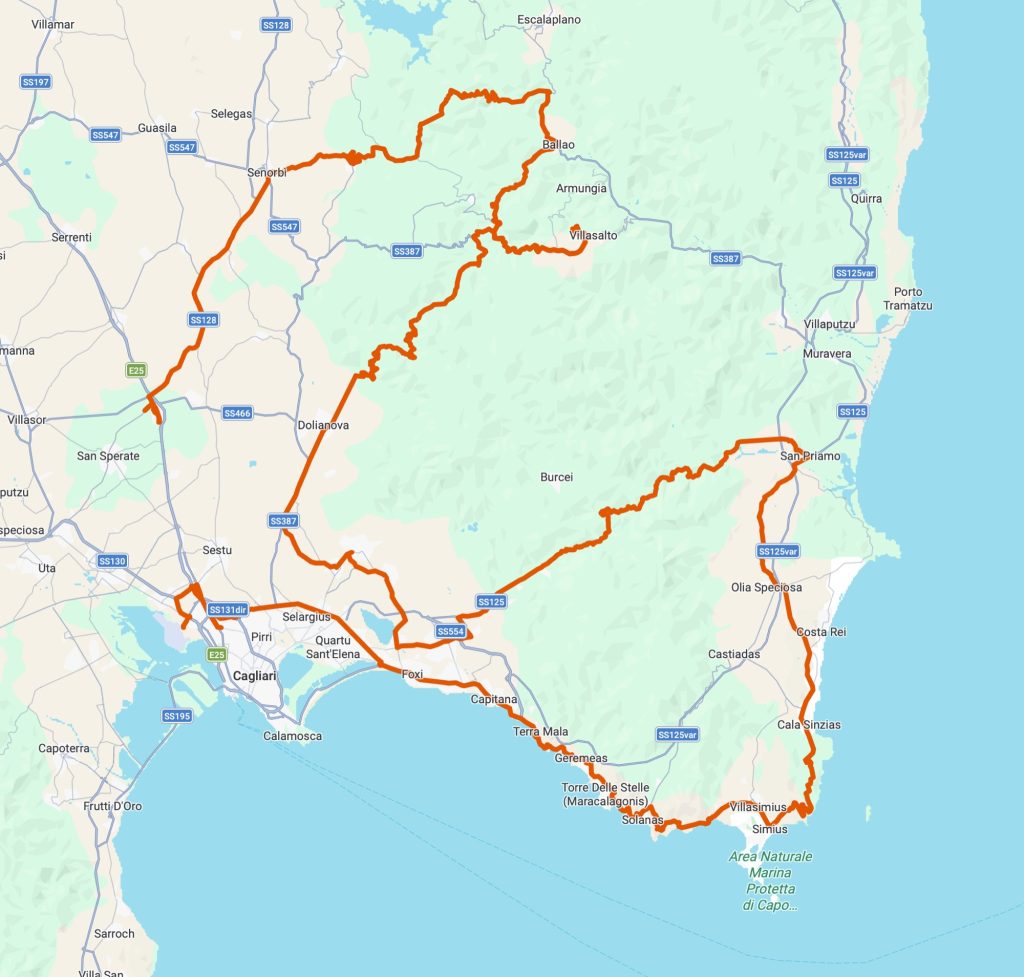
The following morning, I woke to an absolutely wonderful coastal landscape. The owner of my accommodation was a friendly young motorcyclist who had spent quite some time the previous evening explaining where I should ride. He clearly loved the area and was keen to recommend as many interesting routes as possible. Eventually, I combined his suggestions with my own plans and put together the day’s itinerary. First, I wanted to explore the island’s south-eastern coastline, then turn north and continue through the Monti del Sarrabus mountains. From there, I’d take the SS125 through the forested hills of Settefratelli before heading west towards Cagliari. The map showed some absolutely fantastic combinations of bends, and after the first few kilometres, I already knew I’d made an excellent choice.
The south-eastern coastline immediately revealed one of Sardinia’s most attractive sides. Sometimes the road wound directly beside the sea, while elsewhere it climbed small hills, offering views of one beautiful bay after another. I passed the unusually named Capo Carbonara, or Cape Carbonara, before slowly turning north along the magnificent coastline around Villasimius. The colour of the sea, the rocky coves and the dry hills covered in Mediterranean vegetation created an atmosphere that was almost impossible not to love. The traffic wasn’t particularly troublesome either, so I had plenty of time to admire the scenery and get acquainted with the Moto Guzzi. The motorcycle was beginning to feel increasingly natural beneath me, but the truly interesting part was still ahead. At San Priamo, I turned west onto the SS125, which crosses the mountains of south-eastern Sardinia towards Cagliari. Even on the map, it was obvious that some serious cornering awaited me.
SS125 – My First Proper Sardinian Motorcycling Experience
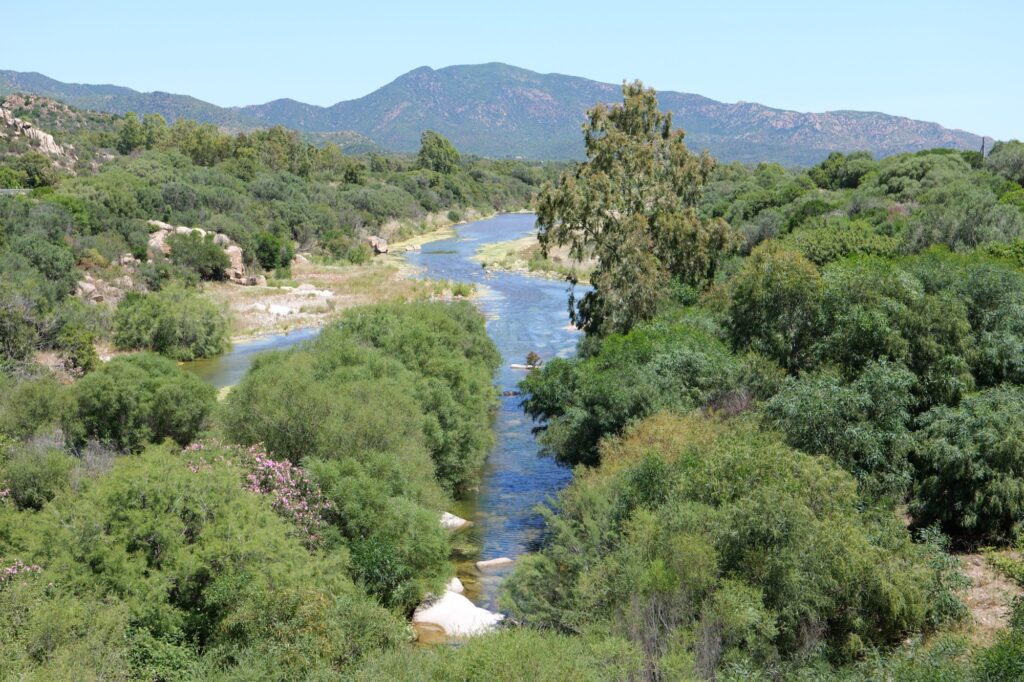
One of the first memorable places on the road into the mountains was the Picocca River and the old stone bridge beside it. The sea was still visible in the background, while ahead of me rose the Settefratelli forest and the mountains of Sarrabus. The landscape gradually changed around me. The open coastal panoramas gave way to rocky valleys, canyons and wooded mountainsides, while the road became narrower and increasingly winding. The tarmac wasn’t perfect everywhere, with cracks and minor imperfections in many places, but the layout was absolutely fantastic. Hairpin followed hairpin, and the curves between the rock faces were so extraordinary that I almost immediately forgot about the number of kilometres I’d planned to cover that day.
By mid-morning, I was already beginning to suspect that my planned 350 kilometres probably weren’t going to happen. You simply can’t ride straight through a region like this. You have to keep stopping to take photographs, admire the scenery and discover interesting side roads, and naturally I wanted to enjoy the riding itself too. The SS125 is particularly well suited to all of this. The rhythm of the corners is almost perfect, the landscape reveals a different side of itself around every bend, and the Moto Guzzi was increasingly proving that it wasn’t merely a comfortable touring motorcycle but also had some serious sporting ambitions. The grip provided by the Pirelli Angel GT tyres was a particularly pleasant surprise. Although the road surface was cracked and coarse in several places, the Guzzi followed the curves confidently, and it felt stable even as I began leaning it further into corners. I was already forming the opinion that the V100 Mandello is a much sportier motorcycle than its appearance or touring equipment might initially suggest.
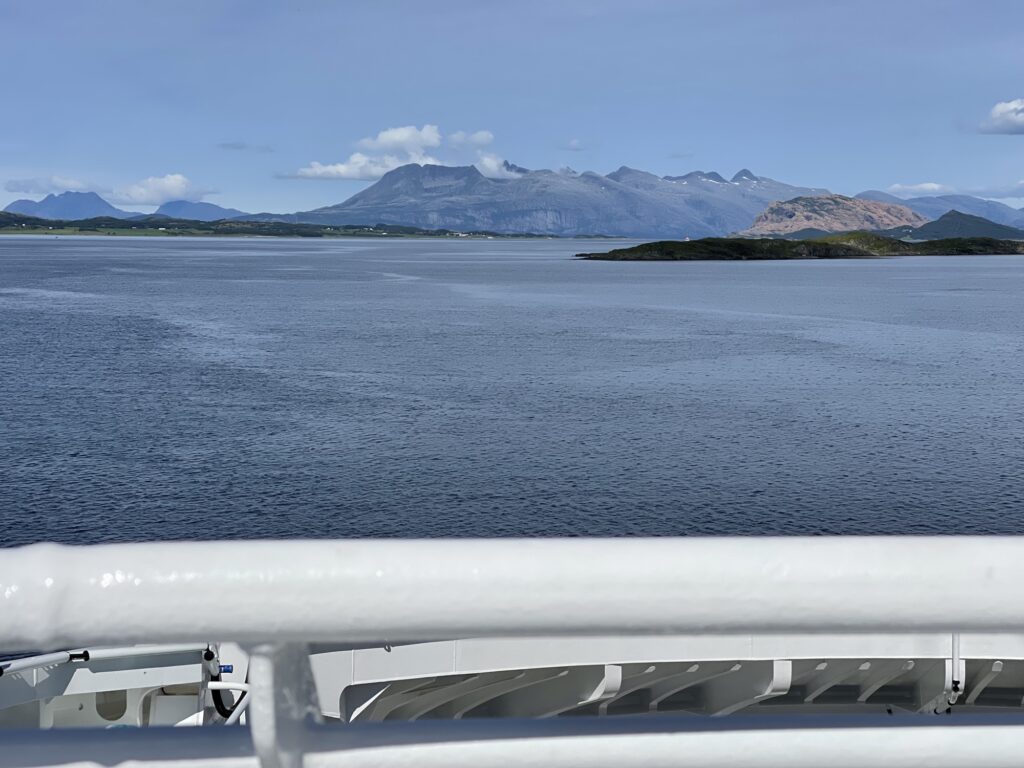
Incidentally, Settefratelli means “seven brothers” in Italian, referring to seven distinctive mountain peaks in the area. I found this particularly amusing because, during my earlier tour of Norway, I’d encountered a similarly named mountain group: Syv Søstre, or the Seven Sisters. Who knows, perhaps these Sardinian brothers are distant southern relatives of the Norwegian sisters. In any case, the landscape was spectacular, and the SS125, winding through canyons and rocky mountainsides, was steadily winning a place in my heart. There’s a good reason why so many people consider Sardinia one of the best motorcycling destinations in Europe. On my very first proper touring day, I’d already discovered roads that I’d happily travel hundreds of kilometres to experience elsewhere.
One Hundred Thousand Kilometres – A Special Moment
As I rode through the mountains, the moment I’d been looking forward to for so long finally arrived. While crossing a tiny bridge, I reached exactly 100,000 kilometres of motorcycling according to my own records. I didn’t stop immediately, but continued for approximately another twenty kilometres until I found somewhere quiet where I could reflect on it all. Eventually, I pulled over beside an abandoned building that had partly collapsed. The location suited me perfectly. I’ve always loved old ruins, abandoned buildings, castles and towns. Celebrating my 100,000th kilometre of motorcycling beside a place like this felt completely natural.
I later discovered that the building wasn’t an old hotel, as I’d initially thought, but a so-called casa cantoniera, a service house built for road maintenance workers. Buildings like these once stood along many Italian main roads. They provided accommodation and a working base for road maintenance staff, but as transport infrastructure developed, many lost their original purpose and eventually became abandoned. For me, at least, it was the perfect backdrop for a little reflection.
I was able to calculate my hundred thousand kilometres fairly accurately because I knew the odometer readings from when I’d bought and sold my previous motorcycles, thanks to the relevant sales agreements. Later, I also began keeping regular records of my journeys. Naturally, my total mileage includes some estimates and figures compiled from various records, but my calculations allowed me to track my riding distance over the years with reasonable accuracy. Now it was time to remember the motorcycles I’d ridden and the roads I’d travelled to accumulate this considerable distance.
From a Scooter to a Moto Guzzi – The Story of 100,000 Kilometres
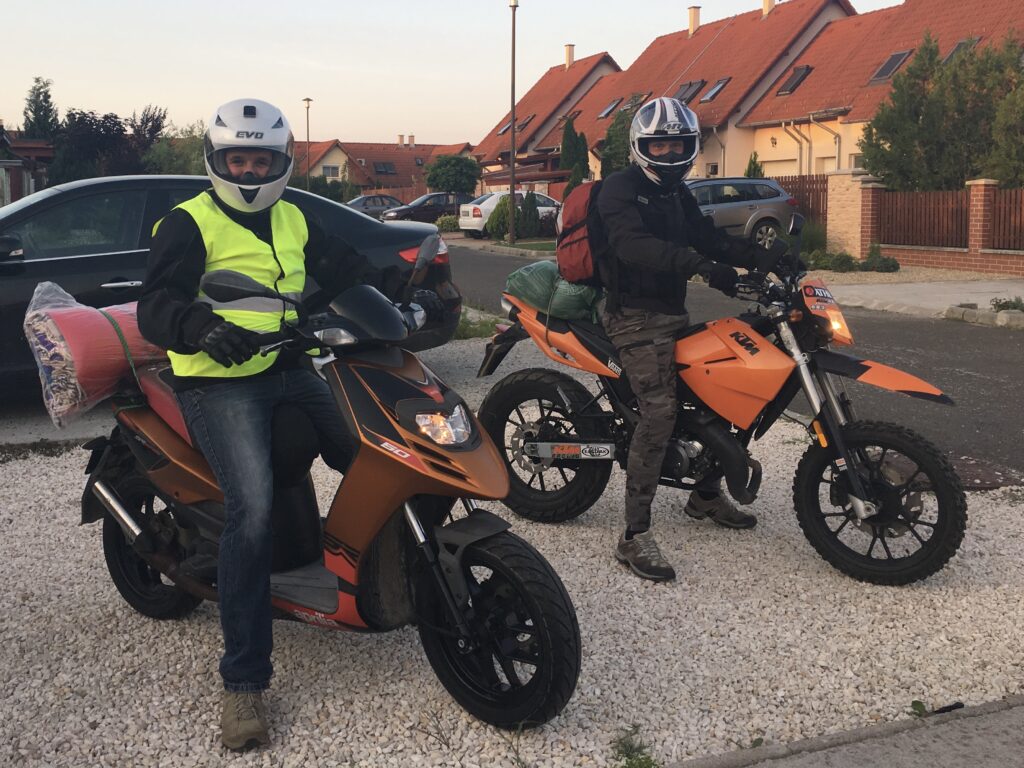
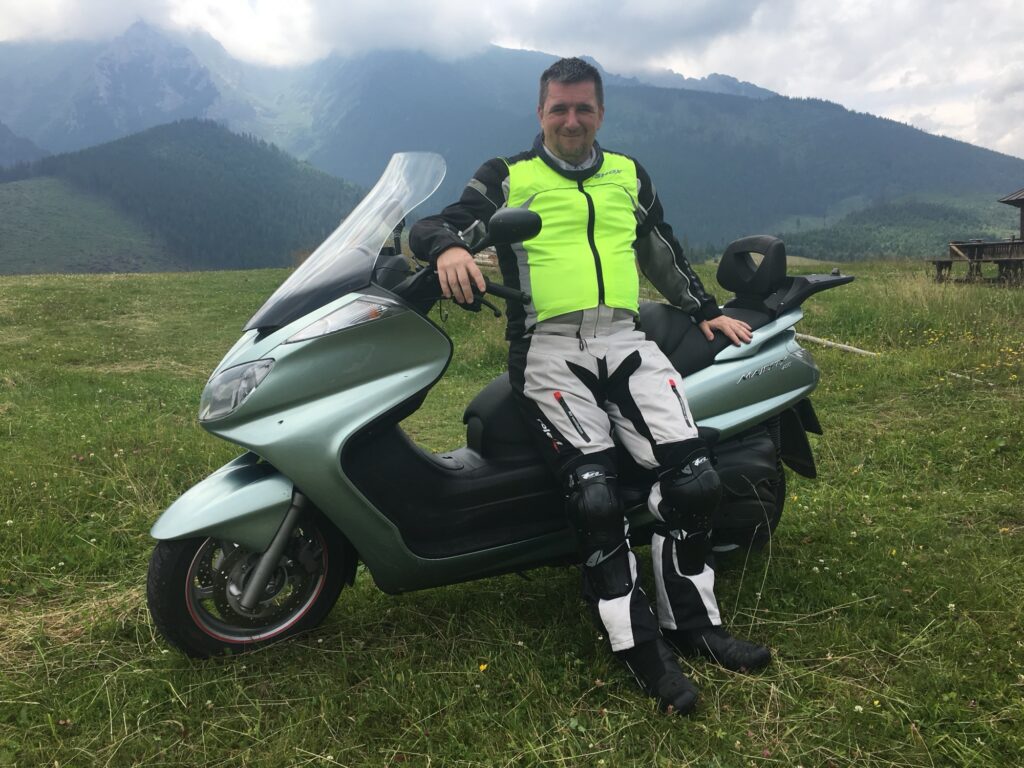
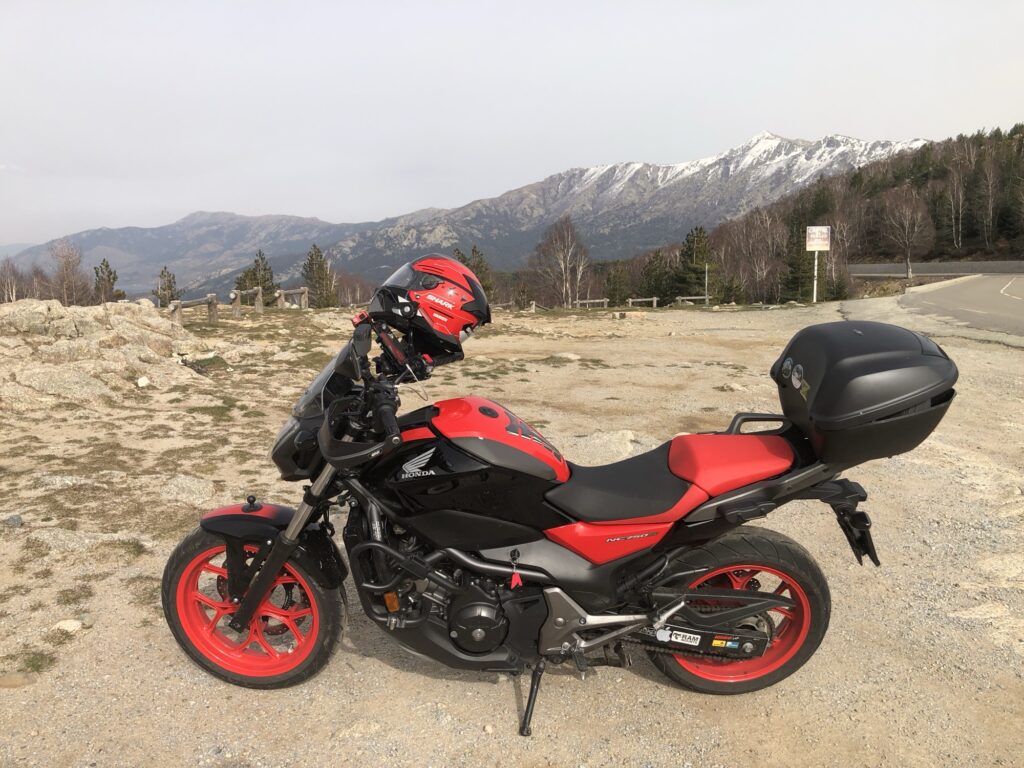
The story began in 2013 with an Aprilia SR50 Motard scooter, on which I covered approximately 5,800 kilometres over four years. I didn’t yet have a licence for larger motorcycles, but I’d already fallen in love with the freedom of travelling on two wheels. Then, in 2017, I obtained my unrestricted Category A motorcycle licence and continued with a Yamaha Majesty 400 scooter. I covered approximately 7,100 kilometres on that before buying my first proper large touring motorcycle in 2018, a Honda NC750S. The Honda served me for three years, during which I rode a total of 31,500 kilometres. That was already a serious amount of riding, and it was during those years that the motorcycle tourer in me really began to emerge, gradually setting off on longer and more distant adventures.
In 2020, the BMW F900R arrived, and it has remained one of my most important motorcycles ever since. By the time I reached the hundred-thousand-kilometre milestone, I’d covered approximately 38,200 kilometres on it. Meanwhile, off-road riding was also becoming an increasingly important part of my life. In 2021, I bought a Honda CRF300L, on which I rode approximately 1,600 kilometres before eventually replacing it with a KTM 690 Enduro R. At the time, I’d personally covered roughly 8,100 kilometres on the KTM. Alongside these motorcycles, I’d naturally ridden countless test bikes and borrowed machines. Some I’d ridden for more than a thousand kilometres, such as the Honda CB1000 Hornet and Yamaha Tracer 9 GT+, while others I’d only experienced during shorter tests, press launches or rides with friends.
Over the years, I’ve ridden motorcycles including the Honda Africa Twin DCT, Yamaha XT600, KTM 790 Duke, Aprilia Tuareg 660, Kawasaki Ninja 500, Versys 1000 and Versys 1100 SE, Triumph Street Triple RS, Kawasaki Z900RS and many others. I’ve also had the opportunity to try friends’ motorcycles, including a Honda CB600 Hornet and a BMW R1100R. Individually, these shorter encounters might not seem particularly significant, but when you add them together, they account for a surprising number of kilometres and an enormous collection of experiences. According to my calculations, I’d covered roughly 99,000 kilometres on my previous motorcycles and test bikes, and I accumulated the final thousand on the Moto Guzzi V100 Mandello S. That’s how the story of my first hundred thousand kilometres came to an end, on a motorcycle and in a location that I could hardly have planned more beautifully.
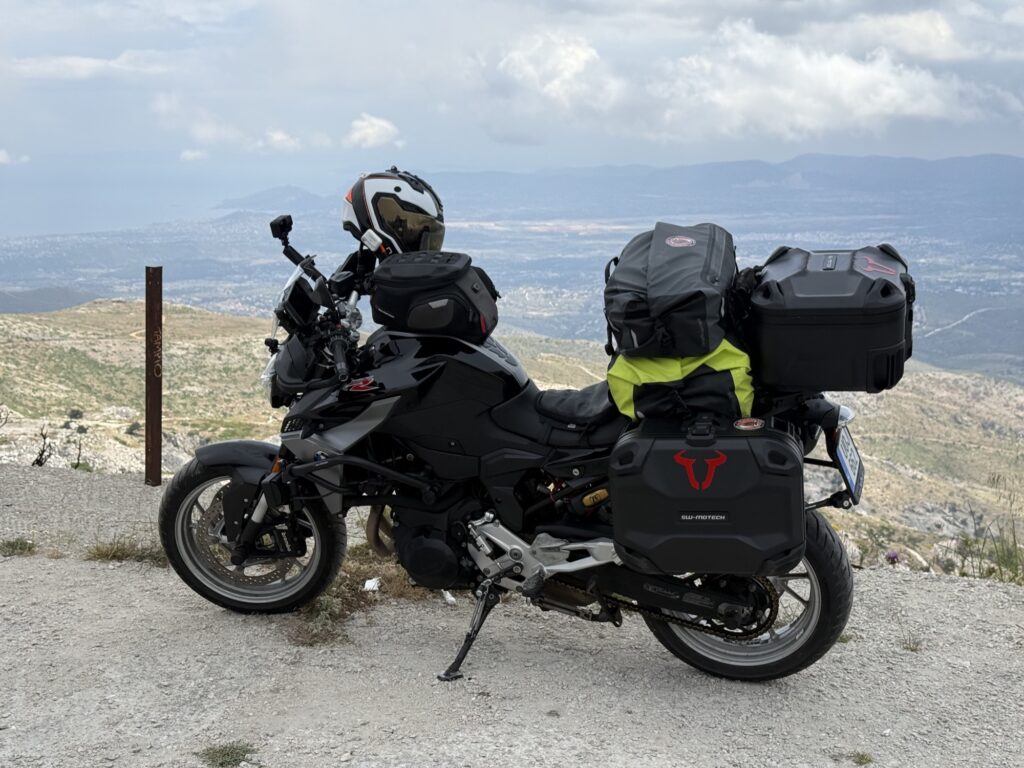
And those hundred thousand kilometres aren’t just about motorcycles. During my tours, I’ve travelled through twenty-five countries on two wheels. I’ve ridden in Norway, Finland, Sweden, Denmark, Estonia, Latvia, Lithuania, Poland, the Czech Republic, Slovakia, Germany, Austria, Switzerland, France, Italy and Spain. I’ve visited Morocco, Romania, Serbia, Croatia, Slovenia, Albania, Montenegro and Greece, and of course I’ve also covered countless kilometres in Hungary. Every country offered a different experience, and each left me with something that made the journey worthwhile. The endless tranquillity of Scandinavia, the incredible winding roads of the Alps, the unpredictable adventures of the Balkans and the truly distinctive world of Morocco all became part of those hundred thousand kilometres.
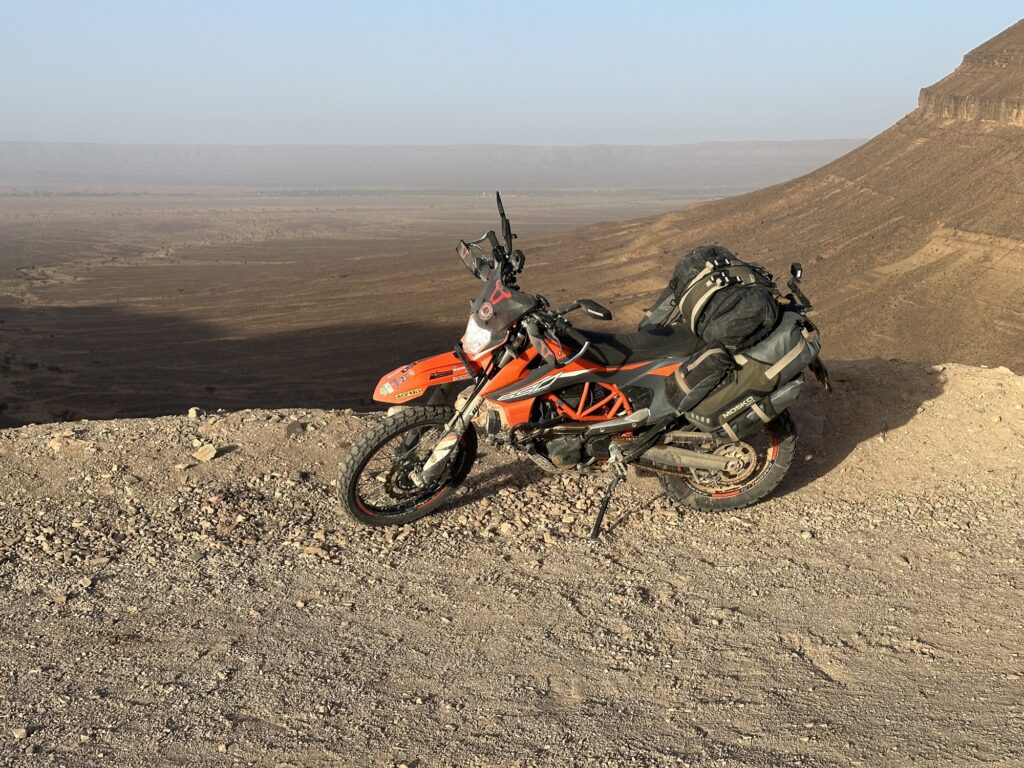
I didn’t want to dwell on the past for too long, but this milestone felt important enough to celebrate. When I first started riding motorcycles, I’d certainly never have imagined that one day I’d visit so many countries, experience such a wide variety of bikes, or that motorcycling would become such a defining part of my life. But now, standing beside a ruined building in Sardinia, I was already thinking more about the next hundred thousand kilometres. I wished for those kilometres to bring the same sense of freedom, adventure and hopefully worry-free riding, wherever in the world they might take me. Then I put on my helmet, started the Guzzi and returned to the fantastic bends of the SS125.
The Moto Guzzi Was Beginning to Reveal Its True Character
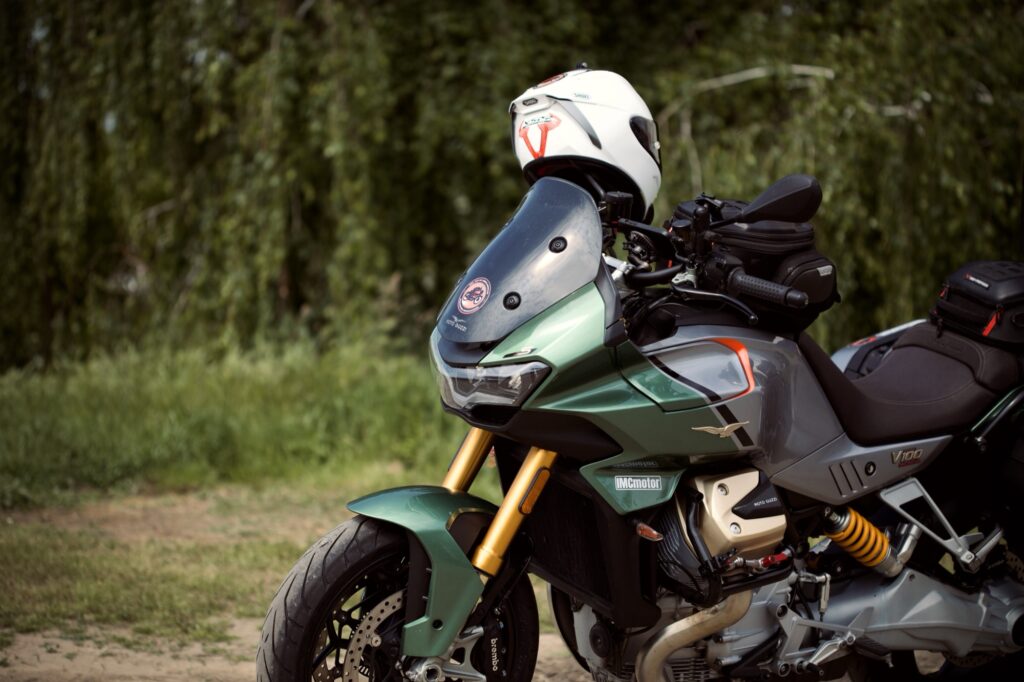
As I continued through the Sarrabus mountains, the Moto Guzzi V100 Mandello S began revealing more and more of its fascinating character. The transverse V-twin is a distinctive, direct and thoroughly enjoyable engine, while the chassis offered a level of stability and precision that reminded me of much sportier motorcycles. The grip from the Pirelli Angel GT tyres remained extremely convincing, even on the cracked, rougher sections of road that didn’t necessarily inspire confidence at first glance. I was becoming increasingly comfortable leaning the motorcycle into corners, gradually developing a feel for the lines it preferred. The Mandello was proving to be much more than a comfortable touring machine; it was a motorcycle that could be genuinely entertaining when ridden sportily through winding mountain roads. I was still only at the beginning of getting to know it, but I was already certain that I’d discover plenty more interesting things about it over the coming days.
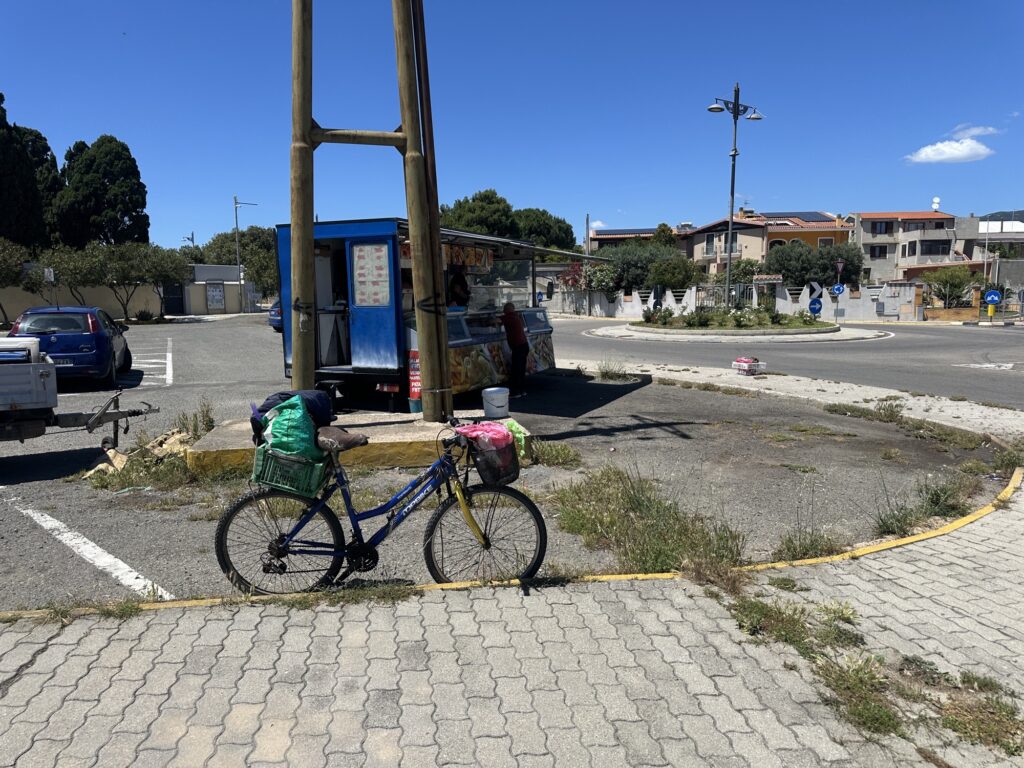
Then another motorcyclist caught my attention. He was riding ahead of me on a strangely loaded machine, and at first glance I couldn’t understand how he could possibly travel with it arranged like that. His luggage was hanging in all directions, with some bags positioned in highly unusual places, almost beside the engine and in front of his knees. The whole contraption looked lopsided, with a backpack sitting crookedly at the rear and three foam camping mats somehow secured to the front. I even wondered whether the headlight was visible behind all that equipment. The rider clearly didn’t have a particularly sophisticated luggage system, but that certainly hadn’t stopped him from heading out into the world. I would have loved to stop him for a chat, because I was convinced he’d have some fascinating stories to tell. Unfortunately, that never happened, so I could only admire the contraption from a distance. Later, when reviewing the footage, I spent several minutes studying his motorcycle and trying to understand how the whole arrangement could possibly work. One of the great things about motorcycling is that the same freedom can be experienced in completely different ways. I need an organised, practical luggage system, while he had apparently managed to make everything work with whatever happened to be available.
Seafood in the Middle of a Roundabout
I gradually descended from the mountains towards Cagliari and started feeling hungry. It must have been around two in the afternoon when I decided to find somewhere for lunch. In Italy, that isn’t always the ideal time, because many restaurants have already closed their kitchens by then, but eventually I managed to find somewhere rather special. It was essentially a modest-looking little eatery in the middle of a roundabout, serving various kinds of fish, octopus and other seafood. I wasn’t entirely sure where I was, and I didn’t even know the Italian names for half the dishes, but the atmosphere seemed so authentic that I immediately liked the place.
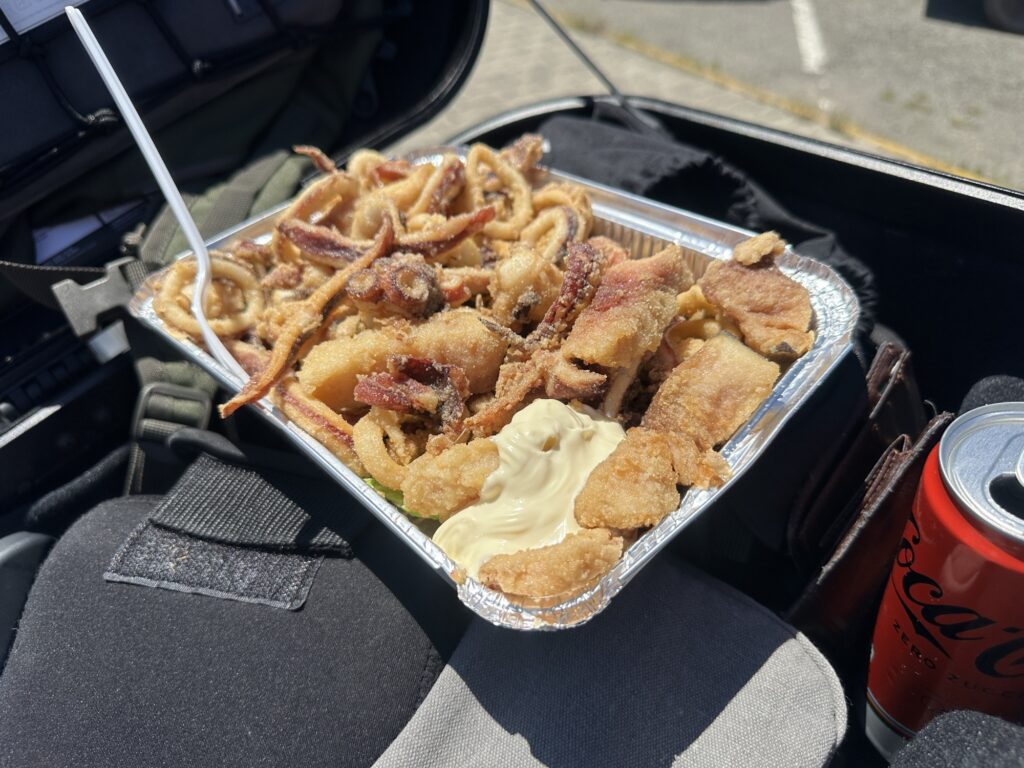
In the end, I received an enormous portion of seafood and two soft drinks for twenty euros. The food was absolutely delicious, but the portion was so large that I simply couldn’t finish it. The only shaded spot was occupied by an elderly man who was rolling a cigarette, so I settled somewhere else. I struggled with the enormous serving for a while before admitting defeat and deciding that it would also provide dinner. All I had to do now was work out how to pack the leftovers. I wanted to ask for some aluminium foil, but I had no idea what it was called in Italian, so eventually I managed to solve the problem with paper wrapping. I carefully packed the remaining food into my luggage and hoped it would somehow survive the afternoon’s riding. In the summer heat, that obviously wasn’t the best idea, but I’d enjoyed the meal so much that I was determined to have some more later.
A Mining Museum and an Old Family Memory
After lunch, I headed back towards the mountains, this time further north and east. I’d spotted an interesting attraction on the map: the Su Suergiu Mining Museum near Villasalto, where visitors can see old industrial facilities and the remains of former smelting furnaces. The site immediately caught my attention, and the road leading to it looked particularly promising for motorcycling, so I didn’t need much convincing. For me, mining isn’t merely an interesting chapter of industrial history; it’s also connected to a personal family memory. My grandfather was a bauxite miner who travelled the roads on an MZ Trophy. I’ve remembered him fondly since childhood, and I owe him a great deal. As I rode the Guzzi towards the old mine, I couldn’t help thinking about him. Somehow, I found it rather moving that both mining and motorcycling had a place in my family’s history.
Entry to the Su Suergiu museum cost just five euros, and for that I received a genuinely special experience. The guided tour was conducted by the great-granddaughter of the former owner, who was clearly enormously proud of her family’s history and the objects that had been preserved. There was just one small communication problem: she didn’t speak a word of English, and my knowledge of Italian mining terminology was rather limited. Nevertheless, we somehow managed to understand each other remarkably well. She enthusiastically showed me old documents, tools and historical objects, while I tried to work out what she was telling me from every gesture and facial expression. I think a shared interest and a personal connection can sometimes help people overcome language barriers. Although I didn’t understand much of what she actually said during the tour, the history of the place and her enthusiasm came across perfectly.
After exploring the museum building, I decided to visit the remains of the old smelting furnaces as well. Unfortunately, there was no proper tarmac road leading to them, only a rough, stony dirt track. And I was sitting on a Moto Guzzi V100 Mandello S, a motorcycle clearly not designed for such conditions. But curiosity is a powerful thing, and ultimately any motorcycle can be an enduro, at least until you encounter obstacles that are too serious. I cautiously set off along the dirt road, trying to find the line that offered the best grip, while increasingly wondering whether taking such a valuable test motorcycle onto this kind of terrain was really a sensible idea.
Things became even more complicated when I encountered cattle grazing freely in the area. This isn’t particularly unusual in Sardinia or Corsica, which is why I always say that if you see cow pats on the road, the production line can’t be far away. This time, however, I encountered not just the tell-tale evidence but the cows themselves. Some of them regarded me with considerable uncertainty, and I had no idea whether they intended to move aside, approach out of curiosity or become frightened by the Guzzi’s distinctive rumbling exhaust note. So I had to pay attention to the rocky surface, the motorcycle’s balance and the unpredictable movements of the animals all at once. Eventually, I reached the old industrial buildings, admired the remains and then returned along the same track. I won’t pretend I wasn’t nervous, but fortunately both the Guzzi and I made it safely back onto the tarmac.
The Radar Station I Looked for on the Wrong Mountain
I still had one unusual destination in mind for the end of the day. That morning, the motorcycling owner of my accommodation in Villasimius had recommended an old military radar station that supposedly offered absolutely spectacular views of the surrounding area. Abandoned and unusual places like this have always fascinated me, so naturally I wanted to visit. There was just one problem: I hadn’t been given precise coordinates, only a rough indication of where to look. I selected a promising mountaintop on the map and headed towards it. For a while, I was quite convinced I was going in the right direction, but gradually it became obvious that something wasn’t right. There was no sign of the station.
Eventually, I looked around from a higher point and noticed a small white structure in the distance, sitting on top of another mountain. It looked very much like the place I’d actually been searching for. The funniest part was that I’d probably ridden right past it approximately an hour earlier without noticing. By then, however, it was already late afternoon, and I’d covered a considerable distance since setting off that morning. I decided not to turn back that day. The radar station could wait, there would be another day tomorrow, and Sardinia had so many interesting roads that I was hardly likely to get bored.
Monastir – The End of My First Proper Touring Day
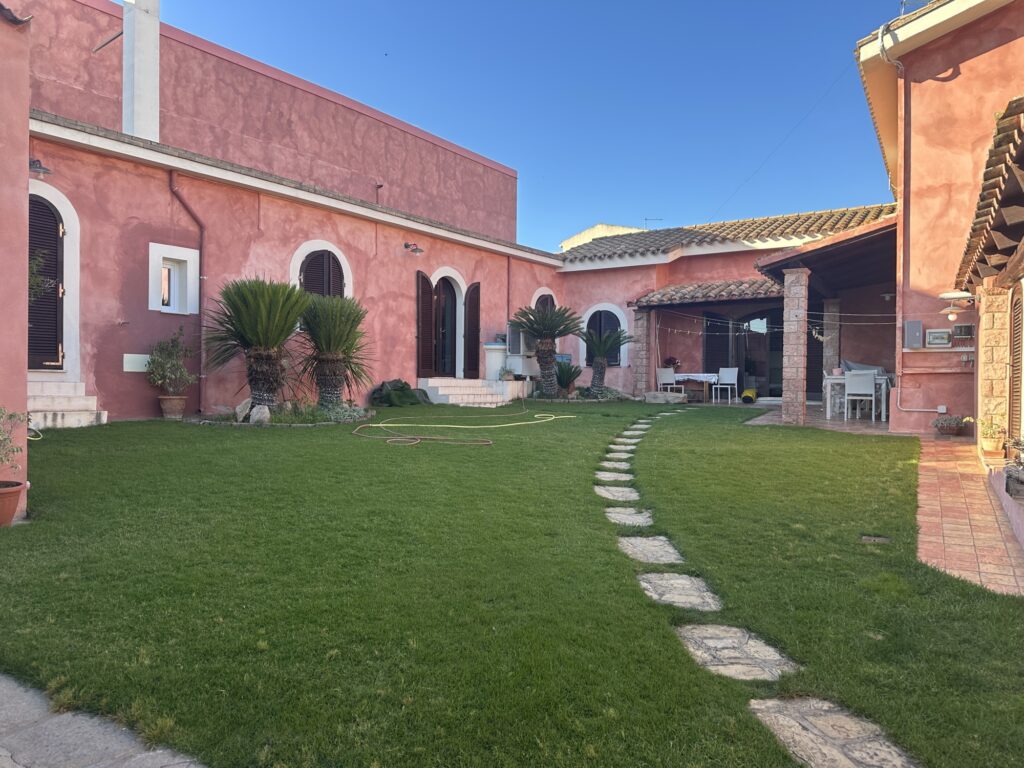
I’d booked accommodation in the nearby town of Monastir, so I slowly set off to cover the final kilometres of the day. My plan was simple: arrive, park the motorcycle, find a shop, buy a few beers and, if the seafood left over from lunch was still edible, have that for dinner. By the end of the day, I wasn’t particularly interested in another major adventure, because I’d already experienced so much. I’d woken up that morning on the coast at Villasimius, ridden around the south-eastern corner of the island, discovered the fantastic winding roads of the SS125, reached my 100,000th kilometre on a motorcycle, visited a remarkable mining museum and even managed a little off-road riding on a motorcycle that had absolutely no business being on a rocky dirt track.
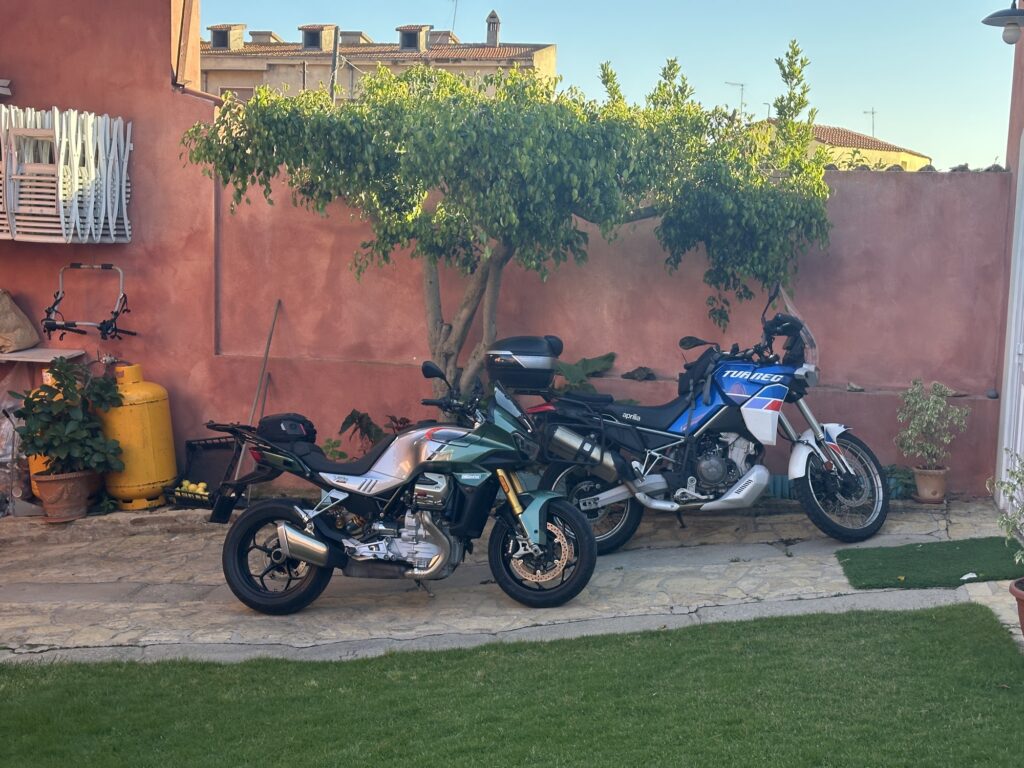
And all of this had happened simply because I’d got a date wrong. I’d arrived in Sardinia a day earlier than necessary for the start of our group tour, and I’d managed to make the most of that unexpected gift. The Moto Guzzi V100 Mandello S had already made an excellent impression on me during my first proper touring day. I found it comfortable, powerful and surprisingly sporty, while the Sardinian roads provided an almost perfect environment in which to get acquainted with it. There were still hundreds of kilometres waiting for me on the island over the following days, and after that, who knew where the road would take me?
 And so The Great Escape had begun, and the very first day had already proved that sometimes the best stories come from unexpected turns of events. That’s exactly why I love travelling by motorcycle. Not simply to reach a destination, but also to experience things along the way that could never happen while sitting at home. And after my hundred-thousandth kilometre, I had just one wish for myself: may there be at least another hundred thousand ahead, filled with the same freedom, curiosity and enthusiasm for riding.
Watch the first episode of the motorcycle touring series here: