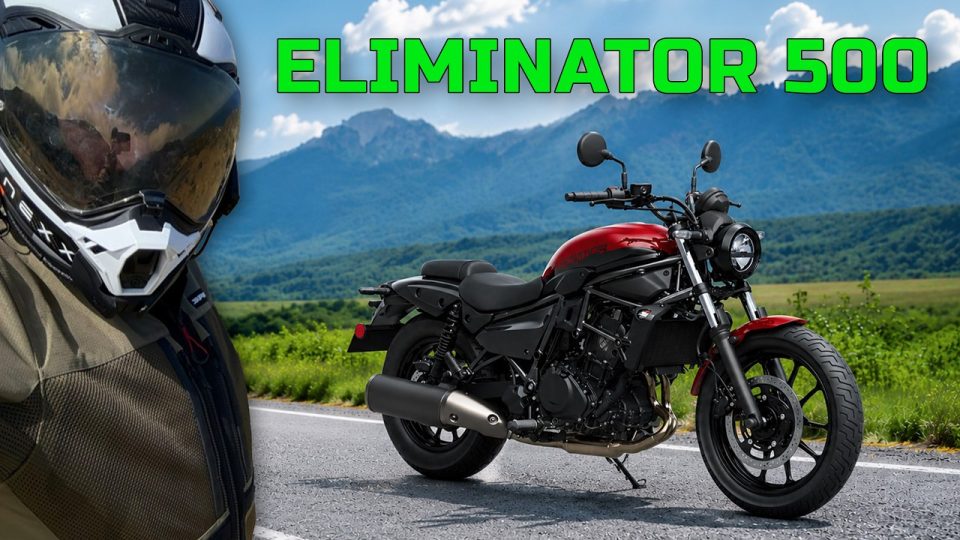
 At the beginning of the week, my friend Teó from Kawasaki called me. He had an interesting little motorcycle that he thought wasn’t getting nearly the attention it deserved. What’s more, the prices of bikes from previous model years had been significantly reduced, making them particularly good value. Would I like to try one? He was talking about the Kawasaki Eliminator 500. What immediately caught my interest was that this little cruiser uses the same 451cc parallel-twin engine I’d already grown very fond of in the KLE500. I’d also ridden the Ninja 500 previously, so I knew I could expect considerably more from this engine than its modest specifications might initially suggest.
So, on a beautiful summer day, I picked up the burgundy Eliminator and headed out on one of my favourite routes through northern Hungary. The winding road near Cered, Zabar, Ózd, Eger, and finally the twisting roads of the Mátra Mountains were all on the itinerary. By the end of the day, I’d covered approximately 450 kilometres, and I’d spent almost the entire ride grinning inside my helmet.
Classic Cruiser Spirit, Without the Frills
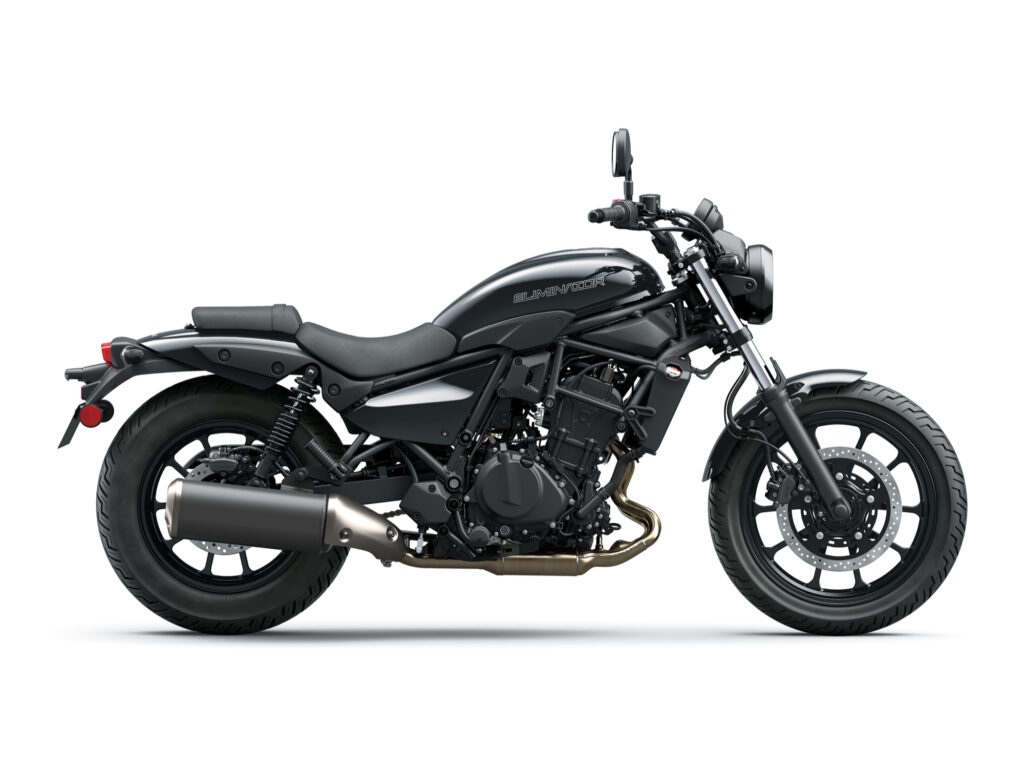
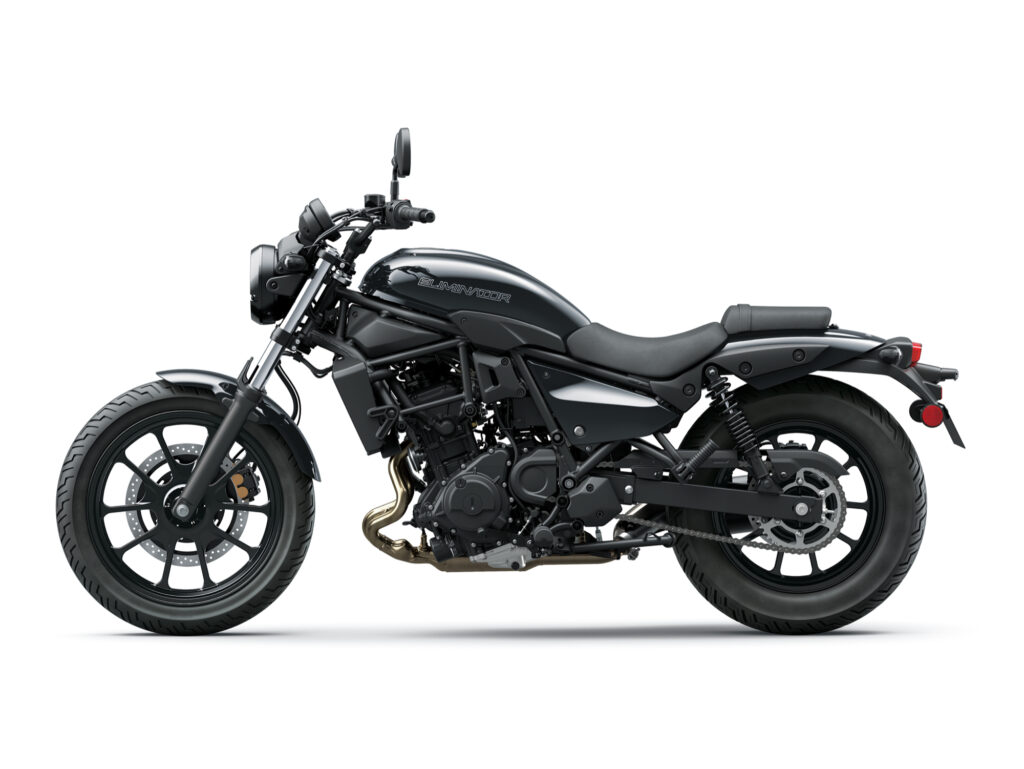 At first glance, the Eliminator 500 makes it perfectly clear what kind of motorcycle it’s meant to be. Low, elongated proportions, a round headlight, a round instrument display, clean lines, and a low seat that promises plenty of comfort. Essentially, everything you’d expect from a classic cruiser, just packaged as a modern, compact Kawasaki. My test bike was the simple standard version, without any fancy extras. Unlike the better-equipped SE, it doesn’t have a factory headlight fairing or special seat upholstery. Personally, I really liked this minimalist appearance.
Of course, when you’re riding a cruiser, you ought to do things properly. In my imagination, I pulled out my Steppenwolf jacket, hung some decorative tassels from the handlebar ends, threw a pair of leather saddlebags over the bike, and set off down the endless highway to the rhythm of Born to Be Wild. Then I woke up and realised that, in reality, I’d simply fitted my usual SW-Motech tank bag and a smaller rear bag. At least fitting the tank bag required no effort. Kawasaki uses the same fuel filler design on many of its models, so the tank ring I’d previously used on the Ninja 1100 fitted the Eliminator perfectly. I secured the rear bag with hooked straps, and those two small pieces of luggage were enough to carry everything I needed for a full day of riding.
45 Horsepower That Feels Like Much More
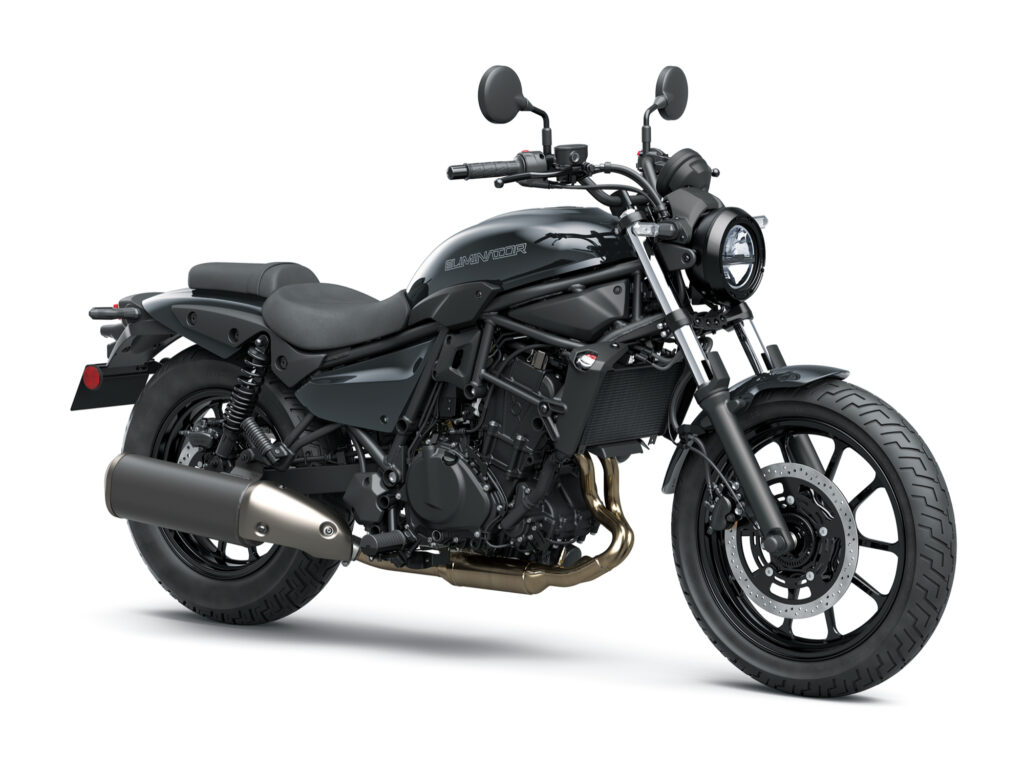 The Kawasaki Eliminator 500 is powered by a 451cc, liquid-cooled, four-stroke parallel-twin engine. It features dual overhead camshafts and four valves per cylinder, producing a maximum of 45 hp at 9,000 rpm. Peak torque is 43 Nm at 6,000 rpm. On paper, these are perfectly ordinary figures for an A2 motorcycle. In reality, however, this engine somehow feels considerably stronger.
I’d already noticed during the KLE500 test how well Kawasaki’s engineers had developed the engine’s character, and the Eliminator delivered exactly the same experience. The throttle response is remarkably lively, and the engine reacts almost immediately. Give it a decisive twist, and the bike surges forward without becoming nervous or jerky. At the same time, the throttle is easy to control gently, the engine behaves smoothly at low revs, and it doesn’t punish its rider for the occasional imprecise input. These two qualities make it exceptionally likeable. It’s forgiving and easy to handle, but whenever I feel like riding a little more enthusiastically, it’s immediately ready to join in.
Sometimes those 45 horsepower feel like at least sixty, perhaps even seventy. Obviously, the engine hasn’t magically gained power simply because I perceive it that way. But the lightweight construction, direct throttle response, and broad spread of usable torque combine to create a completely different experience from what the figures suggest. The Eliminator also weighs just 176 kilograms ready to ride, which is a particularly favourable figure for a cruiser. That low weight contributes enormously to its lively performance. Initially, I assumed I’d have to keep the engine revving constantly to make decent progress. But on the winding road near Cered, I quickly discovered that it was far more flexible than I’d expected.
Even in fifth gear at around 80 km/h, it pulled nicely. I accelerated out of corners in third or fourth where, on other motorcycles, I’d instinctively have selected a gear lower. The engine is usable across a surprisingly broad rev range and doesn’t fall flat just because it isn’t operating near peak power. But if you really want to enjoy it, there’s nothing stopping you from revving it all the way to nine or ten thousand rpm. That’s when the twin develops its distinctive sound, and the motorcycle accelerates with such enthusiasm that it’s difficult not to smile inside your helmet. What I particularly like is that I can enjoy this high-revving, engaging riding experience at relatively modest speeds. I don’t need to be travelling at 200 km/h to feel that something exciting is happening beneath me.
Light, Easy to Handle, and Surprisingly Good in Corners
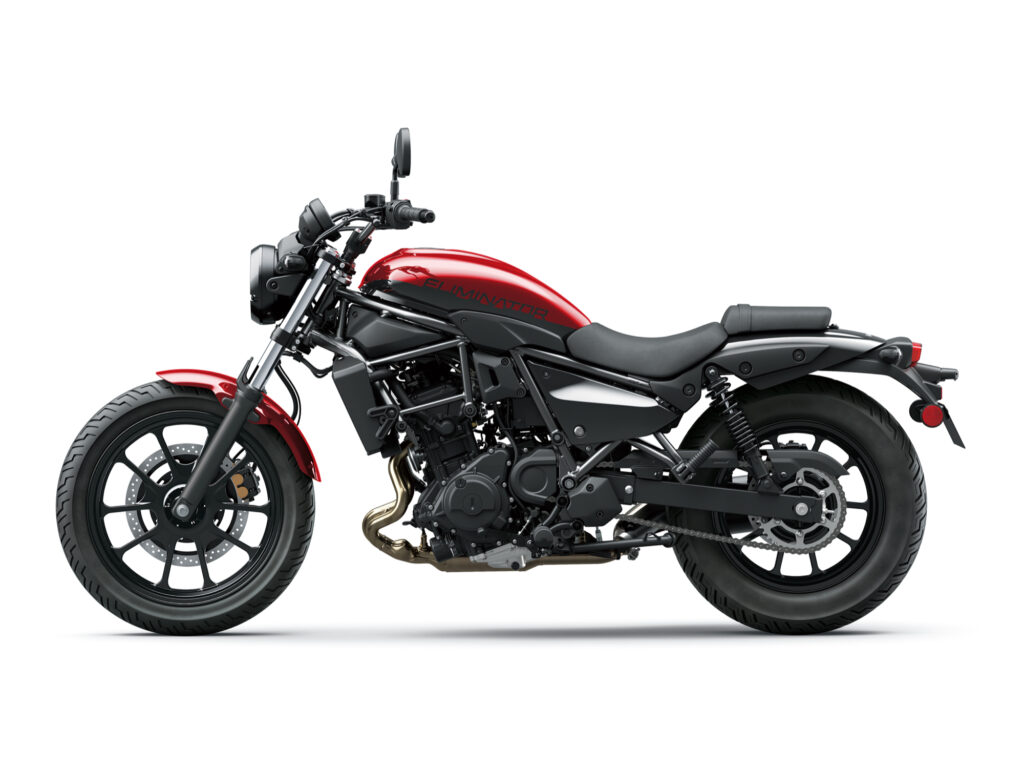 One of the Eliminator’s greatest strengths is its handling. As you’d expect from a cruiser, the front fork is set at a more relaxed angle than on a conventional naked bike. The specified rake is 30 degrees, the trail measures 121 mm, and the wheelbase is 1,520 mm. These figures are intended to provide calmer, more stable handling. Despite the relaxed steering geometry, the bike doesn’t feel cumbersome in corners at all. Quite the opposite: it leans over surprisingly easily, responds very naturally to steering inputs, and can be moved from one line to another with remarkably little effort. Naturally, the low centre of gravity and modest weight play a major role in this.
After just a few corners on the Cered road, I felt as though the Eliminator and I had known each other for years. It isn’t nervous or overly sensitive to every tiny movement, but when I start leaning it into a corner, it willingly follows my intentions.
Kawasaki has also got the handlebar width just right. It isn’t as wide as the KLE500’s, for example, making it easier to filter between cars in Budapest traffic. The wide handlebars of large adventure motorcycles often sit at exactly the same height as car mirrors, making it more difficult to squeeze through gaps. I had no such problems on the Eliminator. And easy handling isn’t only an advantage for beginners. I also particularly enjoy motorcycles that don’t require constant effort, that respond naturally to your inputs, and simply let you enjoy riding. The Eliminator is exactly that kind of motorcycle.
The Cered Road and the Reality of Hungarian Tarmac
 The road near Cered is one of my favourite motorcycle routes in Hungary. I’ve ridden it on countless motorcycles, and I always enjoy returning. The surrounding countryside is particularly beautiful in spring and early summer. The weather on the day of the test was perfect. Clear skies, pleasant warmth, beautiful scenery. Everything was in place for a fantastic ride. Unfortunately, the quality of the tarmac doesn’t always match the beauty of the surroundings.
The Kawasaki’s suspension is a fairly simple design. At the front, there’s a conventional 41 mm telescopic fork with 120 mm of travel, while the rear uses twin shock absorbers with just 90 mm of travel. For me, the suspension tuning struck a good balance. It isn’t too soft, doesn’t wallow, and keeps the motorcycle sufficiently stable through corners. On poorer road surfaces, of course, you can feel the limitations of the short suspension travel. Larger potholes and bumps can give the rider quite a shaking. What I liked, however, was that the suspension made a real effort to keep the wheels in contact with the road, even over uneven surfaces. It didn’t start bouncing unnecessarily or become unsettled, remaining predictable even on rougher sections. I much prefer this kind of firmer, controlled suspension to setups where manufacturers try to compensate for bad roads by making everything excessively soft, leaving you riding what feels like a rocking horse.
Of course, the Eliminator’s suspension wasn’t designed for racetracks, nor does it pretend otherwise. It’s a straightforward, properly functioning system that proved entirely suitable for the motorcycle’s purpose and performance. The bike rolls on an 18-inch front wheel and a 16-inch rear, fitted with 130/70 and 150/80 tyres respectively. The larger front wheel and long wheelbase contribute to its calm, stable behaviour.
There is, however, one limitation that became very obvious in the Mátra Mountains: lean angle. The low-slung motorcycle has 150 mm of ground clearance. Its footpegs are mounted relatively low, partly to provide a more comfortable knee angle. But that comes at a price. When I started riding more enthusiastically through the beautiful corners of Route 24, the footpegs quickly began scraping the road. The Eliminator loves corners, but it isn’t a sportbike, and its available lean angle reflects that.
There’s Time to Enjoy the Scenery, Not Just the Corners
There’s a beautiful valley on the road between Cered and Zabar that holds particularly many memories for me. I’ve been here on my BMW, an Aprilia and countless other test bikes. Once, I even stopped on a nearby dirt road with my old Honda to answer an urgent call of nature. I made such a mess of stopping that I eventually managed to topple the motorcycle over. So quite a few things have happened to me around here. This time, however, I simply enjoyed the scenery. This stretch of road has appeared in countless videos of mine, but I never get tired of it. I genuinely think riding here could be prescribed as therapy.
And somehow, the Eliminator fits this atmosphere perfectly. It doesn’t force me to take every corner at the highest possible speed. It doesn’t constantly whisper in my ear to accelerate harder, brake later, and lean further. Instead, it lets me look around and enjoy the scenery, the fresh air, the sound of the engine, and the journey itself.
Of course, there’s a little self-deception involved here too. The twin revs so enthusiastically that sometimes, at just 60 or 70 km/h, I feel as though I’m riding much faster. And that makes the whole experience particularly entertaining. I get the pleasure of lively motorcycling without constantly needing high speeds. Some days I love attacking a series of corners at a brisk pace. On other days, a relaxed ride with time to look around is worth far more. The Eliminator proved to be an excellent companion for exactly that kind of journey.
Riding Position and Comfort
 The Kawasaki Eliminator 500 has a seat height of just 735 mm. That’s one of its most important characteristics, particularly for shorter riders. Thanks to the low seat and low centre of gravity, it’s very easy to hold the motorcycle steady when stopping. The 176 kg kerb weight doesn’t present much of a challenge either, so the bike can inspire confidence even in less experienced riders.
The riding position is surprisingly natural. My upper body is almost completely upright, the handlebars are comfortably within reach, and I don’t have to hunch forward to reach them. By sliding a little further back in the saddle, I could also adopt a second, more relaxed sitting position. The position of my arms and upper body changed, but it remained comfortable. Before the test, I was slightly concerned about the knee angle. Such a low seating position usually means your knees are more sharply bent, which can become uncomfortable over longer distances. But the Eliminator pleasantly surprised me here as well. The footpegs are positioned relatively low, so even at my height of 183 cm, I didn’t feel nearly as cramped as I’d expected. Taller riders might want to consider Kawasaki’s optional seat, which is 30 mm higher. For shorter riders, there’s also a seat available that’s 20 mm lower. I could also imagine the bike with a more traditional cruiser-style forward footpeg arrangement, allowing an even more relaxed riding position. Nevertheless, the standard ergonomics worked well for me.
As for wind protection, there’s not much to discuss, because the standard version essentially has none. The airflow reaches my upper body and helmet without obstruction. Up to a certain speed, that’s actually very pleasant, as it’s part of the feeling of freedom that comes with riding a cruiser. For me, approximately 110 km/h was the speed at which I still felt comfortable. Of course, the bike can go faster, but above that point, the constant wind pressure becomes increasingly tiring. On Route 21, where I was able to maintain that speed for a longer stretch, sixth gear suited the motorcycle’s character particularly well. The gearing isn’t excessively tall, so the engine stays in a useful rev range and doesn’t feel weak when accelerating. The engine certainly has enough power to travel considerably faster, but for me, the Eliminator’s real strengths became apparent at a pleasant cruising pace on ordinary roads.
Kawasaki’s Gearbox Wins Me Over Again
One of the drivetrain’s greatest strengths is its six-speed gearbox and Assist & Slipper clutch. Kawasaki designed this clutch mechanism to perform two tasks. First, the assist mechanism reduces the effort required to operate the clutch lever. Second, the slipper function reduces excessive back-torque transmitted to the rear wheel during strong engine braking. In practice, this results in an incredibly light, smooth clutch. You can operate the lever effortlessly with just two fingers, and its engagement is beautifully progressive. That’s particularly valuable in city traffic with frequent starts and stops, but it can also make life considerably easier for beginners.
And the gearbox is simply fantastic. I’d already loved it in the KLE500, and here I found the same precise, beautifully smooth mechanism. Each gear engages positively yet effortlessly, making shifting feel like a completely natural movement. There’s no quickshifter, but I didn’t miss one at all. With a slight roll-off of the throttle, you can shift up very smoothly without using the clutch. Downshifts can also be made smoothly without the clutch if you match the engine speed with a suitable throttle blip. And when I do use the clutch, changing gears requires almost no effort. Finding neutral was always easy too.
On the road between Zabar and Ózd, I repeatedly caught myself trying to shift into seventh gear. The changes were so effortless that I simply hadn’t noticed I was already in sixth. Thanks to the engine’s flexibility, I often didn’t need to downshift at all. At around 90–100 km/h, I could ride through the gently flowing corners quite happily in sixth gear.
Simple Electronics, Wonderful Riding
The Eliminator 500 has a fairly modest electronics package. There’s ABS, and that more or less concludes the list of major rider assistance systems. There’s no traction control, no selection of riding modes, no electronic suspension, and certainly no cruise control. I have to admit, I didn’t miss any of them. Given the engine’s performance and character, the easily controlled throttle and predictable drivetrain already make the motorcycle exceptionally friendly to ride.
The instrument display also suits the bike’s appearance particularly well. It’s a round digital unit that evokes classic analogue instruments while displaying all the important information. The black and greenish-grey colour scheme reminded me of old Casio quartz watches. A little retro, a little playful, but it looks absolutely right on this motorcycle. It’s also remarkably easy to read. Even in bright sunshine, I could clearly see the speed, engine revs and gear indicator. The dashboard can connect via Bluetooth to Kawasaki’s RIDEOLOGY THE APP, providing access to motorcycle information, ride logging and certain settings, among other features. Personally, on a motorcycle with this kind of retro styling, I don’t particularly feel the need for smartphone functions. Naturally, I did take out my phone for navigation, although I didn’t even need that until Salgótarján.
The round front headlight contains modern LED lighting, and the rear light also uses LEDs. Yet the overall appearance remains classic and simple, which I think suits the Eliminator perfectly.
Are the Brakes Good Enough?
The Eliminator has a single 310 mm front brake disc with a two-piston caliper. At the rear, there’s a 240 mm disc. It’s not a particularly exciting technical specification, but a 176 kg motorcycle with 45 horsepower doesn’t necessarily need anything more sophisticated. During the ride, I carried out several firm braking tests from 90 km/h. First, I used only the front brake, then I repeated the exercise using both brakes. The Eliminator slowed convincingly in both cases, and the braking force was easy to modulate. At these speeds, the braking performance was entirely satisfactory for me. Kawasaki has clearly chosen a braking system that suits the motorcycle’s intended purpose. For enjoyable country-road and city riding, I found it more than adequate.
Touring on a Cruiser?
For many motorcyclists, touring automatically means large adventure bikes or touring motorcycles equipped with huge windscreens and luggage systems. But you can travel around the world on a cruiser too. For example, I know a rider called Monca, whose YouTube channel was named Monca Motoron. She rode a similar 500cc cruiser all the way to Vladivostok and back, covering approximately 23,000 kilometres. That’s fairly convincing evidence that the size of your motorcycle doesn’t necessarily determine how far you can travel.
Naturally, the Eliminator does have limitations when it comes to touring. Without wind protection, long motorway journeys can become tiring, while the small passenger seat doesn’t provide much room for luggage. However, Kawasaki offers a factory luggage rack, saddlebags and other touring accessories. The saddlebags require dedicated mounting brackets and provide 19.5 litres of storage capacity on each side. The 13-litre fuel tank isn’t particularly large either, but on a lightweight, relatively low-powered motorcycle, that doesn’t necessarily represent a serious limitation. Kawasaki quotes fuel consumption of 3.8 litres per 100 kilometres. Based on that official figure, a theoretical range of more than 300 kilometres is possible, although the actual distance will naturally depend on speed, riding style and road conditions.
Personally, I’d happily take a motorcycle like this on a multi-day tour. In fact, perhaps a simple, lightweight cruiser like this would be ideal for a more relaxed style of travelling, where the goal isn’t to cover the greatest possible distance each day or find the fastest route, but simply to enjoy the journey.
A2 Licence Friendly, but Not Just for Beginners
The Eliminator 500 produces 33.4 kW, placing it comfortably within the 35 kW power limit of the A2 motorcycle licence. This is important because I’d often recommend a very different motorcycle to a beginner from the one they might choose later with more experience. Many riders deal with the A2 restriction by buying a larger, originally much more powerful motorcycle and having it restricted to 35 kW. The result is that they’re carrying around the extra weight of a larger, heavier machine while only having access to the restricted power output. I think a much better solution is to choose a lightweight motorcycle designed from the outset for the A2 power category.
And the Eliminator is exactly that. Its 176 kg kerb weight and 45 horsepower complement each other beautifully. The motorcycle is easy to handle, friendly, and has smooth, controllable throttle response. The low seat also makes it easy to hold the bike confidently when stopped. For a beginner, these qualities may be far more important than saving a little money on a future motorcycle upgrade.
It’s easier to learn correct cornering technique, braking and slow-speed manoeuvring on a lightweight motorcycle. You develop a feel for what the machine is doing beneath you more quickly, without constantly having to struggle with its weight. But I certainly wouldn’t recommend the Eliminator exclusively to beginners. It could also be an excellent choice for returning riders, shorter motorcyclists, or anyone who simply wants an enjoyable motorcycle that’s easy to handle. During the test, I repeatedly found myself thinking about my old Honda NC, which was my first proper motorcycle. The Honda was considerably heavier, even though it didn’t produce much more power. Because of the Eliminator’s lightness and direct character, I occasionally wondered whether I’d have been better off choosing something like this back then. Of course, the two motorcycles were designed for very different purposes. But in terms of the balance between power and weight needed for enjoyable riding, the Eliminator seems particularly well judged to me. It’s the kind of motorcycle you can easily fall in love with during your very first season, yet with the right attitude, it can continue to provide plenty of enjoyment years later.
The Price That Inspired This Test
One reason this test came about was that Kawasaki had introduced substantial discounts on Eliminators from previous model years. At the time I made the video, the 2025 colour variants were available for approximately HUF 2.3 million (around €5,800). That seemed like a particularly attractive offer, especially considering that mechanically, these motorcycles were identical to the newer 2026 colour variants. The official Hungarian list price of the 2026 model was HUF 2,554,000 (around €6,400) on Kawasaki’s website. Naturally, discounts on earlier model years depend on dealer stock and the conditions of each individual offer.
I’d recommend that anyone considering buying one should definitely take a test ride first. The Eliminator is a particularly good example of how difficult it can be to judge the actual riding experience from a motorcycle’s specifications. My neighbour Norbi also took the test bike for a short ride, and he returned with an enormous grin. He said he hadn’t expected it to be anywhere near this good. That was exactly how I felt too.
A Little More of the Mátra Mountains to Finish the Day
After the corners around Cered and Zabar, followed by the roads near Ózd, I headed towards Eger. Passing through Farkaslyuk, I rode along a beautiful wooded valley, then joined Route 24 after Egerbakta. This section alone is worth making a trip for. Excellent corners, varied curves and beautiful forest scenery. The little Kawasaki was completely in its element here too.
In the Mátra Mountains, I once again confirmed just how easily the bike could be leaned from one corner into the next, and how well it responded to the throttle. Of course, by this point, I’d scraped the footpegs several more times. That’s one of the unavoidable compromises of cruiser design, and something you simply have to accept.
At the end of the day, I stopped in the parking area of the Mátraszentistván ski resort, where I’ve filmed closing sequences countless times before. The weather was beautiful, sunset was slowly approaching, and I thought back over the day’s ride. By then, I’d covered approximately 350–400 kilometres. By the time I returned the motorcycle, the total had reached roughly 450 kilometres. There was one thing I was absolutely certain of: I’d had a fantastic time.
Small Motorcycle, Big Smile!
For me, the Kawasaki Eliminator 500 was one of the most pleasant surprises among smaller motorcycles. Its greatest strength is undoubtedly the effortless way it handles everything you ask of it. The 451cc twin responds beautifully to the throttle, delivers usable power across a broad rev range, and thanks to the bike’s low weight, its 45 horsepower feels much livelier than you’d expect. The gearbox and clutch are simply wonderful. They’re light, precise and smooth to operate, contributing enormously to the riding experience. The motorcycle is easy to steer, calm and predictable, yet surprisingly playful. The suspension is simple but does its job well, while the brakes are perfectly suited to the bike’s character and performance.
Thanks to its low seat and friendly handling, I’d happily recommend it to beginners and returning riders. But I certainly don’t think they’re the only people who could enjoy it. Naturally, there are compromises. Suspension comfort is noticeably limited on poor roads, the footpegs scrape relatively early during sporty cornering, and the lack of wind protection makes sustained high-speed travel less appealing. But it excels at something that I think most motorcyclists actually need. It’s easy to handle, enjoyable to ride, and doesn’t demand any great effort from its rider.
Several times during the day, I found myself thinking how strange it is that we so often judge motorcycles by their power figures and technical equipment. We keep wanting more horsepower, more sophisticated electronics and ever greater performance, while sometimes a simple little motorcycle like this can remind us more clearly than anything else why we love riding in the first place. Not once while riding the Eliminator 500 did I feel that anything was missing from the experience.
I simply climbed aboard, set off, and spent the whole day smiling. I can’t think of a better recommendation than that.
Watch the Video Review Here: